 Sizu
Pace Calculator
Pace, time or distance from the other two, per mile and per km, with mph and km/h; a treadmill speed as a pace; moving vs elapsed time; a clock time in seconds and decimal minutes.
Pace, splits and progress: per mile and per km, race-time estimates, training weeks and the numbers behind walking, cycling, swimming and strength. Book 10 of the Workout Series.
Home › Books › Fitness & Running Math
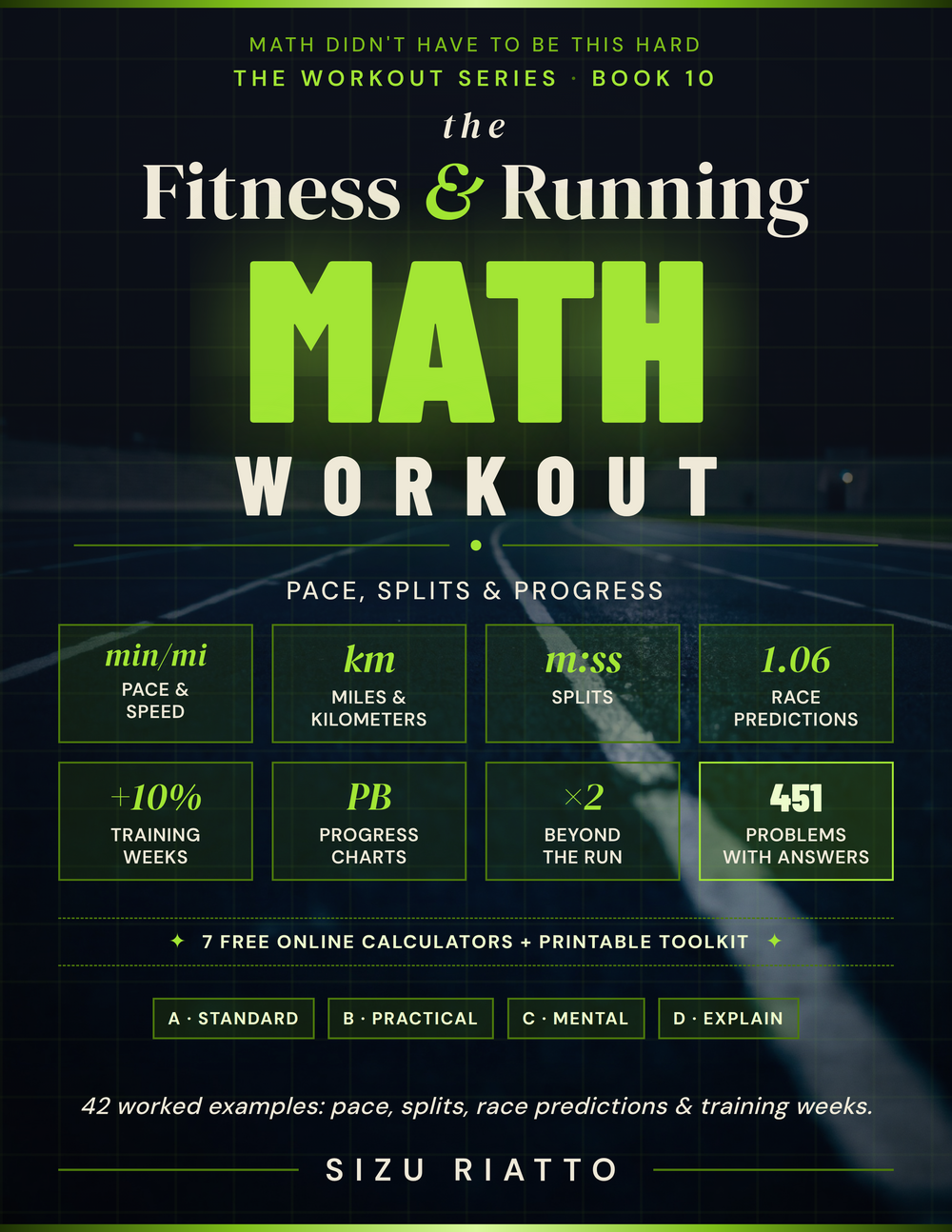
The book starts at the basics (60 seconds in a minute, and turning 1:30 into 90 seconds and 1.5 minutes) and climbs, one chapter at a time, through pace and speed, conversions, splits and clock times, ratios and a power for race estimates, percent steps, averages and charts, to mixed rates and cost per use. Every concept has its own worked example, 42 in all, with every step shown, followed by a warm-up, standard practice, word problems about walkers, runners, a wheelchair racer, swimmers, cyclists and lifters of every age and pace, mental math and “explain it” prompts: 451 problems, every answer in the book with the working shown. Plus 37 diagrams, a fill-in Running Numbers Card and photocopiable training-log pages. Numbers only: no heart rate, no diet, no medical advice. The book does the arithmetic; how much and how hard to train is your decision. Paces, plans and prices in the problems are invented for practice; no watch, app, shoe maker, gym or race is named.
8.5 × 11 in paperback, larger and darker type for easy reading. By Sizu Riatto.
Pace, time or distance from the other two, per mile and per km, with mph and km/h; a treadmill speed as a pace; moving vs elapsed time; a clock time in seconds and decimal minutes.
Miles, km, meters, yards and feet; the 5K, 10K, half and marathon in miles; pace per km ↔ per mile ↔ mph ↔ km/h; laps of a 400 m track; steps per mile; which of two paces is faster.
A goal time as a pace band: the clock at every mile or km and each split, always adding up to the finish; even or a gentle negative split; a check of splits you ran.
Riegel’s well-known estimate from one race to the 5K, 10K, half and marathon, the pace for each, a goal against the estimate, and an honest note on where the formula stops being useful.
Weekly miles from a start, a percent step, a cutback every few weeks, a taper and race week, rounded to the half mile, with percent changes, session load and run/walk intervals. Arithmetic, not coaching advice.
Average pace as total time ÷ total distance (not the average of the paces), improvement in seconds and percent, gains per week, and the mean, median and best of your times.
Weekly activity minutes with vigorous counted double, bike speed and gear ratio, swim lengths and pace per 100, barbell plates per side, shoe cost per mile and gym break-even.
A one-page cheat sheet for every chapter plus blank sheets: a pace chart, a weekly log, a 12-week plan, a splits & pace-band sheet, a race-day sheet, a progress chart and a cross-training & gear sheet.