 Sizu
LED Resistor & E12 Value
The resistor to fit, the one you can buy, and the current you really get.
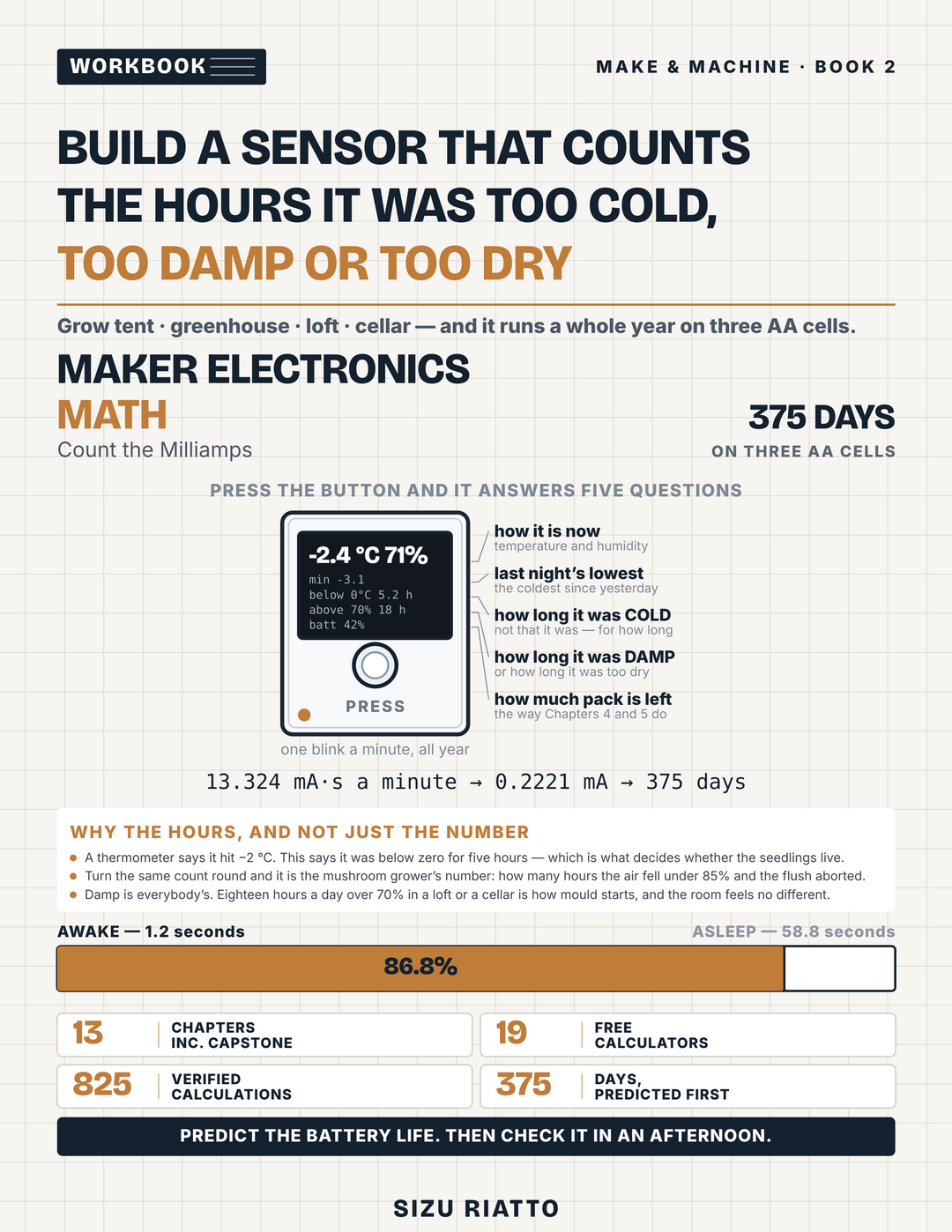
Count the milliamps. Predict how long a battery-powered sensor will last — 375 days, worked out on page forty — then build it and check the prediction in an afternoon.
Home › Books › Maker Electronics Math
One sum, pointed at thirteen different parts of a real project: what a thing draws, multiplied by how long it is connected. Ohm's law and why you round a resistor up; what a battery actually holds as against what the packet claims; the division that turns a wake interval into a year; the two resistors that can halve a runtime if nobody switches them off; what one ADC step is worth, and why a fine reading is not a true one; calibrating a sensor against ice and stating an error bar you can defend; τ = R × C, and what waiting costs in milliamp-seconds; the pull-up that is free until a lid presses on it; why a quarter of the current looks like more than half the light; the eight-pence part whose datasheet line turns 375 days into 16; storage as a second battery that runs out first; a runtime that is a range rather than a number; and finally the capstone — measure a 30-microamp current on a meter that cannot read it, compare with your prediction, and design the one further test that says which line was wrong. Every chapter carries a boxed, skippable Does It Pay? section, and nothing in the book touches mains electricity.
The resistor to fit, the one you can buy, and the current you really get.
Series and parallel packs, a usable derate, and the C-rate a load asks for.
The one to bookmark. Every line of your design, and its share of the battery.
Output, loading, source impedance, and the yearly bill if nobody switches it off.
What one step is worth — and why fine is not the same as true.
Slope and offset from two known points, and an error bar you can defend.
How long to wait before reading, and what the waiting costs.
What a load costs per year once you say how long it is connected.
A quarter of the current does not buy a quarter of the light.
The two bills a regulator sends, and buck against linear for your interval.
Which runs out first, the battery or the memory — and what a radio costs.
Runtime when the world decides how often, plus stall current.
Measure a current your meter cannot read, then explain the gap.
Any two of volts, milliamps, ohms and milliwatts — and the other two.
Combine resistors, and find the E12 value you can actually buy.
Cells in series and parallel — volts, usable mAh, and days.
Runtime at every interval, and where waking less often stops paying.
Readings past a line, turned into hours below freezing or above damp.
The unit conversions every battery sum in the book turns on.