 Sizu
A cup of flour can weigh quite a lot more or less depending on how you scoop it, so two people following the same cup recipe can bake two different doughs. Bakers fix that by weighing, and they write the recipe as percentages of the flour. Once you can read that, any bread recipe becomes one you can resize.
Step 1: flour is always 100%
In a baker’s recipe the flour weight is called 100%. Every other ingredient is a percentage of that flour weight, not of the whole dough.
Here is a simple loaf formula:
- Flour 100%
- Water 70%
- Salt 2%
- Instant yeast 1%
To use it, pick a flour weight. Say 500 g.
Step 2: multiply each percent by the flour
- Water: 500 × 0.70 = 350 g
- Salt: 500 × 0.02 = 10 g
- Yeast: 500 × 0.01 = 5 g
Total dough: 500 + 350 + 10 + 5 = 865 g.
Step 3: why the percents add up to more than 100
Add the column: 100 + 70 + 2 + 1 = 173%. That surprises people the first time. It is not an error. The percentages are all measured against the flour, not against the total, so the sum is simply how much heavier the dough is than its flour: 865 ÷ 500 = 1.73.
The 70% water figure has a name, hydration: water as a percent of flour. Higher hydration gives a wetter, stickier dough. This formula is a medium one.
Step 4: resize to the dough you want
Now the useful part. Suppose your tin or your oven wants 1,000 g of dough. The scale is the total percent:
Flour = 1000 ÷ 1.73 = 578 g (578.03, rounded)
Then each other ingredient is a percent of 578 g:
- Water: 578 × 0.70 = 404.6, so 405 g
- Salt: 578 × 0.02 = 11.6, so 12 g
- Yeast: 578 × 0.01 = 5.8, so 6 g
Check: 578 + 405 + 12 + 6 = 1,001 g. The extra gram is rounding, which does not matter in bread.
Notice that you did not need to work out a scale factor by hand, as you would with cups. You just changed the one number, the flour, and everything else followed from the percents.
Step 5: use it to fix a recipe
Percentages also let you compare recipes at a glance. A recipe with 350 g water and 500 g flour is 70%. A second recipe with 400 g water and 500 g flour is 80%. You can see straight away the second is wetter, which means it will be stickier to handle, even though the totals differ.
They also catch misprints. If a recipe says 2 g of salt per 500 g of flour, that is 0.4%, far below the usual 1.5 to 2.5% range for bread. The recipe has probably dropped a digit.
A note on yeast and salt
Weighing 5 g of yeast and 10 g of salt needs a scale that reads to the gram, and smaller amounts are easier on a 0.1 g scale if you have one. If you are weighing very small amounts, make a bigger batch or measure in teaspoons just for those two, which is common home practice.
A second dough, to see it work
Take a recipe written as flour 100%, water 80%, salt 2%, yeast 0.5%, and say you only have 400 g of flour. Water is 400 × 0.80 = 320 g, salt is 400 × 0.02 = 8 g and yeast is 400 × 0.005 = 2 g. The total is 400 + 320 + 8 + 2 = 730 g, and the percents add to 182.5%, which gives 730 ÷ 400 = 1.825. The same two checks work every time: the percents should add to the total divided by the flour, and the flour should always be 100.
Compare it with the first dough: 80% is wetter than 70%, so this one will feel stickier to handle even with less flour in the bowl.
Try it with your own numbers
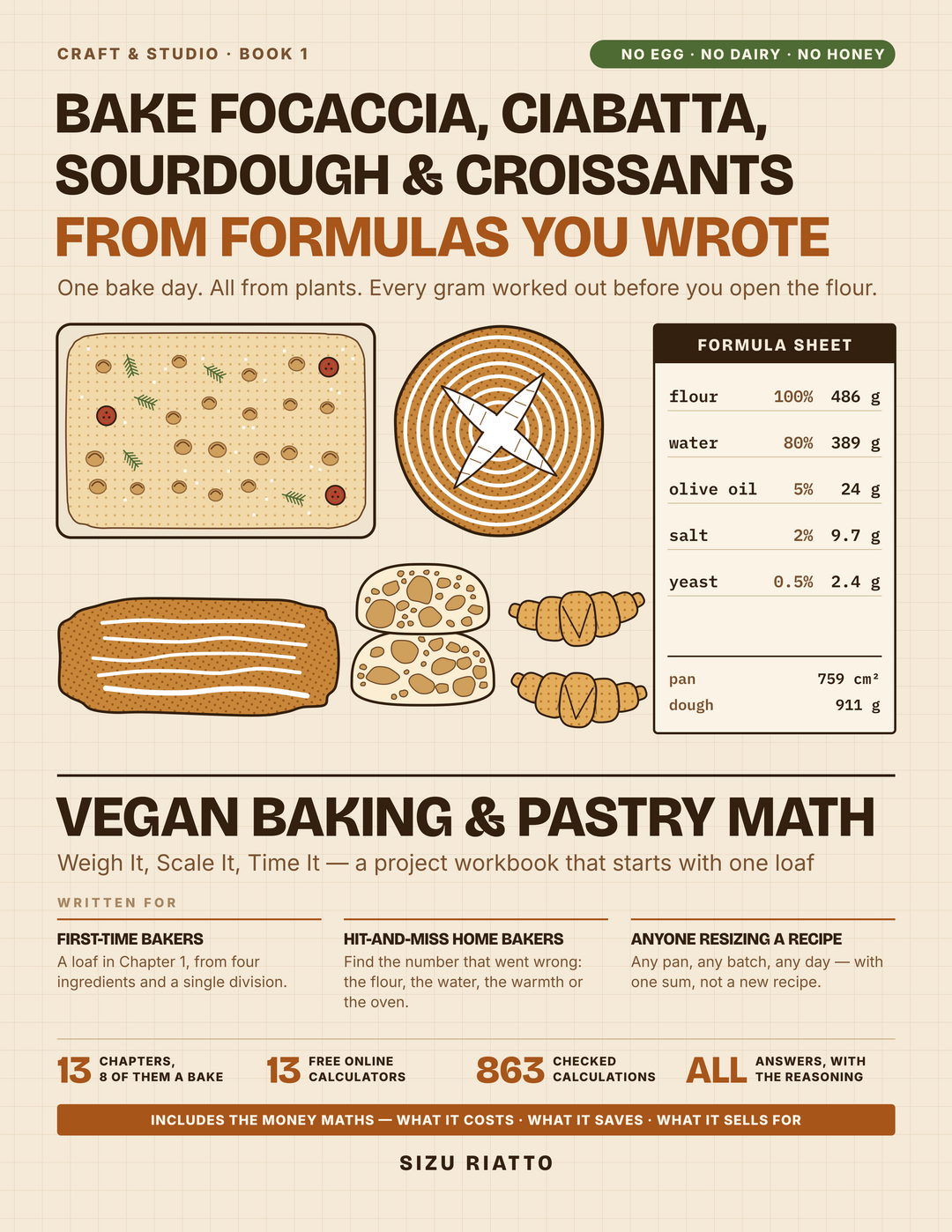
The free Baker’s Percentage Calculator turns a formula into grams for any dough weight, or reads a recipe back into percentages. It comes from Vegan Baking & Pastry Math, a book of arithmetic about bread and pastry made entirely from plants, whose chapters include “Weigh, Don’t Scoop” and “Flour Is Always 100.”
Rule of thumb: flour = 100%. Grams of anything = its percent × flour weight. For a target dough weight, flour = target ÷ (total percent ÷ 100).
This is arithmetic for planning a bake, not a substitute for a recipe or food-safety guidance.