 Sizu
A candle jar’s label tells you very little. An “8 oz” tin holds about 5 oz of wax to its fill line, because the fill line sits well below the brim. To make a candle that burns well you need grams of wax and grams of fragrance for your jar, and a little geometry gives both.
Step 1: the volume to the fill line
The book’s Market Batch jar is 70 mm across inside and filled to 72 mm. Its volume is a cylinder:
volume = π × (diameter ÷ 2)² × fill depth = π × 35² × 72 = 277,088 mm³
and 1,000 mm³ is 1 mL, so that is 277.09 mL. For a jar that is not straight-sided, fill it with water to the line and weigh the water instead.
Step 2: the weight of hot wax
Hot soy wax at about 70 °C weighs 0.887 g per mL:
277.09 × 0.887 = 245.78 g of hot wax
As a quick check, the sellers’ “0.86 rule” (water weight to the line times 0.86) gives 277.09 × 0.86 = 238.3 g. It runs a little low, so the density method is the one to weigh by.
Step 3: split wax and fragrance
The fragrance load is a percentage of the wax. At 8%, the total is wax × 1.08, so
wax = 245.78 ÷ 1.08 = 227.6 g and fragrance = 245.78 − 227.6 = 18.2 g
Check the load: 18.2 ÷ 227.6 = 8.0%.
Step 4: a run of twelve
For a market run, work from one jar and add a spare allowance for spills and test burns:
- Wax: 227.6 × 12 jars × 1.05 = 2,867.4 g
- Fragrance: 18.2 × 12 × 1.05 = 229.4 g
Keep some back
Wax shrinks about 1 − 0.887 ÷ 0.92 = 3.6% as it sets, which leaves a dip around the wick. Keep that back to top up the jar once, so the surface sets flat.
Honest limits
The fragrance load is the book’s example, not a safe figure for every wax and scent. Check your wax supplier’s maximum load and your fragrance’s certificate, and test-burn a jar before selling. Check in writing that the wax is plant-based and palm-free, because some “coconut” blends contain paraffin.
Try your own jar
The free Wax by Volume calculator takes the jar’s inside width and fill depth (or its water weight), the wax density, the fragrance load, the number of jars and the spare, and gives the grams for each. It comes from Vegan Soap & Candle Math, which works out lye, scent, wicks, cost and profit step by step for palm-free soap and plant-wax candles. It is available as a paperback.
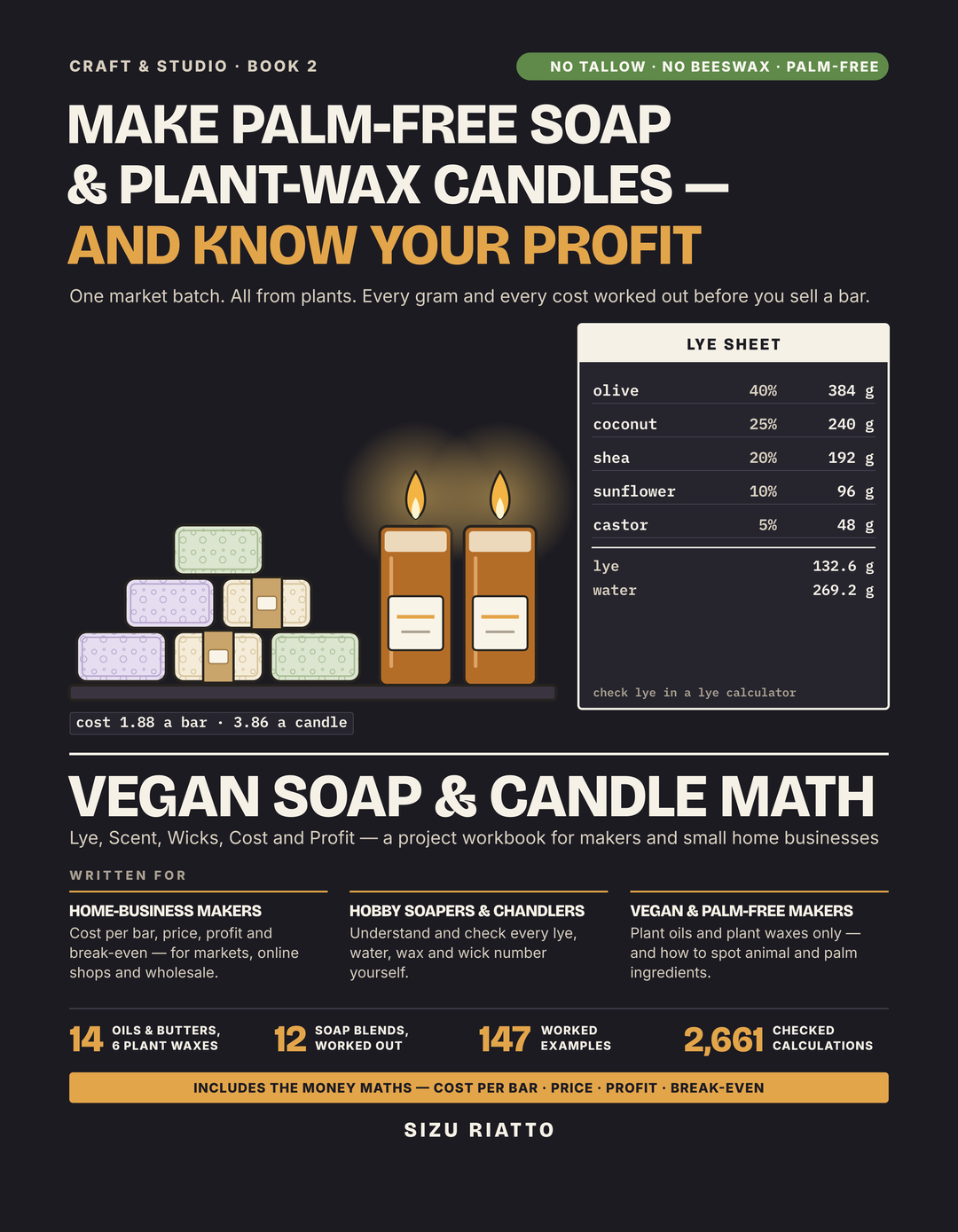
Worked example from the book. Densities, loads and prices vary: test before you sell.