 Sizu
A wall of cat steps is easy to start and hard to fix. Put the rises too far apart and an older cat will not use them. Run the top step into the ceiling and there is nowhere to sit. Both mistakes come from skipping three short sums, and you can do them with a pencil before you buy a single board.
Step 1: how many steps
Pick where the first step sits, how high the last one goes and the rise between them. The book’s route starts the first board 450 mm above the floor and climbs to 1,950 mm with a rise of 300 mm, about 12 in:
steps = (top − first) ÷ rise + 1
(1,950 − 450) ÷ 300 = 5 rises, and 5 + 1 = 6 steps. Each step has two brackets, so that is 12 brackets.
If the rises do not come out whole, round the rise down so the top stays under the ceiling, never up.
Step 2: headroom
The ceiling is 8 ft, which is 2,438.4 mm. With the top step at 1,950 mm:
2,438.4 − 1,950 = 488.4 mm of headroom.
The book keeps at least 450 mm, so this passes with 38.4 mm to spare.
Step 3: the hop across the zigzag
Zigzag the steps so each one sits above and beside its neighbor. The wall studs set the sideways distance, here 406.4 mm (16 in). The hop from one step to the next is the long side of a right triangle:
hop = √(406.4² + 300²) = √(165,160 + 90,000) = 505.1 mm
and the angle is arctan(300 ÷ 406.4) = 36.4°. A cat that hops down one 300 mm rise lands at √(2 × 9.81 × 0.3) = 2.43 m/s.
Honest limits
Retailers suggest 12 to 18 in between steps for an adult cat and 8 to 12 in for a senior. These are guides, not rules for your cat. For a kitten, a senior or a heavy cat, go gentler: add steps rather than stretching the rise. Always fix brackets into studs, not plaster, and check the bridge and shelf loads in the book before a heavy cat uses them.
Try it on your own wall
The free How High, How Far calculator takes your first step, top step, rise, ceiling height and stud spacing, in millimeters or inches, and gives the number of steps, the headroom and the hop. It comes from Cat Highways, the weekend builder’s math for wall steps, shelves, a bridge, a sisal post and a window catio, sized to your cat. It is available as a paperback.
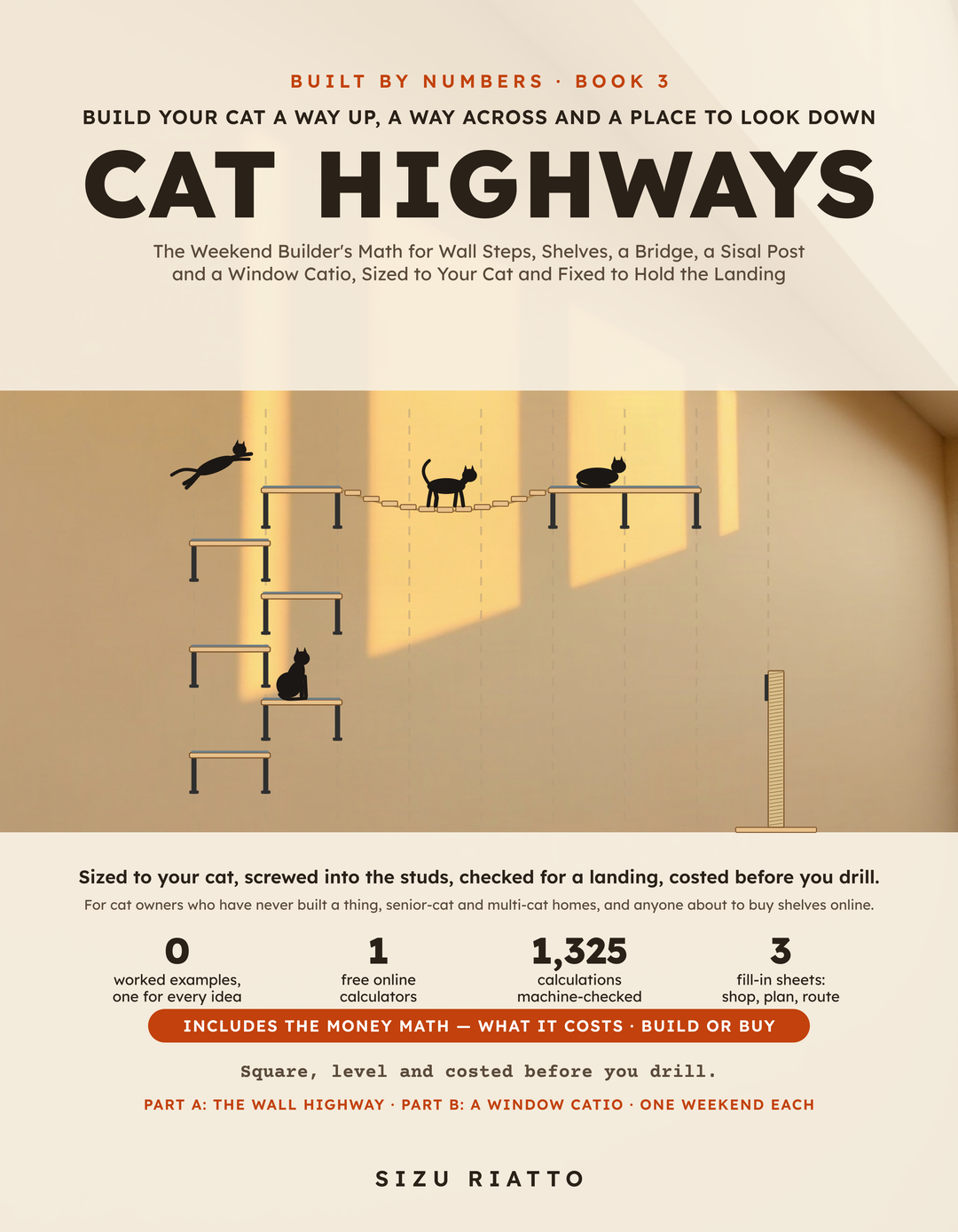
Worked example from the book. Check your own cat, wall and fixings.