 Sizu
Most arithmetic mistakes are not small. A decimal point in the wrong place, a number typed twice, a percentage taken the wrong way round: these make an answer wrong by a lot. You do not need exact arithmetic to catch them. You need a quick answer that is close, and ten seconds of rounding gives you one.
The method
Round each number to a nearby easy one, do the easy sum, and say “about”. Easy means numbers that divide well: tens, hundreds, halves, quarters. Keep each rounding small, so the errors stay small, and ideally one up and one down so they cancel.
Four sums
- 19% of $412. 19% is close to 20%, and $412 is close to $400. 20% of 400 = 80. Exact: 0.19 × 412 = $78.28. The estimate is 2.2% high.
- 7/15 of $61. 7/15 is a little under a half, and $61 is close to $60. Half of 60 = 30. Exact: 61 × 7 ÷ 15 = $28.47. The estimate is 5.4% high.
- 0.48 × 52. 0.48 is almost a half, and 52 is almost 50. Half of 50 = 25. Exact: 24.96. The estimate is 0.2% high.
- $1,180 ÷ 23. Round 1,180 up to 1,200 and 23 up to 24. 1,200 ÷ 24 = 50. Exact: $51.30. The estimate is 2.5% low.
All four are within about 6% of the exact answer. That is plenty to tell $78 from $780, or a till total that is right from one that is wrong.
Why the errors stay small
In the fourth sum the two roundings (1,180 up to 1,200, and 23 up to 24) push the answer in opposite directions, so they partly cancel. When you round the top of a division up, round the bottom up as well. In the first sum, 19% to 20% is a rise of 5%, and 412 to 400 is a fall of about 3%, so the error is smaller than either.
How to use it
- At the till: round each price and add the rounded prices. A basket of five items that rounds to $32 against an exact $32.32 is fine; one that rounds to $32 against a till of $41 is not.
- For a discount or tip: use 10% (move the point) and double or halve it.
- For a bill split or a unit price: round to a divisor you know.
- With a calculator in your hand: estimate first. If the calculator’s answer is far from yours, one of you made a slip.
When to trust the estimate
It is for checking, not for the final figure. If a number goes on an invoice, a label or a tax form, use the exact answer, and use the estimate to confirm you typed it right.
Try it with your own numbers
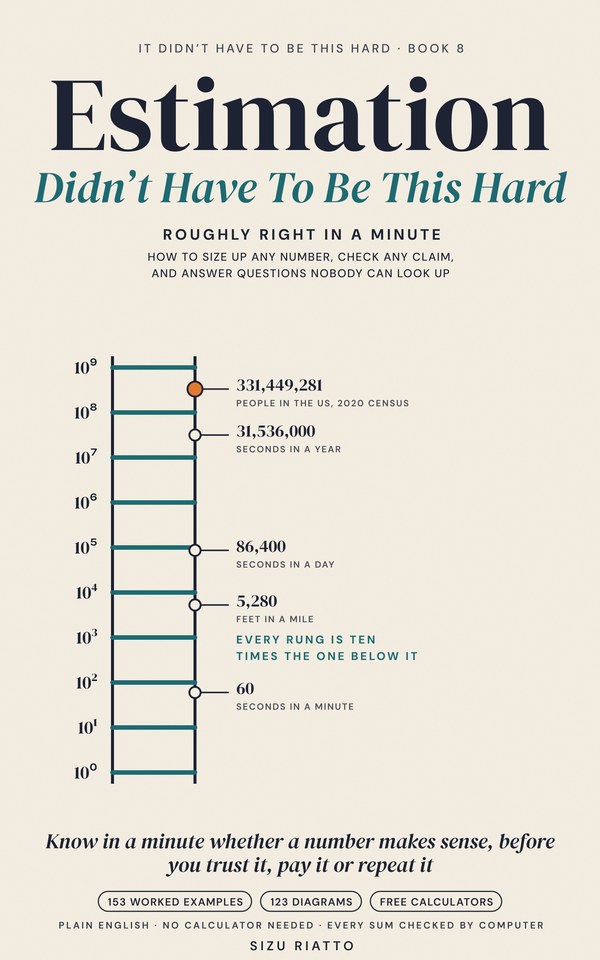
The free Estimate Checker lets you enter a list of prices, a percentage of an amount, a fraction of an amount, a product or a division. It shows a quick estimate beside the exact answer. It opens on the examples above. It comes from Estimation Didn’t Have to Be This Hard, which teaches how to size up any number, check any claim and answer questions nobody can look up.
Prices above are examples for practice.