 Sizu
Most of us follow people by accident: someone replies to a post, we tap Follow, and a year later the feed is a noisy mix we do not enjoy. If you want numbers to make more sense, a better approach is to choose the people who explain them well. A Bluesky starter pack makes that fast, and a short check makes it good.
This post shows what a starter pack is, gives you one ready to use, and walks through a five-step check for choosing who to follow. It ends with a small sum that explains why a short list beats a long one.
What a starter pack is
A starter pack is a short list of accounts that one person has picked around a topic. You open the pack, tap the follow button for the whole list, and you are following everyone in it. It is the quickest way to arrive on a topic without searching account by account.
The pack in this post is called Everyday Maths and Money. It holds 16 people, in three groups:
- 9 maths teachers and communicators, people who teach maths for a living or explain it to the public.
- 5 data-visualization designers and analysts, who show how to draw charts that tell the truth.
- 2 money and personal finance writers, who explain household and nonprofit money in plain terms.
You can open it here: the Everyday Maths and Money starter pack. The starter pack page on this site lists every person with a line about who they are and links to their profiles, so you can look before you follow.
Why a short list works
There is simple arithmetic behind a calm feed. Say each account you follow posts about 3 times a day, and you spend about 10 seconds on each post. These are example numbers; your own will differ, but the shape does not change.
- 16 accounts: 16 × 3 = 48 posts a day, 48 × 10 seconds = 480 seconds, which is 8 minutes.
- 50 accounts: 150 posts, 1,500 seconds, 25 minutes.
- 100 accounts: 300 posts, 3,000 seconds, 50 minutes.
Reading time grows in a straight line with the number of accounts, so a feed that feels fine at 16 accounts becomes a chore at 100. People then do one of two things: skim everything, which means learning little, or stop opening the app. A small, chosen list avoids both. Feeds also shift if some accounts post far more than others, so the 3 a day here is an average, not a promise.
A five-step check for who to follow
You can use these steps for any topic, not only maths. Each takes under a minute, and together they take about five.
- Open the profile and read the bio. A real person or organization usually says who they are and what they post about. A blank bio and a random name is a reason to wait.
- Look at the last post date. An account that has not posted in months will not fill your feed. A few posts in the last couple of weeks is a healthy sign.
- Read five recent posts. Do they match the topic you want? Teaching and explaining is what you are after; a feed of arguments is not.
- Check that the numbers are shown. For a maths or data account, look for posts that show the working, name the source or draw the chart honestly. Claims with no working are worth less.
- Ask whether you would be sorry to miss it. If you would not miss a month of their posts, skip them. You can always follow later.
Run the check on a handful of accounts and you will start to see patterns. You can also run it on every person in a starter pack before you tap Follow all, and then unfollow anyone who does not suit you.
A worked example
Suppose you open a profile and find this. The bio says maths teacher and head of department. The last post was today. Five recent posts include a worked method for a school maths question, a chart and a link to a resource. The posts show their working.
That passes all five steps, so you follow. Now suppose a second account has no bio, the last post was seven months ago, and the recent posts are reposts of other people. That fails steps 1, 2 and 3, so you leave it, without any bad feeling. Most of the value of the check is giving yourself permission to say no.
Go further than the feed
A good feed gives you ideas; practice makes them stick. The people in the pack teach the ideas. If you would like to practice the numbers yourself, the free calculators on this site show every step of the working, and each book in the series is built the same way.
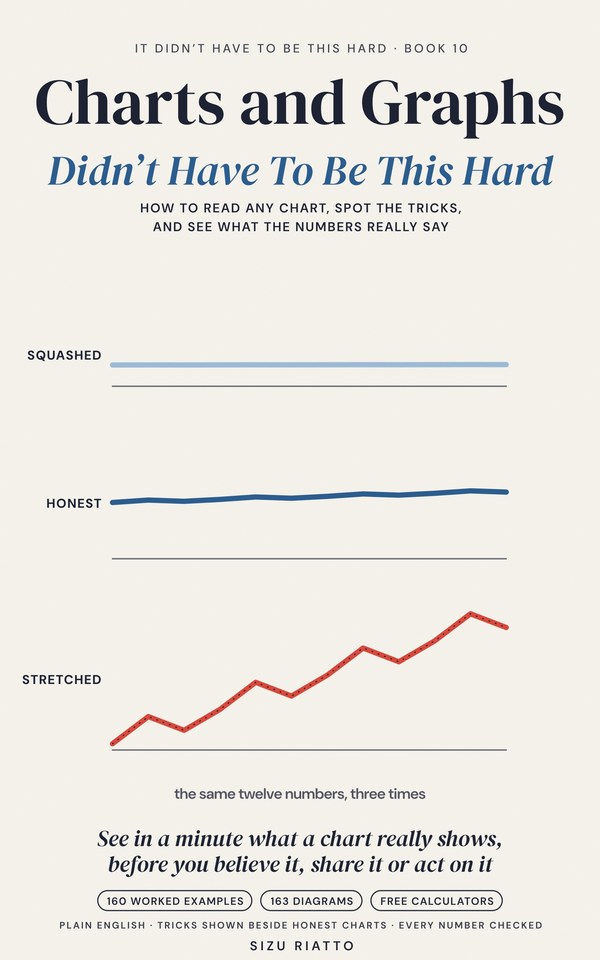
If charts are what you want to understand, the people in the data-viz group will show you what a good one looks like, and Charts and Graphs Didn’t Have to Be This Hard teaches how to read one in a minute.
If the money side is your reason for coming, the writers in the third group are a good start, and Money Didn’t Have to Be This Hard covers the everyday sums behind bills, loans and savings.

How the pack was chosen
Each account was picked by hand because it posts regularly about maths teaching, charts and data, or money, and was active in recent weeks. Nobody paid to be included and none of them is connected to this site. Being in the pack means their work is useful on the topic, not that every post anyone makes is endorsed. If you are in the pack and would rather not be, say so on Bluesky and you will be removed.
Know someone who belongs? Send their handle to @sizuriatto.com and it will be considered for the next update.