 Sizu
Your child comes home with a sheet of curved arrows over a line and a sum: 47 + 28. You know the answer in a second, but the worksheet wants jumps, not a column. Before you say “that’s not how we did it”, here is what it is. The method is not a different kind of maths. It is the arithmetic you already do in your head, with the steps drawn where a child can see them.
(The numbers are an example. A child’s own sheet will have different ones, and your child’s teacher is the authority on exactly how their class does it.)
Step 1: jump the tens, then the ones
This kind of line is often called an open number line, because it does not need every number marked on it. You mark only where you start, where you land, and the jumps.
- Start at 47.
- 28 is 20 and 8. Jump +20 to land on 67.
- Jump +8 to land on 75.
So 47 + 28 = 75. If you add in your head, you probably did exactly this without drawing it.
Step 2: what is the same as the column method
In the column method you add the ones (7 + 8 = 15) and the tens (40 + 20 = 60), then combine them: 60 + 15 = 75. The line does the same sum, in the order of tens first. Same answer, same reasons. The column method is shorter to write, and your child will meet it later. The line helps a child see why it works.
Step 3: jump to a friendly ten
Some children prefer to break the 28 differently. Many adults do this too: 47 is only 3 away from 50, which is a friendly number.
- Jump +3 from 47 to 50.
- The 28 is now 3 used up and 25 left, since 28 − 3 = 25. Jump +25 to 75.
Same sum, same 75, different route. Neither route is the “right” one. What matters is that your child can say what each jump means.
Step 4: taking away by counting up
The line is not only for adding. For 82 − 47, many children count up from the smaller number to the larger one, and the jumps add up to the difference.
- 47 to 50 is 3.
- 50 to 80 is 30.
- 80 to 82 is 2.
3 + 30 + 2 = 35, so 82 − 47 = 35. Check it the other way: 47 + 35 = 82. Counting up avoids the “borrowing” step that tangles so many adults, and it is how a shopkeeper counts your change.
Why schools draw it at all
The point of the line is that a child can see a number as something you move along, in steps they choose, rather than a pile of digits to line up. It builds a feel for size: 47 is close to 50, and 28 is close to 30, so the answer should be near 80, and a result like 615 is clearly wrong. That “does it look right?” habit is worth as much as the answer. A quick estimate, 50 + 30 = 80, lets your child check 75 before anyone says whether it is correct.
When the numbers get bigger
The same jumps work for larger sums. For 358 + 276, jump the hundreds, then the tens, then the ones: +200 lands on 558, +70 lands on 628, +6 lands on 634. A child who is comfortable with the small line finds the big one is just more of the same, with a hundred jump added.
Slips to watch for
- Jumping from the wrong place. The second jump should start where the first one landed (67, not 47).
- Dropping part of the number. If 28 is split into 20 and 8, both pieces must be used.
- Uneven spacing. The line is a sketch, so it does not need to be to scale, but a jump of 20 should look bigger than a jump of 8.
What to say at the kitchen table
You do not need to teach it. A few questions do more than any lesson:
- “Where do you start, and where do you want to end up?”
- “What size jump could you make that is easy?” (A ten, or up to the next ten.)
- “How could you check?” (Do it in the other direction, or by a different route.)
If your child gets a jump wrong, ask them to say it out loud, since a slip of 10 is often just a miscounted tens. Resist the urge to take the pencil. If a method still feels strange, it is fine to say so and ask what the teacher likes them to use.
Try it with your own numbers
The free Number Line Jumps tool draws any addition or subtraction as jumps: tens then ones, jumping to a friendly ten, counting up to find a difference, and more. It works with money too, so you can try a shop bill. It comes from Your Kid’s Math Homework Didn’t Have to Be This Hard, a plain-English guide to the methods children bring home, with the US and UK name for each one.
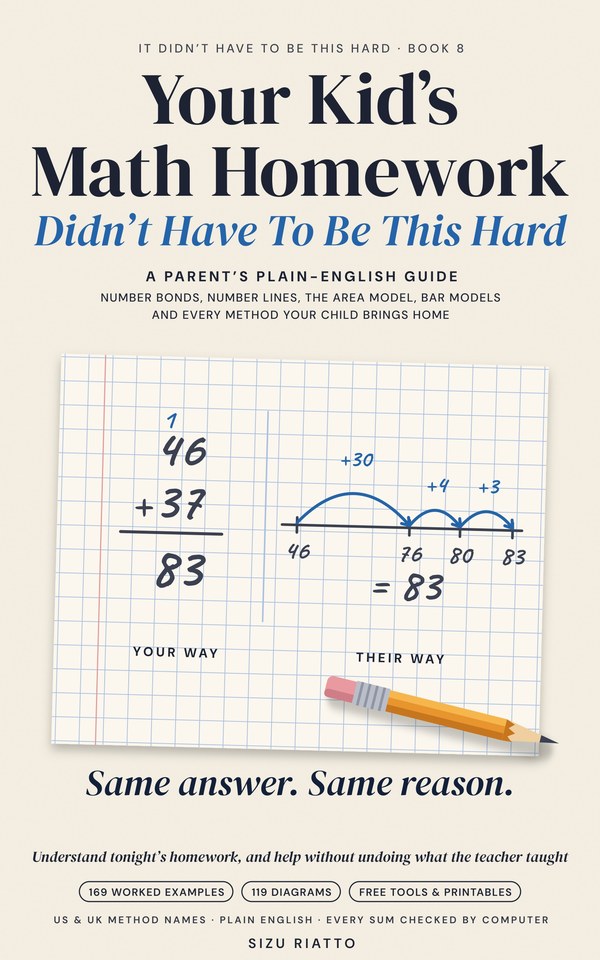
Rule of thumb: a number-line jump is just a step of an addition written down. Tens first, or a friendly ten first, and then check the answer a second way.