 Sizu
A well-built wall does real work around a home. A low wall can help hold back shallow flood water and runoff, so floors, furniture and belongings stay out of the water. The same wall gives you a boundary, privacy and shelter for a garden. Whichever job yours has to do, the first practical question is how many blocks to buy, and a wrong count means a stalled weekend or a pile of leftovers.
Ask how many blocks a wall needs and most people multiply the block’s length by its height and divide. That answer comes out too low, because it forgets the mortar joint. Every block on a wall takes up its own size plus one joint. Over 100 blocks, those joints add up to a lot of missing blocks.
This post counts one wall properly, then shows how an opening and a waste allowance change what you actually order.
Step 1: find the module
A standard 390 × 190 mm block with a 10 mm joint occupies a 400 × 200 mm module. The module is the unit you count with. The block is a little smaller than the space it takes, and the joint fills the difference.
Step 2: blocks per square meter
Blocks per m² = 1 ÷ (module length × module height), both in meters.
1 ÷ (0.4 × 0.2) = 12.5 blocks per m²
Notice what this says. If you had used the bare block size, 0.39 × 0.19 = 0.0741 m², you would expect 13.5 blocks per m², which is about one block too many on every square meter. The joint matters, and the module is the number to trust.
Step 3: count it two ways
Take a wall 6.0 m long and 7 courses (rows) high.
- By area. Height is 7 × 0.2 = 1.4 m, so the area is 6.0 × 1.4 = 8.4 m². Then 8.4 × 12.5 = 105 blocks.
- By courses. Length ÷ module is 6.0 ÷ 0.4 = 15 blocks per course. Then 15 × 7 = 105 blocks.
The two counts agree, which is the check. If they disagree, the wall length is not a whole number of modules, and you will be cutting blocks.
Step 4: subtract the opening
Walls rarely run unbroken. Say this one has a gate or doorway 1.2 m wide and 1.0 m high, starting at the foot of the wall.
- Width: 1.2 ÷ 0.4 = 3 modules.
- Height: 1.0 ÷ 0.2 = 5 courses.
- Blocks not needed: 3 × 5 = 15.
So the wall needs 105 − 15 = 90 blocks. The area method gives the same: the opening is 1.2 × 1.0 = 1.2 m², and 1.2 × 12.5 = 15 blocks.
If the opening does not fall on whole modules, round its width and height down when you subtract. A partial module still has to be filled with cut blocks, so you cannot take it off the order.
Step 5: when the length is not a whole number of modules
Make the wall 6.2 m long instead. 6.2 ÷ 0.4 = 15.5 blocks per course. You cannot buy half a block, so each course ends with one block that is cut, and you count it as a whole one: 16 blocks per course. Over 7 courses that is 16 × 7 = 112 blocks, not the 108.5 the plain division suggests. Count the cut block as a full block, and be pleased if the offcut finds a use elsewhere in the wall.
Step 6: add waste
Breakage and cuts mean you order more than you lay. A common allowance is around 5 percent, and some people choose 10 percent for a wall with many cuts or corners. Both are choices, not rules, so use your own judgement.
- 5 percent on 90 blocks: 90 × 1.05 = 94.5, which you round up to 95.
- 10 percent on 90 blocks: 90 × 1.10 = 99, so 99.
- The original uncorrected sum, with the opening ignored and 5 percent added: 105 × 1.05 = 110.25, so 111.
The last line is the one to avoid: it orders 16 blocks more than the 95 the wall needs.
Always subtract the opening first and add waste last. The waste applies to what you lay, not to what you leave out.
Common slips
- Using the block size instead of the module. Leave out the joint and you miscount by nearly a whole block per square meter.
- Counting only the full courses. Count partial courses at the top too, since a half-height course still takes a whole row of cut blocks.
- Adding waste before subtracting the opening. It turns a small allowance into a big surplus.
- Rounding down at the end. Blocks come whole, so waste always rounds up.
Rule of thumb
Module = block + joint. Blocks per m² = 1 ÷ (module length × module height). Count by area and by courses, subtract openings, then add waste and round up. For the 6.0 m wall with a gate opening, that is 90 blocks to lay and 95 to order.
Try it with your own wall
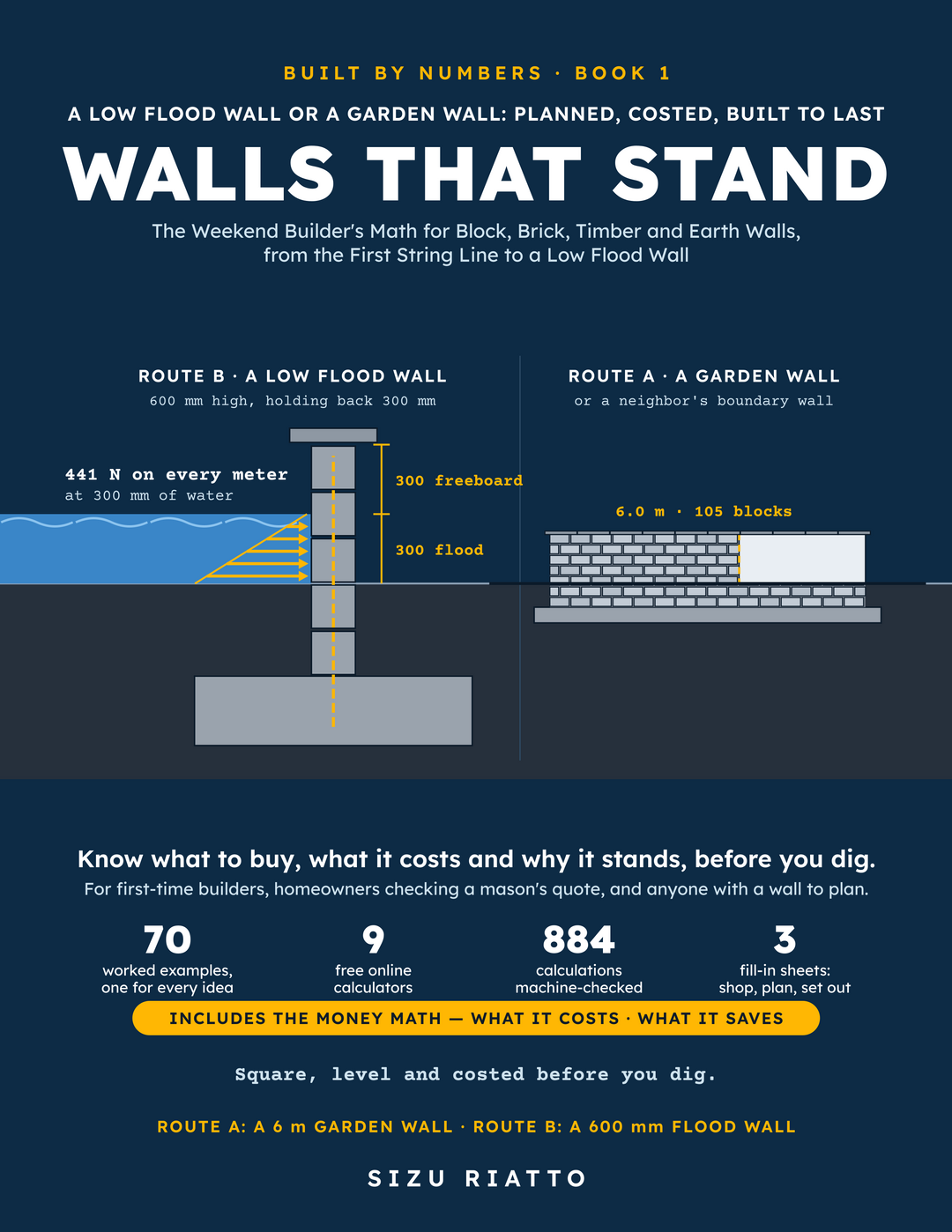
The free Block and Brick Counter does this for US CMU, UK and Australian blocks and bricks, in meters or feet. It comes from Walls That Stand, Book 1 of Built by Numbers.
This is arithmetic for planning, not an engineering design. Follow your local building department and, where a wall holds back water or soil, a licensed engineer.