 Sizu
You sell hand-poured candles at weekend markets. Some months feel busy and still leave you wondering whether you made anything. There is one number that answers that question before you start the month: the number of candles you must sell just to break even.
Below it you lose money. Above it, every extra candle is profit. Here is how to find it, with an invented but realistic stall.
Step 1: separate the two kinds of cost
Costs come in two kinds, and the sum depends on keeping them apart.
- Fixed costs do not change with how many you sell. For the month: four market days at $90 a stall ($360), plus $120 for insurance, a card reader subscription and a website. Total fixed: 360 + 120 = $480.
- Variable costs happen once per candle: wax, wick, jar, label, box and the card fee. Say that is $9 per candle.
Step 2: how much does each sale contribute?
You sell each candle for $22. The $9 of materials and fees is gone, and what is left is $13. This is the contribution of one sale: the money it adds towards covering the fixed costs.
Contribution = price − variable cost = 22 − 9 = $13.
Step 3: divide fixed costs by contribution
Every candle puts $13 towards the $480 bill. How many does it take?
480 ÷ 13 = 36.9, so you need 37 candles. Always round up, because 36 candles leave you $12 short (36 × 13 = 468, and 468 − 480 = −12).
Check at 37: 37 × 13 = 481, minus 480 = $1 profit. At 37 candles, sales are 37 × 22 = $814.
Step 4: how far above is your plan?
Say you hope to sell 60 candles this month.
- Profit = 60 × 13 − 480 = 780 − 480 = $300
- Margin of safety = (60 − 37) ÷ 60 = 23 ÷ 60 = about 38%
The margin of safety says how far sales could fall short of plan before you slip into a loss. Here, a 38 percent drop (to 37) would take you to zero. If your busiest month had 60 and a rainy one had 40, you can see you will still scrape through, and if a rainy month could mean 30, you cannot.
Step 5: what moves the number
You have three levers, and the sum shows you what each one is worth.
- Raise the price to $24. Contribution is 24 − 9 = $15, so break-even is 480 ÷ 15 = 32 candles.
- Drop it to $19 for a sale. Contribution is 19 − 9 = $10, so break-even jumps to 480 ÷ 10 = 48 candles.
- Cut a fixed cost, such as skipping one market ($90): fixed costs are $390, and 390 ÷ 13 = 30, so 30 candles, if you lose none of the sales you would have made at that market (you might, so check).
Look at the $19 case again. Three dollars off the price (14 percent) raises the number of candles you need by 11, which is about 30 percent more. A discount does much more damage than it looks, because it cuts the contribution, which is small to start with.
Honest limits
This is a simple model. It assumes the price and variable cost are the same on every candle, that fixed costs really are fixed, and that you value your own time at zero. If you want to be paid for the hours you pour and sell, add that wage to the fixed costs and the break-even moves up. Do the sum both ways, and see how much of a gap there is.
Rule of thumb
Break-even = fixed costs ÷ (price − variable cost per sale), rounded up. Check it by multiplying back, and compare it with what you realistically sell in a quiet month.
Try it with your own numbers
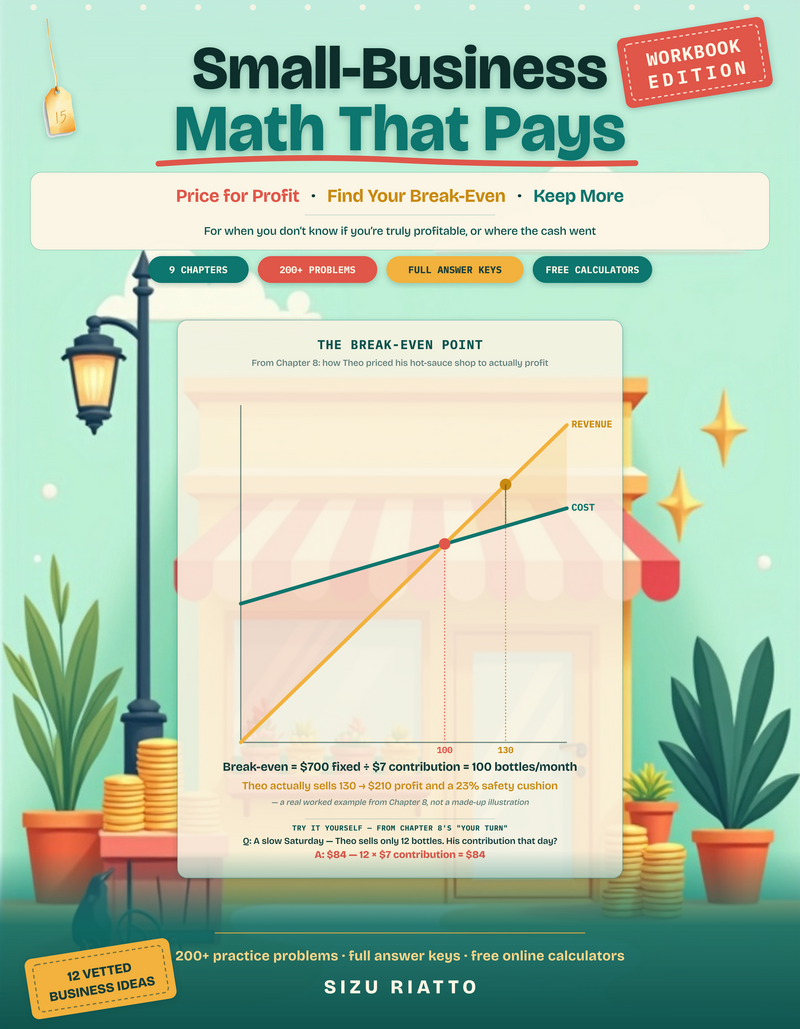
The free Break-Even calculator takes fixed costs, price and variable cost and gives the break-even in units, the revenue and the margin of safety. It is from Small-Business Math That Pays, whose book page says it covers revenue versus profit, the true cost of a sale, markup and margin, pricing for profit, break-even, cash and setting money aside for tax.
All figures are made-up examples. This is arithmetic for planning, not financial, tax or business advice.