 Sizu
You make candles. Each one costs you $60 to produce, all in: wax, jar, wick, labels and your share of the packaging. You decide you want to make 40% on every sale, so you add 40% to the cost and print the price tag. Then, at the end of the quarter, the profit is smaller than you planned.
The problem is not your sums. It is that “40%” meant two different things.
Step 1: add a 40% markup
Markup is profit as a share of the cost. A 40% markup on a $60 cost adds:
60 × 0.40 = $24
So the price is 60 + 24 = $84.
Step 2: check what that is as a margin
Margin is profit as a share of the price, the money the customer actually hands over. Same $24 of profit, divided by the $84 price:
24 ÷ 84 = 0.2857, which is 28.6% (rounded to one decimal place).
Same sale, same $24 in your pocket, two honest percentages: 40% and 28.6%. The markup is always the bigger number, because it divides by the smaller amount (the cost).
Step 3: price for the margin you actually want
If you want a 40% margin, then the cost is the other 60% of the price. So the cost is 0.60 of the price, and you can turn that around:
price = cost ÷ (1 − margin) = 60 ÷ 0.60 = $100
Check it: a $100 price with a $60 cost leaves $40 of profit, and 40 ÷ 100 = 40%. Correct.
That is a $16 difference per candle. On 500 candles in a quarter, it is 500 × $16 = $8,000 of profit that the first method quietly never collects.
Step 4: converting between the two
You will meet both words in the wild, so it helps to convert. With markup written as a decimal (0.40 for 40%):
margin = markup ÷ (1 + markup)
A few values, rounded to one decimal place:
- 25% markup is a 20.0% margin (0.25 ÷ 1.25).
- 50% markup is a 33.3% margin (0.50 ÷ 1.50).
- 100% markup, which means doubling the cost, is a 50.0% margin (1.00 ÷ 2.00).
And back again: markup = margin ÷ (1 − margin). A 40% margin is 0.40 ÷ 0.60 = 66.7% markup. Check: $60 plus 66.7% of $60 is $60 + $40 = $100.
Step 5: see what a discount does to the margin
Say you now sell at $100 and run a “10% off” weekend. The price drops to 100 × 0.90 = $90, but the cost is still $60.
- Profit per candle falls from $40 to 90 − 60 = $30. That is a 25% cut in profit (10 ÷ 40), from a 10% cut in price.
- Margin falls from 40% to 30 ÷ 90 = 33.3%.
A small price cut takes a big bite out of profit, because the cost does not move. That is why it is worth knowing your margin before you say yes to a discount, not after.
Which one should you use?
Neither is wrong. The trouble starts when two people use the same word for different things, so always ask “percent of what?” Margin is handy because it can never pass 100% and it matches how profit and loss reports are written. Markup is handy for a quick shop-floor “add a third”. Pick one, label it on your price sheet, and stick with it.
One more thing this simple version leaves out: the $60 must really be all of your cost. If you leave out your time, a share of rent, or card fees, the real margin is lower than the one you calculated.
Try it with your own numbers
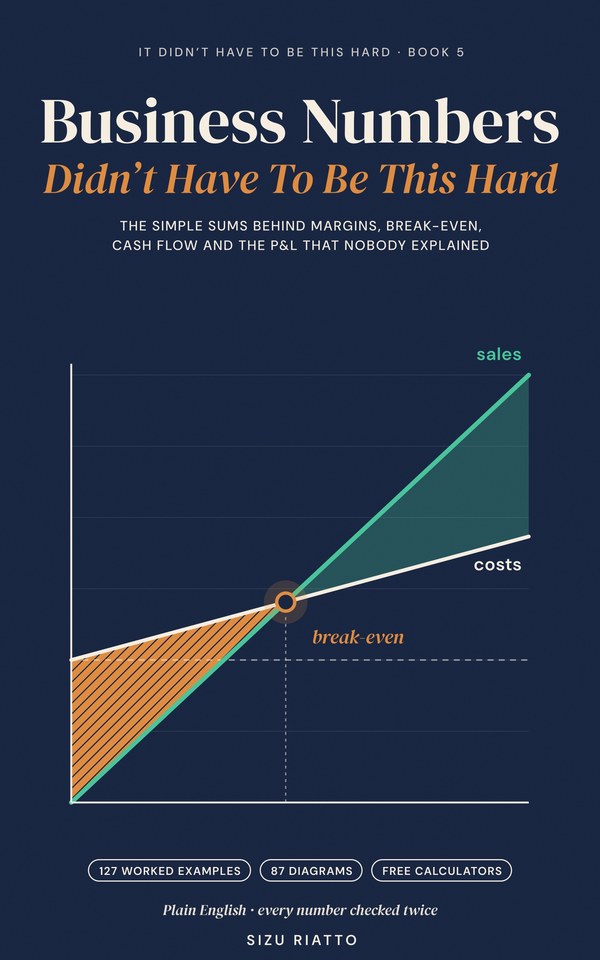
The free Margin and Markup calculator flips between markup and margin and works out the price for a target margin. It comes from Business Numbers Didn’t Have to Be This Hard, a plain-English reading book on margins, break-even, pricing, cash flow and the profit and loss. Put in your own cost and see what a 30% or 50% margin really asks you to charge.
Rule of thumb
- Markup = profit ÷ cost. Margin = profit ÷ price.
- For a target margin, price = cost ÷ (1 − margin).
- Adding a percentage to cost never gives that same percentage as margin.
This is arithmetic for planning, not professional advice. Check your own costs, taxes and local rules before you set prices.