 Sizu
Paint tins show a coverage figure, and most of us ignore it and buy “about three tins.” Sometimes that is too much and sometimes it means a trip back to the shop halfway through the second coat. The sum is short, and it is mostly about not forgetting two things: the door and window come off, and the coats go on.
The example room is 3.6 m by 3.0 m with 2.4 m walls, one door and one window. We will paint the walls only, not the ceiling. The paint covers 12 m² per litre (read the figure on your tin; it varies).
Step 1: find the wall area
The four walls together form a strip as long as the perimeter and as high as the walls:
Perimeter = 2 × (3.6 + 3.0) = 13.2 m
Wall area = 13.2 × 2.4 = 31.68 m²
Step 2: take off the door and window
Measure them rather than guess. Here the door is 0.8 m × 2.1 m and the window is 1.2 m × 1.0 m:
- Door: 0.8 × 2.1 = 1.68 m²
- Window: 1.2 × 1.0 = 1.20 m²
Net wall area = 31.68 − 1.68 − 1.20 = 28.8 m²
Step 3: multiply by the coats
Most walls need two coats, certainly over a colour change or bare plaster. The second coat is the one people forget.
28.8 × 2 = 57.6 m² of paint coverage needed.
Step 4: divide by the coverage rate
57.6 ÷ 12 = 4.8 litres.
One coat alone would be 28.8 ÷ 12 = 2.4 litres. So the forgotten second coat is the difference between half the paint and all of it.
Step 5: turn litres into tins
Tins come in set sizes. With 2.5 L tins:
4.8 ÷ 2.5 = 1.92, so you need 2 tins, which is 5 litres.
The leftover is 5 − 4.8 = 0.2 L, enough for a small touch-up. Because the answer is only just under the tin size, a spill, a thirstier wall or a slightly lower real coverage would leave you short. That is a good moment to look for a 1 L tin to carry as a safety margin.
When the real room is not so tidy
- Coverage is a best case. The figure on the tin assumes a smooth, already-painted wall. Rough or very dry plaster soaks up more, so the real rate can be lower. If the coverage were 10 m² per litre, the same job needs 57.6 ÷ 10 = 5.76 litres, which is three tins.
- Round up to the tin. Never round the litres down; leftover paint is better than a colour that does not match a second batch.
- Ceiling and trim. The ceiling here would add 3.6 × 3.0 = 10.8 m² per coat. Skirting and door frames are small areas usually covered by whatever is left over, or a small tin of trim paint.
- Measure twice. A wall that reads 3.60 m at one end and 3.64 m at the other changes the area by about 1%, which is a rounding detail for paint but a bigger deal for flooring.
The same method for any room
Nothing here is special to this room. For a 4.0 m by 3.5 m room with 2.5 m walls, one door (1.68 m²) and one window (1.2 m²), the perimeter is 2 × (4.0 + 3.5) = 15 m, the walls are 15 × 2.5 = 37.5 m², and the net area is 37.5 − 1.68 − 1.2 = 34.62 m². Two coats is 69.24 m², and at 12 m² per litre that is 69.24 ÷ 12 = 5.77 litres, which is three 2.5 L tins or a 5 L plus a 1 L, depending on what the shop stocks.
Write the four numbers down in order (net area, coats, coverage, litres) and the sum stays the same every time.
Try it with your own numbers
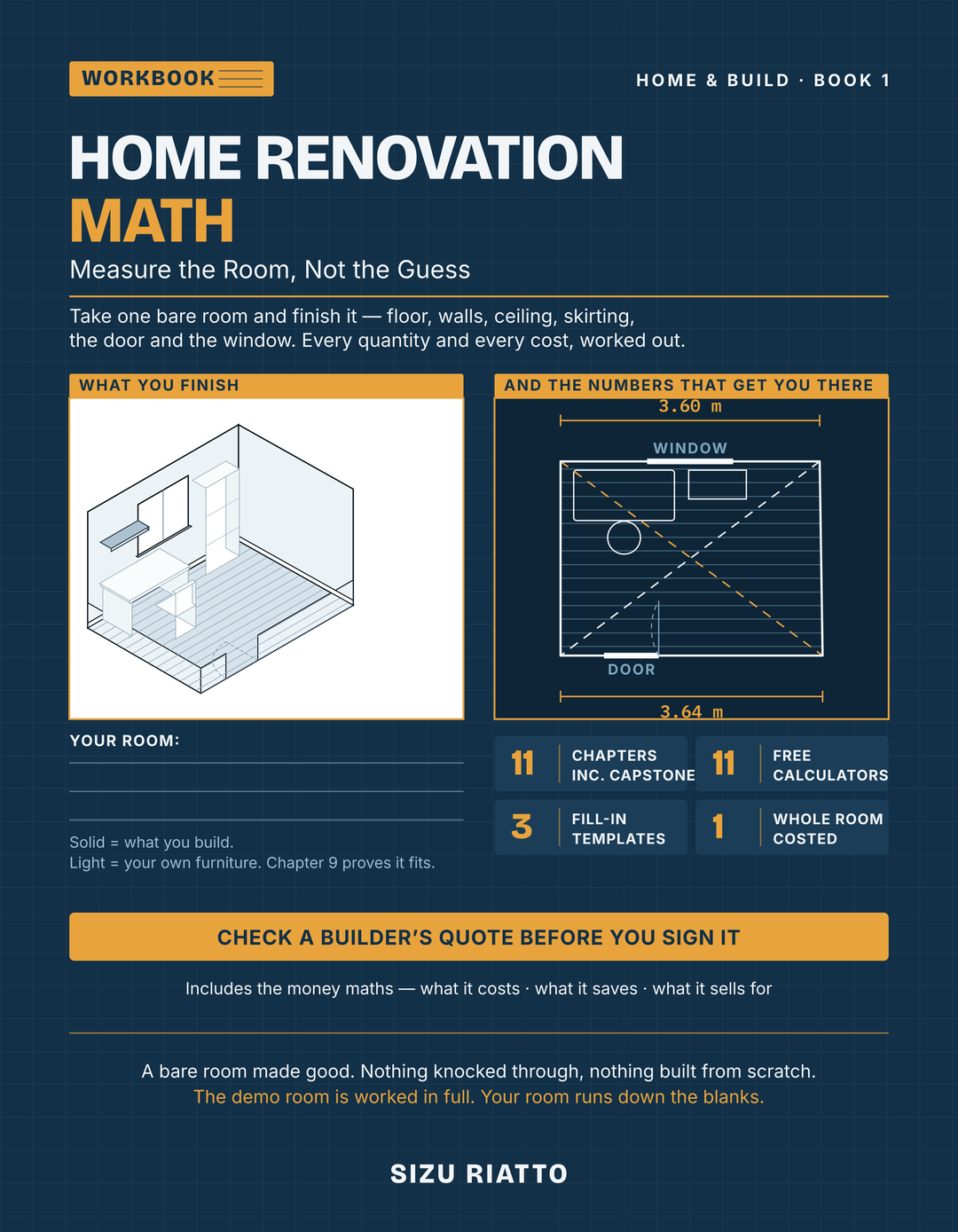
The free Paint & Tin Sizes calculator takes net area, coats and coverage rate and gives litres, the tin to buy and the leftover. It comes from Home Renovation Math: Measure the Room, Not the Guess, which follows one box room from bare walls to finished and whose first chapter is “One Wall, One Tin.”
Rule of thumb: (perimeter × height − doors − windows) × coats ÷ coverage = litres. Round up to the next tin.
This is arithmetic for planning, not a substitute for a qualified tradesperson. Follow the instructions on your paint tin.