 Sizu
You have three debts and a bit of spare money each month. Which debt should get the extra? Two popular answers have names: the avalanche (highest interest rate first) and the snowball (smallest balance first). Here is what each actually does, with the arithmetic.
The three debts (invented)
- Card A: $2,000 at 24% a year, minimum payment $50
- Loan B: $5,000 at 18% a year, minimum payment $100
- Card C: $800 at 12% a year, minimum payment $25
Together the minimums are 50 + 100 + 25 = $175. Say you can pay $475 a month in total, so $300 is extra. The sums below make two simple assumptions: interest each month is the yearly rate ÷ 12 on the balance, and when a debt is paid off its payment rolls onto the next. Real lenders differ in the details, so treat the results as a close guide.
Step 1: how much does interest cost right now?
One month of interest on each debt, at the yearly rate ÷ 12:
- Card A: 2,000 × 0.24 ÷ 12 = $40
- Loan B: 5,000 × 0.18 ÷ 12 = $75
- Card C: 800 × 0.12 ÷ 12 = $8
Total: $123 a month just to stand still. Out of your $175 in minimums, only $52 would reduce the debt at all. That is why paying only the minimums is so slow: on these three debts it takes about 79 months and about $5,929 in interest.
Step 2: the avalanche
Put the extra $300 on the highest rate first: Card A (24%). Once it is gone, move everything to Loan B (18%), then Card C (12%). In month 1 that means $350 to Card A (its $50 minimum plus the $300 extra), $100 to Loan B and $25 to Card C, which adds up to the $475. The high-rate debts, which grow fastest, die first.
Result: debt-free in 19 months, with about $1,198 of interest paid in total.
Step 3: the snowball
Put the extra $300 on the smallest balance first: Card C ($800), then Card A ($2,000), then Loan B ($5,000). The first debt disappears within a few months, which feels good, and each cleared debt frees up its payment.
In month 1 that means $325 to Card C ($25 plus $300), $50 to Card A and $100 to Loan B. Result: debt-free in 20 months, with about $1,286 of interest paid in total.
Step 4: compare
- Interest difference: 1,286 − 1,198 = $88 in favour of the avalanche.
- Time difference: one month.
- Cards cleared: the snowball closes Card C very early, while the avalanche closes it last.
Both totals come from the same $475 a month, and both are far better than minimums alone (about $5,929 of interest). The big saving comes from paying extra at all. The order is the small change on top of that.
Why the gap is small here, and when it grows
The avalanche only wins by a lot when the rates are very different and the balance at the highest rate is large. Here the highest rate is on a mid-sized balance and the lowest rate is on the smallest balance, so the two orders are close. If your biggest balance carried the highest rate, the gap could be much bigger. Run your own figures before assuming either way.
The snowball has a human argument: finishing a debt early can keep you motivated, and a plan that you stick with beats a perfect plan you abandon in month 6. The avalanche has a cold-numbers argument: less interest. Both are reasonable. One thing both agree on: never miss a minimum payment on any debt while you chase the target.
Try it with your own numbers
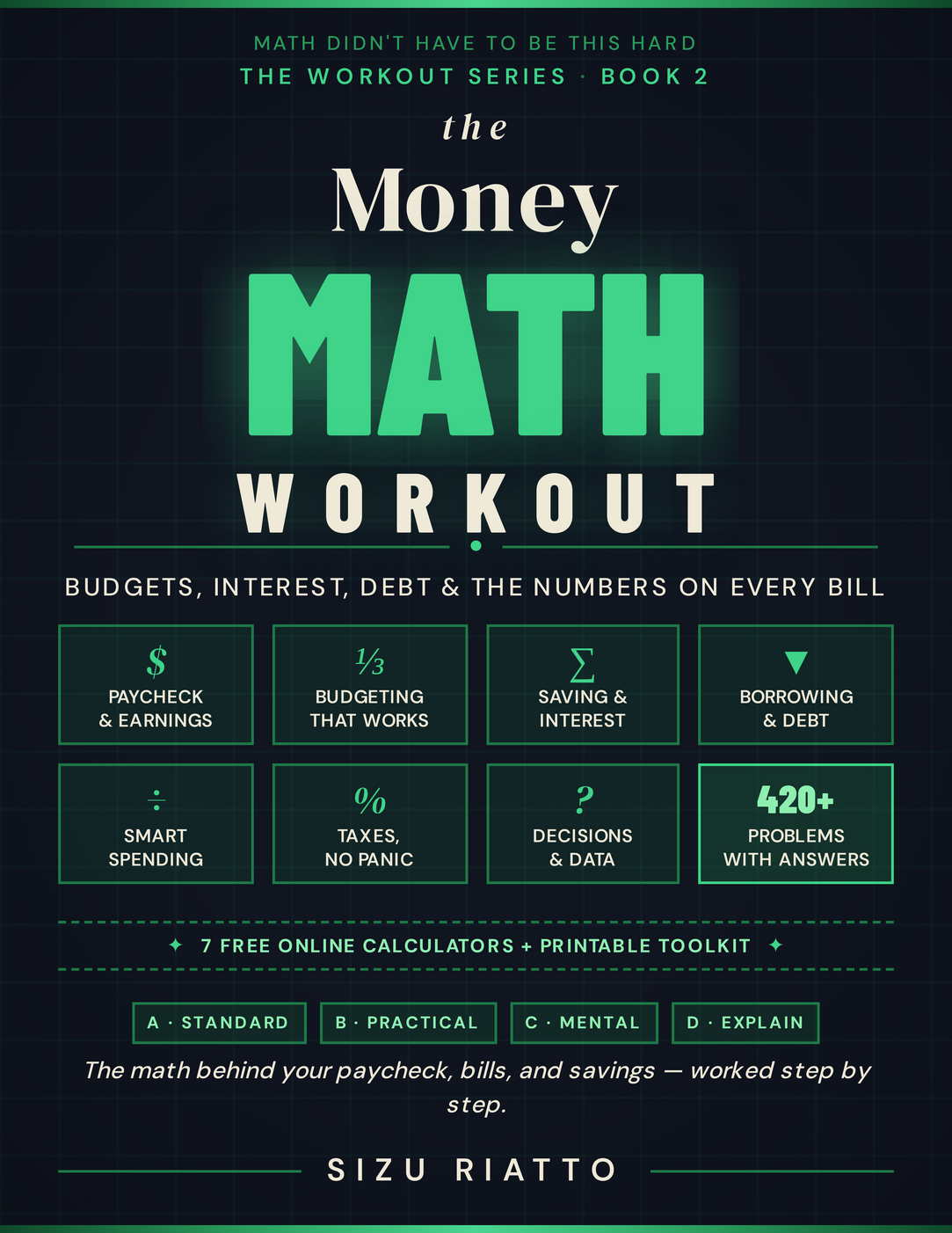
The free Debt Payoff calculator gives the months to payoff, the total interest and an avalanche-versus-snowball ranking for several debts. It goes with The Money Math Workout, a workbook on budgeting, interest and debt, whose page lists this calculator under Chapter 4, Debt Payoff. Type in your balances, rates and minimums, then see how much the order matters for you.
Rule of thumb
- Interest each month is roughly balance × yearly rate ÷ 12.
- Pay every minimum, then put every extra dollar on one target.
- Avalanche saves the most interest. Snowball clears the first debt fastest. Choose the one you will really follow.
This is arithmetic for planning with invented debts, not professional advice. Check the terms on your own accounts, including fees and how your lender applies payments.