 Sizu
You pick up a delivery job that pays $18. The part you remember, the actual trip with the parcel in your hands, took 25 minutes. So it feels like you earned about $43 an hour. Then you look at your week and the money does not add up.
The gap is not your imagination. It is everything around the job that nobody pays you for. Here is how to find your real hourly, using one invented but typical job. Swap in your own numbers as you go.
Step 1: count every minute
Write down the whole story of the job, from the moment you took it to the moment you were free again:
- Active (the paid trip itself): 25 min
- Waiting (for the pickup, in a queue, for a reply): 10 min
- Driving back (to where the next job starts): 8 min
- Admin (messages, logging the job, photos): 2 min
Total: 25 + 10 + 8 + 2 = 45 minutes, which is 0.75 of an hour.
Step 2: the feeling versus the facts
Look at three different hourly rates for the same $18.
- Active minutes only. 18 ÷ (25 ÷ 60) = 18 ÷ 0.4167 = $43.20 an hour. This is the one that feels true, and it is the one a job advert implies.
- All 45 minutes. 18 ÷ 0.75 = $24.00 an hour. Already close to half off.
- All minutes, minus what the job cost you. See Step 3.
Step 3: take off what it cost you
The $18 is the payout, not what you keep. If you use your own car, bike or phone data, the trip itself uses something up: fuel, wear, maybe a parking fee. Say the job costs you $4 in fuel and wear.
Kept money = 18 − 4 = $14.
Real hourly = $14 ÷ 0.75 hours = $18.67 an hour.
Round to the nearest cent here, and remember your costs are an estimate, so the honest answer is “roughly $18 to $19 an hour,” not a number to the cent.
Step 4: what is it worth to you?
A real hourly of $18.67 is not good or bad by itself. Compare it with something real:
- If your day job pays $17 an hour after tax, this job is a small gain, but you also take on the car costs and the waiting uncertainty.
- If the same hour at a quiet desk would pay $22, the delivery is worth less than your time, unless you enjoy it for its own sake.
- Compare it with other gigs the same way. A job that pays $12 for 10 minutes with no waiting and no driving works out to $72 an hour before costs, while a larger payout with a long drive and a long wait can be worse. Put every job through the same four lines (payout, costs, minutes, hourly) and the comparison stops being a matter of feelings.
Also notice which minutes you can change. Waiting is the big one: if you cut it from 10 minutes to 2, the total drops to 37 minutes, and the real hourly rises to 14 ÷ (37 ÷ 60) = $22.70. Taking jobs in a tight area, or batching several, can be worth more than a higher payout.
Taxes and fees
Two things this example leaves out on purpose. If the platform takes a fee, your payout is already after it, so use the amount that actually reaches you. And income from side work may be taxable where you live, so keep records and set some aside. Rules vary, so check with your local tax authority.
Rule of thumb
Real hourly = (payout − the costs the job caused) ÷ every minute, not just the active ones. Time the waiting and the drive for a week and you will know your real number.
Try it with your own numbers
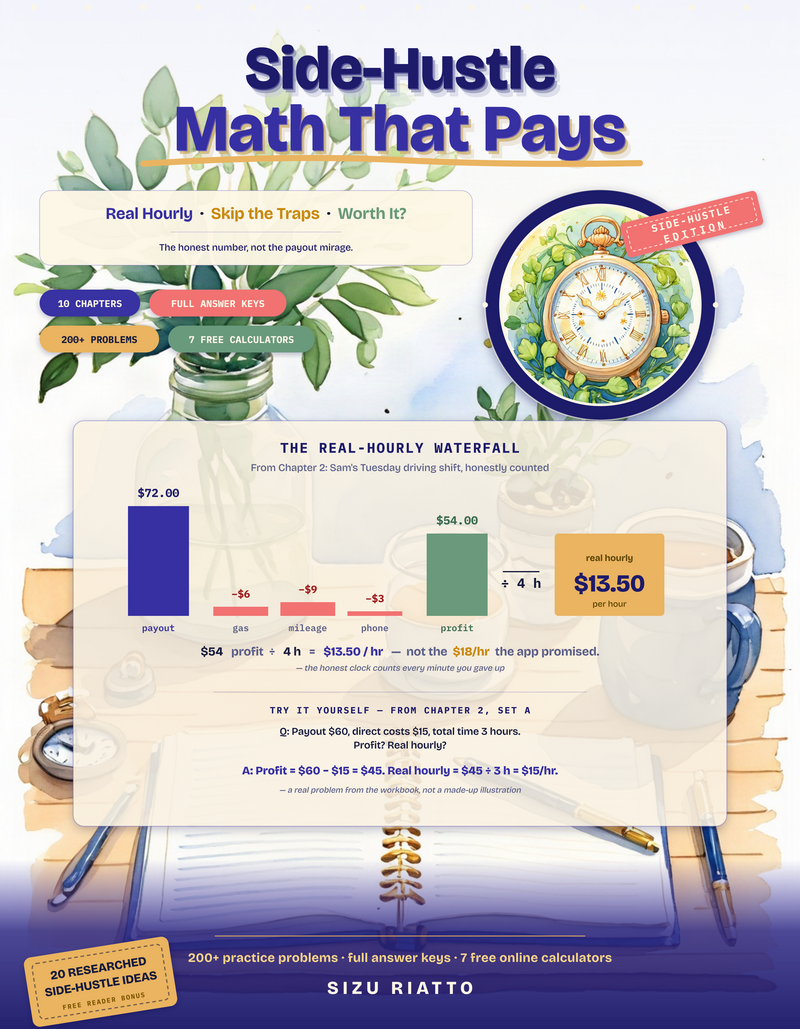
The free Real Hourly calculator takes the payout, direct costs, and your active, waiting, driving and admin minutes. It is from Side-Hustle Math That Pays, whose book page says it covers mapping a hustle onto three levers, the real hourly, fee stacks, forgotten costs, the hobby-versus-business line, quoting a service and deciding whether the next hour is worth doing.
Every figure here is an illustrative example. This is arithmetic for planning, not financial, tax or business advice.