 Sizu
Home › Books › Algebra Didn’t Have to Be This Hard
What this book is
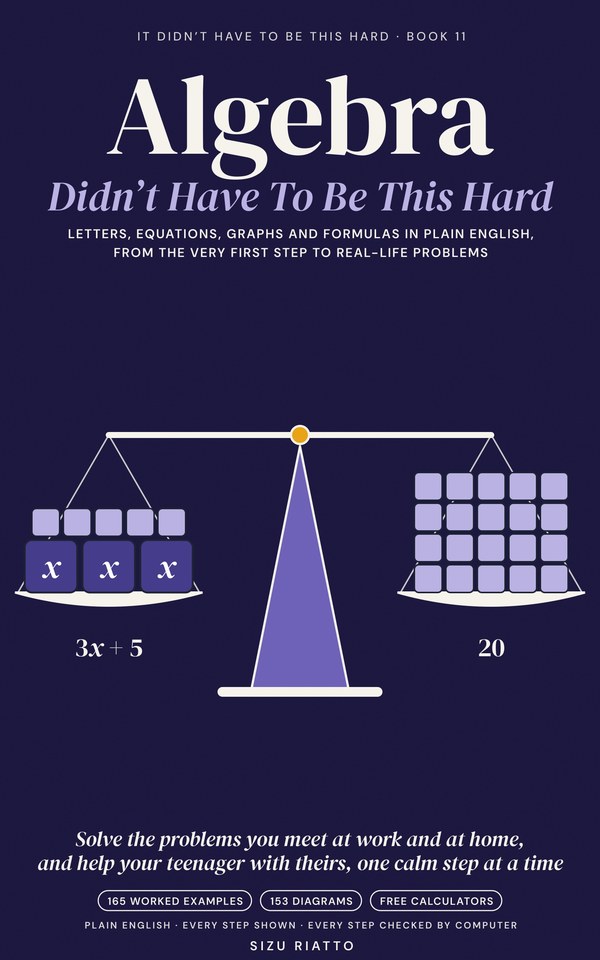
Algebra explained slowly, in plain English, from the very first step. Algebra is arithmetic with a blank in it: when you work out what you spent from the change in your hand, you’re already solving for an unknown. This book gives that thinking a way to be written down, a handful of moves to handle it (keep the balance, undo in reverse order, tidy first, check by putting it back) and a picture for each idea: balance scales, algebra tiles, number lines, coordinate grids and function machines.
It builds in order. Part One is what algebra is: letters, the order of operations, negative numbers and writing things in algebra. Part Two is solving: the balance, multi-step equations, brackets and like terms, fractions in equations and rearranging formulas. Part Three is lines and graphs: the coordinate grid, slope, the equation of a line, two equations at once and inequalities. Part Four goes beyond straight lines: powers, squares and roots, quadratics, growth and functions. Part Five brings it home: word problems, spreadsheets, proportion and ten habits that make algebra stick. Every calculated figure was computed by program and checked a second way, and every line of every equation in the book’s sum boxes, each step of each solving included, was read back off the finished pages and checked.
Who it’s for
Adults returning to study for a course, an apprenticeship or a new career; parents whose teenager has just overtaken them in math; anyone who meets formulas at work in spreadsheets, quotes or manuals; and anyone who was told they weren’t “a math person” and would like to find out. No math assumed beyond arithmetic. Not tied to any test or course, and no grade is promised. Every story is invented to show an idea; formulas from trades appear as arithmetic only, not as professional advice.
Every chapter, its worked examples, and its free calculator
The calculators are free, need no sign-up, and keep what you type in your own browser. Each opens with its chapter’s worked example loaded. The book is complete without them.
Part One · What Algebra Is
Algebra is arithmetic with a blank in it: give the missing number a name, write down how the numbers fit together, work back to it by undoing the steps in reverse order, and check by putting the answer back in.
Calculator: Find the Missing NumberWorked examples 1–7
- Working out what you spent from the change you got back
- The score needed on a third test to reach a target average
- How many boxes are left to pack
- A number puzzle solved by undoing the steps in reverse order
- Guess and check against working backward
- Finding a monthly cost from a spreadsheet's yearly total
- Three rolls of tape plus delivery: the first equation on a practice test
A letter stands for a number: an unknown is one hidden number, a variable can take many values. An expression is a recipe for a number and an equation says two amounts are equal; to evaluate an expression, substitute each letter's number, writing the multiplication signs back in.
Calculator: Plug In a FormulaWorked examples 8–14
- Evaluating an expression from a homework sheet
- A weekly pay formula: hourly rate plus a travel allowance
- The area of a room and the cost of its flooring
- Converting a temperature from Celsius to Fahrenheit, and testing the formula
- Why x squared and 2x are different, and the numbers where they agree
- Notebooks and pens: letters stand for prices, not for objects
- A taxi fare: a pickup fee plus a rate per mile
So that a written calculation means one thing to everyone, we agree on an order: brackets, then powers, then multiplication and division from left to right, then addition and subtraction from left to right. A fraction bar is hidden brackets, and when a reader could hesitate, add brackets.
Calculator: Step-by-Step Order of OperationsWorked examples 15–21
- The viral 8 ÷ 2(2 + 2) puzzle and why it starts arguments
- A coffee-and-muffin receipt as one calculation
- Two small squares or one big one: 2 × 3² against (2 × 3)²
- Money in and out, worked left to right
- Splitting a pizza bill, and the brackets a fraction bar hides
- A homework calculation with brackets inside brackets
- A spreadsheet average that went wrong for want of brackets
Negative numbers sit to the left of zero on the number line. Adding a negative moves left, subtracting a negative moves right (it's the same as adding), and when multiplying or dividing, same signs give a positive and different signs a negative; each rule is what keeps arithmetic working on both sides of zero.
Calculator: Negative Number LineWorked examples 22–28
- How far the temperature fell from sunset to dawn
- A checking-account balance that goes below zero
- Taking away a negative number, as a gap and as a cancelled debt
- Why negative times negative is positive: the pattern and the debts
- From a basement garage to the roof: heights below and above ground
- The average of a week of winter temperatures
- Where the minus sign sits before a square
To turn words into algebra, name the letter with its units, translate phrase by phrase ("less than" reverses the order), and test the result with one number you can check in your head. A table with a steady jump is a straight-line rule: the jump times n, plus the value at zero.
Calculator: Words to Algebra TranslatorWorked examples 29–35
- A print shop's price sign turned into a formula
- The "less than" trap in translating words
- Finding the rule behind a table with a steady jump
- How many matches for a row of squares
- A parent's and a teenager's ages as an equation
- What the equals sign means, and where it came from
- Testing a dinner-bill formula with one easy number
Part Two · Solving Equations
An equation is a level balance, so you can do any move you like as long as you do it to both sides; choose the undo (inverse operation) of whatever was done to the letter until it stands alone, then put the answer back into the original equation to check.
Calculator: Balance an Equation Step by StepWorked examples 36–42
- A bag of washers on a kitchen balance (x + 9 = 23)
- Work boots: the price before a $15 coupon
- Four equal concert tickets that cost $52 together
- A pizza bill split six ways at $7.50 each
- 3x + 5 = 20 solved on a balance, one move at a time
- Bags of marbles on both pans: cancelling what both sides share
- A homework slip caught by putting the answer back in
When several things have been done to the letter, undo them in reverse order, last on, first off; when the letter is on both sides, gather it on one side first; and when the letters vanish, the leftover statement tells you there is no solution (if it's false) or that every number works (if it's always true).
Calculator: Equation Solver That Shows Every StepWorked examples 43–49
- Hours worked from a paycheck with a weekly travel allowance
- A think-of-a-number trick undone in reverse order
- A practice-test equation with the letter on both sides
- Two car-share plans: the mileage where they cost the same
- The Rhind papyrus's problem 24, by false position and by algebra
- Two moving-truck quotes with no break-even point
- Two ways of writing one order of flyers (an identity)
Like terms have the same letter part and collect by adding their numbers; a number outside a bracket multiplies everything inside it (the distributive law, an area picture), and factoring pulls a shared factor back out; none of this changes the value, so test any tidying with an ordinary number like 7.
Calculator: Expand and Collect Like TermsWorked examples 50–56
- Collecting like terms by counting cups
- The area of a garden bed: expanding a bracket
- A minus sign in front of a bracket
- Tidying two brackets before solving a practice-booklet equation
- Factoring a catering bill to split it three ways
- Work shirts, some with a logo, written as one tidy total
- A quiz answer tested with a number: x² and x are not like terms
Clear fractions by multiplying every term on both sides by a common denominator, and decimals by multiplying by ten or a hundred; every percent problem is part = rate × whole, and a percent change is undone by dividing by its multiplier, never by adding or subtracting the percent.
Calculator: Clear the FractionsWorked examples 57–63
- A delivery where two-thirds of the bags were topsoil
- A print run: a quarter and a sixth go to binding machines
- A toolbelt's price before a 15% off sale
- A class turnout: 18 people were 24% of the sign-ups
- Compost and soil mixed in a 3-to-8 ratio for a big job
- A drill's price before 7% sales tax
- A shared gift and card: what did the gift cost?
A formula is an equation with several letters, and you can solve it for any one of them with the same balance moves, treating the other letters as numbers; rearrange first, then put in the numbers, and check by putting the answer back into the original formula.
Calculator: Rearrange a FormulaWorked examples 64–70
- The current drawn by a 1,500-watt heater on 120 volts
- Driving time for 150 miles at 60 miles an hour
- Turning 68°F into Celsius by rearranging the formula
- The width of a dog run from 50 feet of fence
- Sanjay's price formula turned around to fit any budget
- The yearly rate behind $90 of simple interest on $1,500
- Resistance from voltage and current with Ohm's law
Part Three · Lines, Slopes and Graphs
A coordinate grid turns a pair of numbers into a place (across first, then up) and a rule into a picture; a straight row of points means equal steps, and solving an equation is reading the picture backward.
Calculator: Plot Points and Read a TableWorked examples 71–77
- Plotting points in all four quadrants of a grid
- Turning a table of values into a straight-line graph
- Walking a park map with negative coordinates
- The distance between two points on the same grid line
- Reading a graph backward to solve an equation
- Placing a garden bench at the midpoint of a path
- Plotting y = x² and seeing a curve
Slope is rise over run, the change up for each step across; it's every "per" in real life (miles per hour, dollars per sheet), positive going up, negative going down, zero when flat.
Calculator: Slope from Two PointsWorked examples 78–84
- A delivery driver's average speed from two log readings
- The slope of a ramp as a fraction and a percent
- Price per sheet and setup fee from two print jobs
- A draining tank and when it runs dry
- A flat delivery fee and a vertical line
- The fall of a garden path, with units converted first
- Two vans at the same speed that never meet
Every straight line except a vertical one is a start plus a rate, y = mx + b; two points pin down both numbers, and where two lines cross is where two deals cost the same.
Calculator: Line from Start and RateWorked examples 85–91
- Writing an electrician's quote as an equation
- Reading slope and intercept, and checking a point
- Recovering a fee and an hourly rate from two invoices
- The break-even point between two electricians' quotes
- A print shop's break-even job size
- When a candle burns out, from two measurements
- A profit line that starts below zero
Two unknowns need two different facts; the answer is the one pair that fits both, where their lines cross, found by graphing, substitution or elimination.
Calculator: Solve Two EquationsWorked examples 92–98
- How many large and small posters were sold
- Finding where two lines cross, by graph and by algebra
- Hardbacks and paperbacks on a shelf, by substitution
- Prices of mulch and gravel from two receipts
- Blending two coffees to hit a target price
- Systems with no solution or infinitely many
- Adult and children's tickets from a count and a total
An inequality is an equation with room in it: solve it with the same balance moves, flip the sign only when multiplying or dividing by a negative, and let the story decide how to round.
Calculator: Solve and Shade an InequalityWorked examples 99–104
- How many snacks fit in a budget
- Job size needed for free delivery
- Why dividing by a negative flips an inequality
- How many boxes an elevator can take
- The quiz score needed for a target average
- A range between two limits
Part Four · Beyond Straight Lines
An exponent counts how many copies of the base are multiplied, so multiplying powers adds the counts, dividing subtracts them, a power of a power multiplies them, a zero exponent leaves 1, and a negative exponent divides.
Calculator: Exponent Rules CheckerWorked examples 105–111
- Multiplying powers on a study-guide question by counting the factors
- Dividing powers of the same base, and comparing sizes by their exponents
- Why ten to the power zero is 1, from a halving staircase
- Negative powers of ten and the metric units they name
- Raising a power to a power on a teenager's homework
- Why device memory comes in powers of 2 and shows 1,024
- The bracket that changes a squared answer, tested with one number
A square root undoes a square, an equation like x² = 49 has two answers of which the story keeps the one that fits, and the Pythagorean theorem a² + b² = c² turns any right triangle into a square-root problem.
Calculator: Squares, Roots and Right TrianglesWorked examples 112–118
- The side of a square patio from its area in paving stones
- Both answers to a squared equation, and which one a story keeps
- A square root bracketed between squares, sharpened by divide-and-average
- Checking a shed corner is square with the Pythagorean theorem
- How high a leaning ladder reaches up a wall
- Why a screen's size is its diagonal
- Doubling a patio's side, and the side that doubles its area
A quadratic has an x² term, its graph is a parabola, and its solutions are where the curve crosses zero; factoring with the zero-product rule, completing the square or the quadratic formula finds them, and the vertex marks the best or worst case.
Calculator: Quadratic Solver with GraphWorked examples 119–125
- Multiplying two brackets with algebra tiles
- Factoring a quadratic and the zero-product rule
- The rectangle that gives the most room for a fixed length of fence
- The pen sizes that give a required area
- Solving a quadratic with the quadratic formula
- Completing the square with a picture, the Babylonian way
- A quadratic with no real solution, and what that means
Linear growth adds the same amount each step and draws a straight line; exponential growth multiplies by the same factor, starts slowly, doubles at a steady pace and always overtakes the line in the end, so ask "over how long?" before comparing.
Calculator: Linear vs Exponential GrowthWorked examples 126–132
- A fixed monthly raise against a percentage raise after one and three years
- Turning a percentage rise into a multiplier and chaining two of them
- The month a percentage raise overtakes a fixed raise
- Doubling time by trying powers and by the rule of 72
- An item losing a steady percentage of its value each year
- How many rounds a school phone tree needs to reach every family
- Telling linear from exponential growth in a table
A function is a machine that turns each input into exactly one output; f(x) names the output, a table with equal steps reveals a line's rule, the inverse runs the machine backward (which is solving an equation), and the domain says which inputs make sense.
Calculator: Function Machine and InverseWorked examples 133–139
- Running a function rule on an input
- Finding a function's rule from a table of inputs and outputs
- Running a function backward to find the input
- A temperature conversion and its inverse
- Discount, coupon and sales tax in different orders at the register
- A rule with two outputs, and the vertical line test
- A workshop cost formula and the inputs that make sense
Part Five · Algebra at Work and at Home
A word problem is a story told twice, once in words and once in algebra. Picture it, name one unknown with its unit, write the one thing the story says is equal, solve, and check the answer against the words, not just the equation.
Calculator: Word Problem Setup HelperWorked examples 140–146
- Two delivery vans on one road, the second leaving an hour later: when it catches up
- Two people painting one room together, by adding their rates
- Diluting a garden spray mix with water to a weaker strength
- Sharing a printing job's money between two shops in a ratio
- Finding the old price from the new one after a percent rise
- Three seat numbers in a row that add to a given total
- A flower bed's width from its area, and the negative answer the story rules out
A spreadsheet is algebra with addresses for letters: a formula is an expression, dragging it down is substitution, dollar signs turn a letter into a constant, and goal seek is solving an equation. Read every formula aloud with units, and test one row by hand.
Calculator: Spreadsheet Formula BuilderWorked examples 147–153
- Reading a spreadsheet quote formula as algebra
- Dragging a formula down a column: one rule, many values
- A setup fee that moved when a formula was dragged, and the dollar-sign fix
- The price that gives a target margin, and why markup is different
- A what-if table of profit at several prices, and the break-even price
- A stock column that falls each day, and the day to reorder
- Minutes multiplied by an hourly rate, and the units check that catches it
In direct proportion the ratio stays fixed (y = kx: double one, double the other); in inverse proportion the product stays fixed (xy = k: double one, halve the other); anything with a fixed fee or starting value is neither. Test a table by dividing pairs and by multiplying them.
Calculator: Direct and Inverse ProportionWorked examples 154–160
- Bags of gravel for a patio base, by direct proportion
- A bigger crew on the same job, by inverse proportion
- Lengths and area from a scale plan
- Scaling a recipe from four people to ten
- The same trip at a slower speed
- A price with a setup fee that doesn't double when the order doubles
- Telling direct from inverse proportion in a pump table
Algebra is ten habits used again and again: name the unknown, picture it, keep the balance, undo in reverse order, tidy before solving, clear the fractions, check by putting it back, draw the graph, watch units and signs, and ask whether the answer makes sense.
Worked examples 161–165
- Two plumbers' quotes, the break-even job length, and hours on a budget
- A raised bed with fixed edging and a target area: two answers, one wall
- Two drivers sharing a trip at different speeds
- Helping a teenager solve an equation with fractions
- How many boxes reach a monthly profit target