 Sizu
Home › Books › Chance Didn’t Have to Be This Hard
What this book is
Probability and risk, explained slowly, from the very beginning. What “one in a million” means, and the question to ask of every chance: per what? Counting the ways; “and”, “or” and “at least one”; chances that change when you know something; and the long run. Then the surprises: why shared birthdays and coincidences are common, why ordinary luck comes in streaks, the three-doors puzzle, why a positive test is often wrong, the winners you see and the failures you don’t, and why the best and worst drift back to average. Then the choices: expected value, lotteries, insurance and warranties, risks that sound bigger than they are, and why a good bet can still ruin you. Last, how to change your mind with evidence, how long you’ll wait, and how things fail together.
It’s written for anyone who has been told “one in a million” and wondered whether to worry, bought a warranty at the checkout, played the lottery, read a scary headline, or been sure a coin was “due” for heads. No math beyond adding, multiplying and dividing. Every example is invented to show a method; it is arithmetic, not gambling, medical, insurance or investment advice. Every figure was computed by program and checked a second way, and every surprise big enough to show up was also played out a million times on a computer.
Every chapter, its worked examples, and its free calculator
The calculators are free, need no sign-up, and keep what you type in your own browser. The new ones open with the book’s own example loaded; Base Rate and Expected Value come from Statistics Didn’t Have to Be This Hard and open with its examples, so type in this book’s numbers. The book is complete without them.
Part One · How Chance Works
Calculators: Chance Converter
Worked examples 1–7
- What a 30% chance of rain really means
- A raffle ticket's chance as a fraction, a percentage and "1 in"
- Reading "4 to 1 against": odds against chances
- One in a million, felt as one second in a million
- A one-in-a-million event in a country of 50 million
- Estimating a late bus from 60 mornings, and why 6 aren't enough
- One in a million per day, per year and per lifetime
Calculators: Ways Counter
Worked examples 8–15
- Rolling more than 4 on one die
- Rolling 8 or more on two dice: the 36-square grid
- Exactly two heads in three flips, by tree
- Counting the lunches in a meal deal
- A thief's three guesses at a four-digit PIN
- Seating plans, 52! and why seven shuffles matter
- Picking two friends for concert tickets; 6 numbers from 49
- Why a 12 on two dice isn't one in eleven
Calculators: At Least One
Worked examples 16–22
- Two green lights in a row: multiplying for "and"
- A heart or a face card: adding for "or" without double counting
- At least one six in four rolls: one minus none
- The Chevalier de Méré's double-six bet of 1654
- A 1% daily breakdown risk over a working year
- Three streets, each a 1-in-3 chance of a parking space
- How many 1-in-20 scratch cards for an even or a 90% chance
Calculators: Two-Way Table
Worked examples 23–29
- Two black socks from a drawer, without putting one back
- Rain and lateness in a table of 1,000 commutes
- Rain given late is not late given rain
- "Most crashes happen near home": danger per mile
- Testing a lucky shirt: what independence looks like
- Drawing straws: why your place in the line doesn't matter
- Two aces in a two-card deal
Calculators: The Long Run
Worked examples 30–36
- 60% heads or more over 10, 100 and 1,000 flips
- Is a die with one six in twelve rolls unlucky?
- Heads minus tails: the gap grows as the share settles
- Why small schools top and bottom the league tables
- A fairground wheel's 10% edge over 10 and 500 spins
- Five perfect reviews against five hundred good ones
- A million computer-rolled dice settling on one in six
Part Two · Why Chance Surprises Us
Calculators: Birthday Problem · Coincidence Counter
Worked examples 37–43
- A shared birthday in a class of thirty
- Why shared birthdays are common: counting the pairs
- Someone in the room with your birthday
- Birthdays within a day of each other
- A one-in-ten-thousand coincidence, for you and for a town
- A Secret Santa where someone draws their own name
- The same lottery numbers drawn twice
Calculators: Streak Simulator
Worked examples 44–50
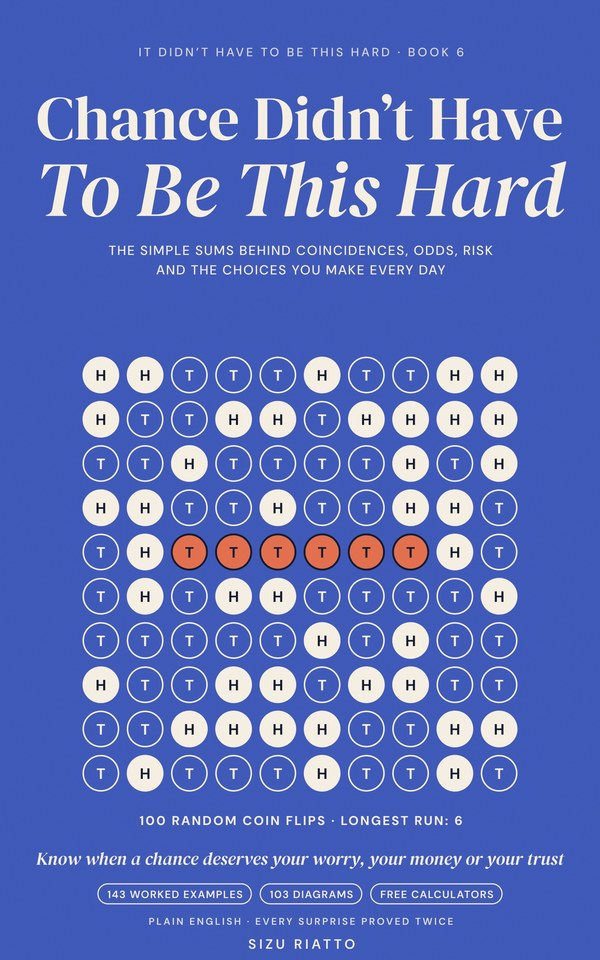
- Spotting made-up coin flips by the longest run
- After five heads in a row: the gambler's fallacy
- Raindrops on paving slabs: how random scatter clumps
- A salesperson's day with no sales
- A five-game winning streak for an ordinary team
- A cluster of bad luck on one street
- A lottery number that is "due"
Calculators: Three Doors Game
Worked examples 51–57
- The three-doors game show: stay or switch?
- Listing every case of the three-doors game
- The three-doors game with a hundred doors
- A game-show host who opens a door at random
- Four doors with one opened
- Three two-sided cards in a hat
- Playing the three-cups game thirty times
Calculators: Base Rate Calculator
Worked examples 58–65
- A crack scanner's red light: how often it is right
- Why false alarms outnumber true ones for rare faults
- A second, independent check after an alarm
- A spam filter, where the thing it looks for is common
- A positive result on a test for a rare (invented) condition
- What an all-clear from a good test means
- Doorbell camera alerts: how many are people
- Making an alarm less jumpy: fewer false alarms, more misses
Calculators: Survivor Simulator
Worked examples 66–72
- Fund managers with ten-year winning records, by luck alone
- The newsletter that is never wrong
- What surviving cafés have in common, and why it can mislead
- Average class size against the average student's class
- Why your friends seem to have more friends
- Who writes online reviews
- Two couriers' on-time rates: Simpson's paradox
Calculators: Regression to the Mean
Worked examples 73–79
- After rolling a six: why the next roll is lower
- The worst shift improves with no help
- A coach's praise and criticism, and what follows them
- Last season's top ten and the second-season slump
- Predicting a retake score from a first score
- A road intersection with a terrible year
- A fair test of whether an intervention works
Part Three · Weighing Choices
Calculators: Expected Value
Worked examples 80–86
- What a school prize drawing ticket is worth, and where the money goes
- A coin game in your favor that can still leave you behind
- A fair mystery box where most buyers get less than they paid
- Refundable or non-refundable ticket: the break-even chance of canceling
- Expected pay from a delivery job with tips
- Holding a fair outdoors or indoors: a decision tree with the weather
- A sure $5,000 or a coin flip for $12,000
Calculators: Lottery Odds
Worked examples 87–94
- Counting the chance of a six-from-49 lottery jackpot
- How long a weekly ticket waits for a jackpot, on average
- The chances of matching three, four or five lottery numbers
- What a $2 lottery ticket is worth: buying every ticket once
- Forty years of one lottery ticket a week
- Popular lottery numbers: the same chance, a smaller share
- "1 in 4 wins": what a scratchcard really pays back
- Why someone usually wins the jackpot, but you won't
Calculators: Warranty and Insurance Check
Worked examples 95–101
- How an insurer pools a thousand homes, and how often it loses
- Why buying home insurance can be sensible though it loses on average
- A washing-machine warranty: dollars paid per dollar of expected repairs
- Phone insurance: monthly cost, deductible and expected benefit
- Choosing a car insurance deductible by its break-even claim chance
- A repair fund instead of warranties: the chance it runs out
- Laptop damage cover and the three-question test
Calculators: Risk Headline Decoder · Risk Over Time
Worked examples 102–109
- "Doubles the risk": relative and absolute risk of car theft
- "Halves the risk": the number of trips needed for one to benefit
- "Up 20%": per cent and percentage points
- A 1% yearly risk over 40 years
- A per-trip risk turned into a yearly and a lifetime risk
- Comparing two airlines' cancellation rates on one scale
- Switching couriers after a scary story: swapping one risk for a bigger one
- "Thousands affected" and "1 in 10,000": the same fact
Calculators: Ruin and Swings
Worked examples 110–116
- A steady wage or commission: same average, different spread
- Up 50% then down 50%: why swings cost money
- A fair game with $20: the chance of reaching $100 before going broke
- The same game with a small house edge
- The doubling betting system and its hidden loss
- A good bet that ruins you if you stake everything
- Why the average of 100 dice barely varies
Part Four · Thinking With Chance
Calculators: Odds Updater
Worked examples 117–123
- Lost keys: what an empty search tells you
- A flagged screen, worked in odds: the evidence ratio
- A second, independent scan of a flagged screen
- An eyewitness and a rare color of van
- A yard-sale painting and a one-in-a-thousand claim
- An interviewer's smile: how much a weak clue counts
- Checking a weather forecaster's track record
Calculators: Waiting Time
Worked examples 124–130
- Waiting for a six: the average, the halfway point and the long waits
- An "overdue" lottery number
- A hundred-year flood over the length of a mortgage
- Quiet hours and busy hours at a help desk
- Why the bus always seems late
- Collecting all six toys from cereal boxes
- Two coin patterns with different average waits
Calculators: Reliability
Worked examples 131–138
- A ten-step production line
- Five suppliers on a wedding day
- Shared bad days: a storm that delays every supplier
- A backup pump
- Two backup pumps on one plug: a common cause
- Three sensors and a two-out-of-three vote
- Machines side by side, then in a row
- How many backups a target needs
Worked examples 139–143
- "One in four homes will claim": over what period?
- A "lucky" shop that sold three jackpot winners
- A fund with eight winning years in a row
- A "95% accurate" leak detector
- A intersection camera that "halved" crashes