 Sizu
The Weigh-In
Tare the scale, size the spawn from a rate, the ratio and the percent two ways, and spawn's price a kg.
Grow gourmet oyster mushrooms in a plastic tote, call every harvest before it comes, and find out what it is worth. Mushroom Growing Math starts at grams and percentages and climbs, one chapter at a time, through moisture, heat, humidity and dew point, biological efficiency and geometric series to cost per kilogram and payback, all on one tub you can eat from.
Hardcover first, and a paperback with the same pages, 8.25 × 11 in, one book page for both. Grow it. Weigh it. Call it.
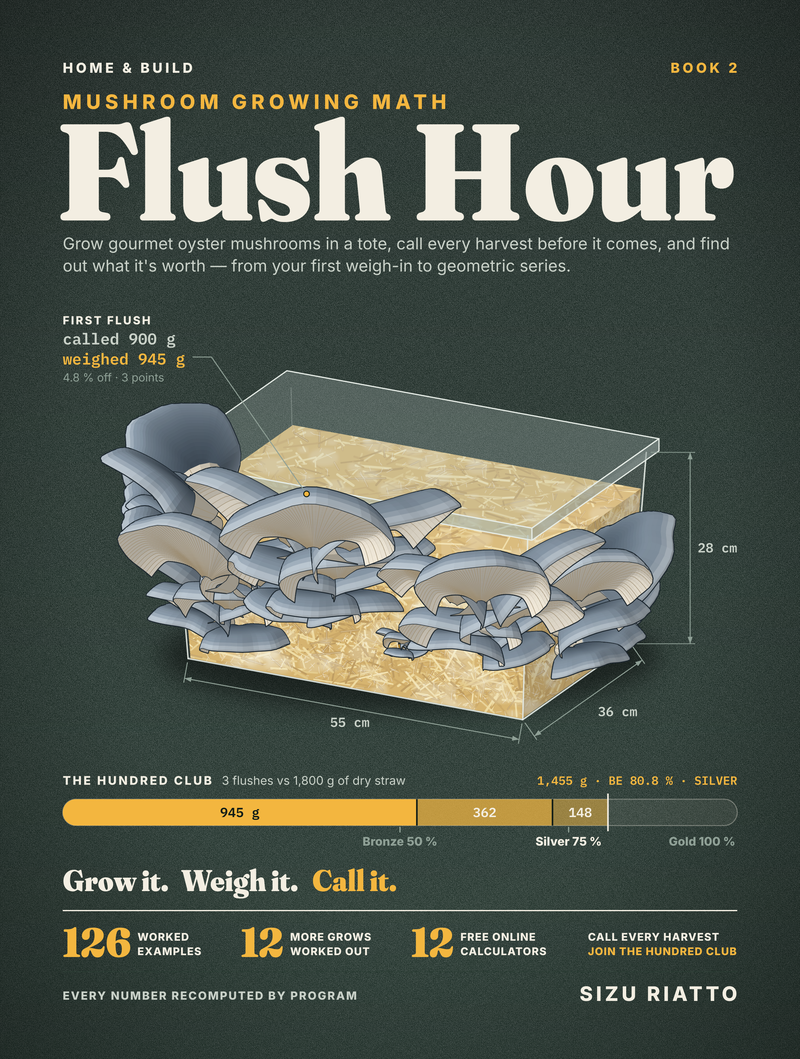
One 55.44 L clear tote of grey oyster mushrooms on pasteurized wheat straw, from a named grain spawn you buy. Every chapter hands it one number, and the Build grows it in order.
These are worked examples on paper from published figures, with a column for your own numbers, not promises: no yield or profit is promised.
Not for: foraging or identifying wild mushrooms, in any form; psilocybin species (illegal, and excluded); sterile lab work (pressure-cooker sawdust blocks are mentioned, not taught); medical or nutrition claims.
Call It: every chapter ends with a number to write down before you measure it, then Check It: within 5% scores 3 points, 10% 2, 20% 1. Spot the Slip: every chapter hides one planted mistake in a grow log, a label or a sum, worth 1 point. Forty points make a season and a Grower rank: Spore, Spawn, Pin or Flush. The Build is scored by the mushrooms: total biological efficiency over the tub's flushes, Bronze from 50%, Silver from 75% and Gold from 100%, the Hundred Club; and by you, with Call the Flush, the first flush's grams called before the harvest. A Quest Map tracks the levels, and a Trophy page holds the medal and the grams.
The book's tub, its straw and its harvests were worked out on paper from published figures, not grown by us: published trials are quoted as one trial each, with their conditions, and your tub is its own trial. No yield or profit is promised. Prices are illustrative, as seen in November 2026, with US and UK figures, and change: the book gives a column for your own. It is not food-safety, medical or legal advice.
The book was written in collaboration with AI tools and reviewed by the author. Its numbers are checked by a verification program, and its figures are drawn by the same program, but mistakes may remain: see corrections & errata.
Each calculator opens on the book's tub and shows its formula, so you can check it by hand.
Tare the scale, size the spawn from a rate, the ratio and the percent two ways, and spawn's price a kg.
An oven test to moisture, dry matter, the wet weight at 70%, the water taken up, and the dry basis.
The recipe card per kg of dry straw, scaled to any batch; spawn on either basis; bags to buy.
A tote's or bucket's liters, the straw's fill depth from its density, percent full, and hole area.
Water for the straw, batches, heat Q = m c ΔT in kWh, minutes to heat, and the meter's efficiency.
The meet-in-the-middle distance, the model's days against your tub's, and the harvest calendar.
Dew point, VPD and vapor by the FAO-56 formula; fresh air in liters a minute; holes and CO₂.
Biological efficiency, Call the Flush points, the medal so far and the grams to the next.
Your flushes as a geometric series: the ratio, partial sums, the ceiling, and when to start a new tub.
Cost a tub and a kg, against the shop; the kit's payback; the drying ratio; a stall's break-even.
Call the Flush, the Hundred Club medal, and the season out of 40 with your Grower rank.
A tote, three totes, a 5 gal bucket or a 10 lb straw bag: the whole recipe scaled to it.
The Quest Map, the book's fill-in templates, the grow log, the harvest scoreboard with the season scoreboard, and the cost sheet, on one page.