 Sizu
Home › Books › Mental Math Didn’t Have to Be This Hard
What you’ll get from it
- Change and totals without a phone: add prices dollars first, make change by counting up, and total a basket by rounding every price and fixing once.
- Products in your head: doubling and halving, moving the point, fives and quarters, the times tables rebuilt from a few facts, breaking numbers apart, and near-round prices like $4.99.
- Percents you can build: 10% is a point move, and every tip, discount and sales tax is stacked from 10%, 5% and 1%, exactly, to the cent.
- Money decisions on the spot: the tip and an even split that adds back, a second discount, the better buy by size or by serving, and a receipt checked by pairs.
- Time, travel and trust: clock times and decimal hours, when to leave and the gas, °C and kilometers, and four quick checks that catch a wrong total before you pay it.
What this book is
Head math is a different method from paper math, not a faster version of it. Paper works right to left and writes the carries down; a head works left to right, biggest part first, and changes the problem into an easier one with the same answer. Three moves run through the whole book: break it (split a number into friendly parts), shift it (round to a friendly number, then fix the difference) and check it (a fast test that catches a slip). Each chapter teaches one method with real-life worked examples, the reason it works, and where it goes wrong.
It builds in order. Part One is numbers in your head: adding, friendly pairs, counting up and round-then-fix. Part Two is multiplying without paper: doubling, the decimal point, fives and quarters, and the times tables. Part Three is bigger products and dividing. Part Four is fractions and percents. Part Five is money: tips and splits, discounts and tax, percent change, unit prices, and checking the bill. Part Six is time, travel and trust: clocks, distance and fuel, conversions, and checking your answer. Every method was checked by computer across thousands to millions of cases, and every sum in the book’s working boxes was checked too.
Who it’s for
Anyone who reaches for a phone to work out a tip, a discount or the change and feels a little slow doing it; anyone taught one written method at school who never learned that heads work differently; a teenager with a first job at a register; a parent who wants to show a child quicker ways; and anyone who wants to check a bill, a quote or a receipt on the spot. If you can count and know a few times-table facts, you can read it. It is about being exactly right; the series’ Estimation book is about being roughly right. Practice makes the practiced skill quicker and surer; the book promises nothing more than that. Every person, place, price and rate in it is invented.
Every chapter, its worked examples, and its free tool
The practice tools are free, need no sign-up, and keep what you type in your own browser. Each opens on its chapter’s first worked example and shows the method step by step, with the words you’d say in your head, and Give me one serves a fresh problem with the answer hidden until you ask. The book is complete without them. All of them are on one page.
Part One · Numbers in Your Head
Head math is a different method from paper math: it starts with the biggest part, keeps one running total, and uses three moves, break it, shift it and check it, to turn a hard sum into a simpler one with the same answer.
Tool: Head Math StarterWorked examples 1–6
- Adding two café prices, dollars first and then cents
- The same two-digit sum by the pencil method and the head method
- Adding $9.99 as $10 less a cent
- Checking a register subtotal with a size check and a last-digit check
- Totaling a market bag with one running total
- Counting up to the hour at a bus stop
Every number has a partner that makes the next friendly number; to 1,000 or any power of ten, each digit's partner makes 9 and the last nonzero digit's partner makes 10, which turns subtraction from a round number and making change into digit-by-digit pairs.
Tool: Friendly Pairs FinderWorked examples 7–12
- Spotting pairs that make ten in a list of six numbers
- Finding a number's partner to 100
- All from 9, the last from 10: the partner of 368 to 1,000
- Change from $1 and from $5 by friendly pairs
- Change from $10 and $100 by all from 9
- Totaling a receipt by pairing cents to whole dollars
Add from the biggest place down with one running total, so the number you hold is nearly the answer from the first step and survives an interruption; to say a sum from the left, look one column ahead for a carry (a column making exactly nine passes a carry along).
Tool: Left-to-Right AdderWorked examples 13–18
- Adding three game scores with one running total
- Adding three-digit numbers with one running total
- A market basket added dollars first
- Saying a sum from the left by looking one column ahead
- Adding prices whose cents pass a dollar
- Keeping a running total through an interruption
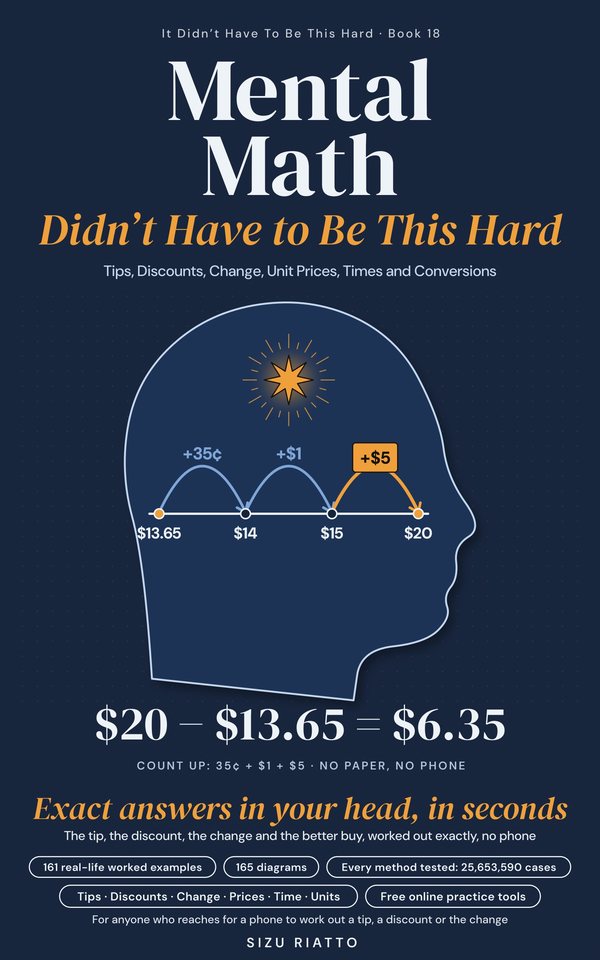
Subtraction is the distance between two numbers, and counting up from the smaller one in hops to friendly numbers finds it without borrowing; counted out of a drawer, the hops are the change.
Tool: Count-Up Change MakerWorked examples 19–24
- Subtracting by counting up in hops
- Counting back change from a $20 bill
- Counting back change from a $50 bill
- Subtracting tens and then ones
- Counting up across 1,000 instead of borrowing
- Counting up from what's spent to a weekly budget
Move an awkward number to a friendly one (round hundreds, whole dollars, whole hours), do the friendly sum, then fix by exactly what you moved: take away what you added too much, give back what you took away too much.
Tool: Round-and-Fix CalculatorWorked examples 25–30
- Adding 99 as 100 less 1
- Subtracting 98, and $7.99 from $20, by taking too much and giving back
- Checking groceries against $40 by rounding each price up
- Rounding prices up and down and keeping one net fix
- An end time as two hours less five minutes
- Rounding only the number that is nearly round
Part Two · Multiplying Without Paper
Double or halve a number one place at a time from the left; times 4 and 8 are two and three doublings, dividing by 4 and 8 are halvings, and doubling one factor while halving the other keeps a product the same while making it friendlier.
Tool: Double and Halve StepsWorked examples 31–36
- Doubling a number and a bus fare, place by place
- Halving a lunch bill, and who pays the odd cent
- Muffins for four classes, seedling trays and a day's pay by doubling
- Sharing 152 bags among eight volunteers by three halvings
- 16 × 25 and 14 × 35 by doubling one factor and halving the other
- The bake sale take, 48 muffins at $1.75, before counting the cash
Multiplying or dividing by 10, 100 or 1,000 slides every digit one, two or three places, which is the same as moving the decimal point; "add a zero" works only for whole numbers, and saying an answer's size first keeps the point in the right place.
Tool: Times Ten Point MoverWorked examples 37–42
- Ten felt pads at $3.40, and an invoice checked by its size
- A hundred cards at 85¢: cents become dollars
- A mileage charge in cents beyond the free miles, and a jar of coins, in dollars
- Twenty lattes and a 40-hour week's pay as a small fact and a point move
- The price of one paper plate from packs of a hundred and of ten
- 10% of a repair fee and 1% of an insured value as point moves
Five, fifty and twenty-five are half of ten, half of a hundred and a quarter of a hundred, so multiplying by them is a point move with a halving or two, times 15 is ten and half again, and dividing by 5 or 25 is doubling or times 4 with a point move.
Tool: Fives and Quarters MultiplierWorked examples 43–48
- Five months of a $68 bus pass, and five coffees, as half of ten
- A field trip at $50 a student, and fifty plant pots at $3.49
- Quarters in a tip jar, and a repair billed in quarter hours
- Twenty-five lattes at $4.75 for a catering order
- Fifteen coffees as ten and half again, and the catering order with tax
- One roll from 5 for $8, and quarters in $8.75, by doubling and a point move
Turn-arounds halve the 144-square times table to 78 facts, the free rows of 1, 2, 5 and 10 and one-line rules for 9, 11, 12, squares and 4 cover all but six, and any fact you're unsure of can be rebuilt in a step from a neighbor, a square or a ten.
Tool: Times Table RebuilderWorked examples 49–54
- How many times-table facts are left once the free rows and rules are counted
- Days in eight weeks: 7 × 8 rebuilt from 7 × 7 and from 8 × 8
- Times 9 as ten copies less one, with both digit checks
- Eleven boxes of pencils by the digit rule, and a dozen seed trays at $12
- Eight weeks of a $6 allowance, and a 6 × 7 seed tray, from the threes
- Thirteen and fourteen times a digit as a ten fact and a small fact
Part Three · Bigger Products and Dividing
Split one number into friendly parts (tens and ones, or dollars and cents), multiply each part, biggest first, and keep one running total; split only one of the two numbers.
Tool: Break-Apart MultiplierWorked examples 55–60
- Seven crates of 48 peaches, split at the tens
- Six muffins at $3.25 and the tax that tips them past a twenty
- An office order of 48 muffins at $3.25
- Two digits by two digits: 23 boxes of 14 books
- Days in four years, three pieces and a running total
- Notebooks at $1.35: choosing the friendlier split
When one number is a step from round ($4.99, 99, 19, 101), multiply by the round number, then fix by the step times the other number: take it off if you rounded up, add it on if you rounded down.
Tool: Near-Round MultiplierWorked examples 61–66
- Six jars of tahini at $4.99 against a "6 for $29.94" sign
- A print run at $99 each: a hundred less one
- Nineteen students at $45: twenty less one
- Just above round: 101 × 64 and 21 sets of pencils
- Mileage at 70¢ for 98 charged miles: fixing by the right number
- Twelve cartons of soy milk at $2.98 for a monthly budget
Squares are areas: a number ending in 5 squares to the tens times one more, then 25; two numbers the same distance from a middle multiply to the middle squared less the distance squared; the next square up adds the number and the next number.
Tool: Squares and NeighborsWorked examples 67–72
- Squaring a number that ends in 5: a 65-inch banner
- Squaring near a round number: a 48-foot square plot
- 47 tickets at $53 by the middle number
- From 40 to 41 feet square: the next square
- Eighteen class places at $22: twenty squared less four
- Adding a dollar more each week by pairing the ends
To divide in your head, split the number you are dividing into pieces that share cleanly, or take away friendly chunks, or halve both numbers first; never split the number you divide by, and give leftover cents one each.
Tool: Head Division StepsWorked examples 73–78
- Sharing an $87 yard-sale cash box among three
- A $100 gift three ways and the leftover cent
- Boxes of 12 for 156 muffins, by chunks
- 360 ÷ 24 by halving both numbers
- The price of one avocado from a bag of six
- Gallons for a 168-mile round trip at 32 miles a gallon
Part Four · Fractions and Percents
A fraction of an amount is the amount divided by the bottom number and multiplied by the top, in whichever order keeps the numbers small and whole; to find the whole from a part, divide by the top and multiply by the bottom.
Tool: Fraction of an AmountWorked examples 79–84
- A quarter of a $60 trip by halving twice
- Three quarters of a $6 allowance, either order, and a year of saving
- Three quarters of a pound of peaches and a pound and a half of apples, rounding only the final cent
- A whole fee from a one-third deposit, and a whole drive from two thirds of it
- Two thirds of a summer, three quarters of an hour and a pool trip in minutes
- One sixth of a $126 food bill, and the five sixths left
Fractions, decimals and percents are three ways to write the same share; know the halves, quarters, fifths, tenths, a third and an eighth as percents, and build the rest by halving or adding; when starting prices differ, compare final prices, not percents.
Tool: Fraction, Decimal and Percent TableWorked examples 85–90
- A third off against 35% off, and why final prices beat percents
- Eighths as percents, and three eighths of a 12-gallon tank
- Sixths and twelfths by halving a third, exactly
- Three for the price of two as a third off
- Quiz scores of 18 and 17 out of 24 as percents
- Cents as decimals, percents and fractions of a dollar, and a 6% tax in cents
Look at the last digit for 2, 5 and 10, the last two for 4, the last three for 8, add up all the digits for 3 and 9, and use both the 2 and 3 tests for 6; for money, test the number of cents.
Tool: Even Split CheckerWorked examples 91–96
- Testing a $147 bill for three-way and six-way splits
- Packs of eight from 96 cells by halving three times
- The last-two-digits test for 4 on 1,316 books
- The digit-sum test for 9 on a $4,527 fundraiser
- A $132.60 bill split six ways in cents
- The leftover from a digit sum, and the nearest bill that splits
Ten percent and one percent are free (move the point one or two places), five percent is half of ten, and every other everyday percent is a short stack of those three, added, doubled or taken away.
Tool: Percent BuilderWorked examples 97–102
- Fifteen percent as ten plus half of ten, checked as half of thirty
- Twenty percent by doubling, twenty-five by quartering
- Eighteen percent off a $45 game as twenty minus two, built up as a check
- Thirty-five percent two ways on a $120 coat
- Fifteen percent of $47.30, carrying the half cent
- What percent a $9 tip on $60 is, by counting pieces
Part Five · Money in Your Head
Every tip starts from 10%, the bill with the point moved one place: double it for 20%, add half for 15%, trim a fifth of it from 20% for 18%; a tip screen's buttons may be figured on the total with tax, and every split must add back to the bill.
Tool: Tip and Split in Your HeadWorked examples 103–108
- A 20% tip as 10% doubled
- A 15% tip and an 18% tip on a lunch for two, both built from 10%
- What a tip screen's 20% button adds when it is figured on the total with tax
- Splitting a dinner bill six ways, to the cent
- Paying your own order plus 26% for tax and tip, and the stray cent
- A 20% tip on a bill that isn't round, and three honest ways to round it
Pay what's left: 30% off is 70% of the price; discounts taken one after another multiply rather than add, so 30% then 20% is 44% off, not 50%; sales tax is lots of 1%, and the order of a percent discount and the tax changes the answer by at most a cent.
Tool: Discount and Tax in Your HeadWorked examples 109–114
- Thirty percent off, as paying seventy percent
- Two stacked discounts, and why they don't make half price
- Buy one, get one half off as a quarter off both
- Sales tax as lots of one percent
- Whether a discount or the tax comes first
- A flat coupon against a percent sale, and the break-even basket
A percent of a number can be flipped (8% of 50 is 50% of 8); a percent change is the change divided by where you started; a rise and a fall by the same percent leave you lower; and a percent already added or taken off is undone by dividing, never by taking the same percent the other way.
Tool: Percent Flip and ChangeWorked examples 115–120
- Turning an awkward percent round: 8% of 50 as 50% of 8
- Checking a rent rise quoted as a percent
- A price up a quarter and down a quarter, ending lower
- The price inside a tax-included total
- The old price behind a sale price
- Percentage points against percent change for an interest rate
A unit price is the price of one ounce, one pound or one serving; when one pack is a friendly multiple of another, scale the small price up instead of dividing, read the unit on every tag, and price only what you'll actually use.
Tool: Better Buy ComparerWorked examples 121–126
- Comparing two jar sizes by scaling, not dividing
- Shelf tags in different units, put in the same unit
- Checking a multi-buy deal with one multiplication
- Comparing jars that aren't friendly multiples, and paper towels by the sheet
- Rolled oats and instant packets compared per bowl
- A bag of potatoes priced per pound actually used
Check a bill in four quick looks: read each line for size, total it by pairing cents into whole dollars, check the tax as lots of 1%, and count change up from the price; for cash, many stores now round the total to the nearest 5 cents by its last digit, while card payments stay exact.
Tool: Receipt CheckerWorked examples 127–132
- Adding a grocery receipt by pairing cents into dollars
- Spotting a receipt line that is the wrong size
- Checking a receipt's sales-tax line
- Counting change up from the price, and adding the price's cents
- Rounding a cash total to the nearest 5 cents by its last digit
- A sale price that didn't ring up, and a double scan caught by counting
Part Six · Time, Travel and Trust
Add clock times by counting to the next hour first, then whole hours, then the minutes left; minutes carry at sixty, a tenth of an hour is six minutes, and a date's weekday is a short count from a doomsday such as 4/4 or 6/6.
Tool: Clock and Duration CalculatorWorked examples 133–138
- Adding a duration to a clock time by counting to the hour first
- The gap between two appointments, with the drive taken out
- Adding durations and carrying at sixty minutes
- Decimal hours on an invoice, and why thirds of an hour need the fraction
- 24-hour time, counting back past midnight, and four time zones
- Days until a date, and its weekday by the Doomsday rule
Turn a speed into minutes per mile or miles per five minutes so driving time becomes a multiplication, price gas in tenths of a cent as the round price less a tenth of a cent a gallon, and find an average speed from total miles over total time, stops included.
Tool: Trip Time and FuelWorked examples 139–144
- A departure time at a mile a minute
- Driving time at 48 mph in five-minute chunks, and distance in a time
- Minutes per mile, and what a faster road really saves
- Gas for a long trip priced in tenths of a cent, and a tank's range
- A per-mile travel charge with free miles, by round then fix
- Average speed with a stop, and the two-speeds trap
Celsius to Fahrenheit is exactly double, take off a tenth, add 32 (and back: take off 32, divide by 9, times 5); kilometers to miles by five eighths and Canadian to US dollars at the example rate by three quarters less 2% are close routes whose error is known.
Tool: Head ConverterWorked examples 145–150
- Celsius to Fahrenheit exactly: double, take off a tenth, add 32
- Fahrenheit to Celsius exactly, and five landmark temperatures
- How far "double it and add 30" is from the exact answer
- Kilometers to miles by five eighths, and how close it is
- A price per liter in Canadian dollars as US dollars a gallon
- A price in Canadian dollars at an example exchange rate
Check every answer from a different direction: the size check catches a slipped decimal point, the last digits catch a wrong ending, odd and even catch an impossible total, casting out nines catches most one-digit slips but not swapped digits, and undoing a sum confirms it.
Tool: Answer CheckerWorked examples 151–156
- The size check on a catering order
- Catching a wrong total from its last two digits
- Casting out nines on a product and a receipt column, and the swaps it misses
- An impossible total caught by odd and even
- Checking a split bill and a handful of change by undoing them
- A tip that would have been bigger than the meal
Every method in the book is break it, shift it or check it, with one running total said out loud; practice one method a week on the numbers you meet anyway, and check with the phone afterward, not before.
Tool: All the Mental Math ToolsWorked examples 157–161
- An ordinary day with tax, cash rounding, a discount and gas
- A market basket totaled in pairs, a bag's real unit price, and the change
- A group dinner: tax, tip and six fair shares to the cent
- A working day's times, three invoices, fuel and an undo check
- A travel day in kilometers, Celsius and liters