 Sizu
Home › Books › Music Theory Didn’t Have to Be This Hard
What you’ll get from it
- Work out songs by ear and know what you just found: which key it’s in, which chords fit under the melody, and why the bass line goes where it goes.
- Find chords that fit, from the seven chords of any key to the progressions under a great deal of pop, blues, folk and jazz, and read a chord chart in letters, Roman numerals or Nashville numbers.
- Move a song to any key for a singer’s range, with a capo or without, and name every chord in the new key correctly.
- Talk with other musicians in their own words: intervals, scales, modes, key signatures, seventh chords, time signatures, swing, all counted on a keyboard or a guitar neck before they get a name.
- Set tempos, delays and grids on purpose in a DAW, from milliseconds per beat to a swing setting, and read the staff well enough to follow a choir part.
What this book is
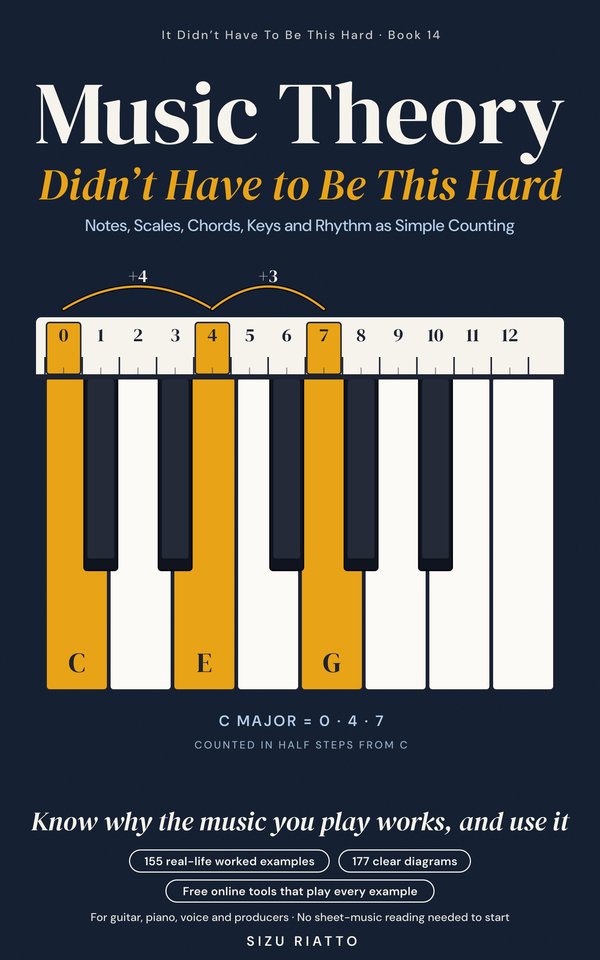
Music theory has a reputation for gatekeeping. This book rebuilds it as counting to twelve. There are twelve notes and then they repeat; every distance between two notes is a number of half steps; a scale is a pattern of steps; a chord is notes stacked by counts; a key is a set of seven of the twelve; rhythm is fractions of a beat. Every idea arrives as a count on a keyboard or a guitar neck before it gets its name, every symbol is read aloud the first time it appears, and the twelve-note clock, C at the top and the other notes round it like hours, ties it all together.
It builds in order. Part One is sound and the twelve notes: frequency, the keyboard, the guitar neck, why twelve, and the staff without fear. Part Two is intervals and scales: major, minor, the modes, pentatonic and blues. Part Three is chords and keys: triads, the chords of a key, seventh chords and chord symbols, key signatures, the circle of fifths, transposing with and without a capo, and progressions that work. Part Four is rhythm and time: tempo, note values, time signatures, swing and the grid. Part Five puts it together: melody and harmony, the physics you can hear in harmonics and tuning, and theory in an ordinary week. Theory here describes what many listeners expect; it doesn’t forbid anything. Every note, scale, chord and key signature in the book’s working boxes was checked by computer.
Who it’s for
Self-taught guitarists, bassists and ukulele players who play from tabs and chord charts and want to know why it works; bedroom producers and beatmakers who write in a piano roll; singers in a choir, a band or a school musical who want to read their part and find harmonies; adults returning to the piano, and parents helping with a child’s lessons. No reading of notation is assumed and no instrument is required, though a keyboard or a guitar helps. Not tied to any exam board, and it doesn’t replace practice or a teacher: it helps you understand what you’re practicing. Every person, band and town in it is invented; the only melodies quoted are old public-domain tunes.
Every chapter, its worked examples, and its free tool
The tools are free, need no sign-up, and keep what you type in your own browser. Each opens on its chapter’s first worked example, shows the working step by step, draws a keyboard, guitar neck, clock, circle or beat grid from your notes, and plays the sound when you press Play. The book is complete without them. All of them are also on the calculators page.
Part One · Sound, Notes and the Number Twelve
Music theory counts what you already hear: there are twelve notes and then they repeat an octave higher, so the notes sit on a clock where one step is a half step; a distance is a count, a tune is a list of counts, a chord is a shape, and moving a song is adding the same number to every note.
Tool: Note CounterWorked examples 1–6
- Naming the notes up a guitar's A string by counting frets
- Counting past twelve on the note clock: up 14 from C, down 3 to A
- Playing "Twinkle, Twinkle" from any starting note by its counts
- Moving a three-chord song two frets higher for a singer
- Why open C and D chords are the same shape on the note clock
- Finding middle C in four places on a guitar
A note's pitch is how many times a second its source vibrates, measured in hertz; A above middle C is 440 Hz by today's standard, going up an octave doubles the number, halving a string doubles its frequency, and loudness is a separate number, the size of the swing, not its speed.
Tool: Note and FrequencyWorked examples 7–12
- The frequency of every A on a keyboard, by doubling 440
- How many times a speaker swings during a 2-second note
- Why fret 12 on a guitar string sounds an octave higher
- Turning up the volume: why a louder note isn't a higher one
- A piano's range in hertz and octaves, from A0 to C8
- How many octaves separate a synth bass note and a whistle
A keyboard is one group of twelve keys repeated: seven white keys named A to G and five black keys, in groups of two and three, named as a sharp of the letter below or a flat of the letter above (one key, two names); E–F and B–C have no black key between them, and octave numbers, which change at every C, say which octave a note is in (middle C is C4).
Tool: Keyboard Note FinderWorked examples 13–18
- Finding and counting every C on an 88-key piano
- A homework question: the black key between F and G
- E-sharp and C-flat: sharps and flats that land on white keys
- How many of a piano's 88 keys are white and how many black
- Octave numbers and MIDI numbers around middle C
- Two half steps below E-flat: why the answer is spelled D-flat
On a guitar one fret is one half step and two frets a whole step; each string is a keyboard starting on its open note (E A D G B E, five half steps apart except four from G to B), so every fret is named by counting from its open string, fret 12 starts every string over an octave up, and most pitches live in several places on the neck.
Tool: Fret FinderWorked examples 19–24
- Naming a fret on the low E string for a bandmate
- The half steps between a guitar's open strings, and the odd one out
- Tuning a guitar by ear from one string, with the fifth-fret method
- One pitch, E4, in five places on a 22-fret guitar
- Why every guitar string starts over at fret 12
- The C major scale on one guitar string: whole and half steps
In equal temperament every half step multiplies the frequency by the twelfth root of 2, about 1.0595, so twelve of them make exactly an octave and every key works alike; small differences are measured in cents (100 per half step), and twelve equal steps put the fifth within two cents of the pure 3:2.
Tool: Twelve-Step CalculatorWorked examples 25–30
- The frequency one half step above A 440
- Working out middle C's frequency from A 440
- Why twelve equal half steps land exactly on the octave
- How close an equal-tempered fifth is to the pure 3:2, in cents
- Where the frets go on a 25.5-inch guitar neck
- Tuning a piano to A = 442 for an orchestra: the shift in cents
A staff is a ladder of letters, each line or space one letter higher than the last; the treble clef names its second line G4 and the bass clef names its fourth line F3, ledger lines extend the ladder (middle C sits on one between the two staffs), sharps and flats in front of a note last to the end of the bar, and tab shows where to play while the staff shows what sounds.
Tool: Staff Note NamerWorked examples 31–36
- Naming the lines and spaces of the treble staff from the G clef
- Reading the bass staff from the F clef's landmark
- Why middle C sits on a ledger line between the two staffs
- Naming a choir alto's first notes by counting down from G4
- A sharp in the middle of a bar, and how long it lasts
- The same three notes as staff for a singer and tab for a guitarist
Part Two · Intervals and Scales
An interval is the distance between two notes, counted twice: the number of half steps gives its size, and the number of letters from one note to the other (counting both ends, starting from one) gives its name; the quality word (perfect, major, minor, augmented, diminished) says which size of that number it is, so a "third" can be three or four half steps.
Tool: Interval FinderWorked examples 37–42
- A choir's "third below": counting letters and half steps from C up to E
- Why the same "third below" was four half steps once and three the next
- The perfect fifth in "Twinkle, Twinkle", and the one white-key fifth that isn't
- D-sharp or E-flat: why one key gives two different interval names
- Singing "in unison" in a mixed choir: unisons and octaves
- Seven public-domain tune openings to remember the intervals by
Stacking intervals adds their half steps and adds their numbers minus one (the shared middle note is counted twice), so a third on a third is a fifth; flipping an interval (its inversion) leaves a pair whose half steps add to twelve and numbers to nine, swapping major and minor and keeping perfect perfect; intervals past the octave are an octave plus a smaller interval; and the smoothest intervals are the ones whose frequencies make small whole-number ratios.
Tool: Interval CalculatorWorked examples 43–48
- Stacking two thirds in an open C chord to make a fifth
- A power chord flipped upside down: a fifth becomes a fourth
- Moving a harmony from a third below the tune to a sixth above
- The added ninth in a guitar's Cadd9 chord
- Two synth tones in 3:2 and 5:4 ratios against the keyboard's notes
- The tritone: the interval that stays the same size when flipped
A major scale is the step pattern W W H W W W H (whole, whole, half, whole, whole, whole, half; twelve half steps in all) counted up from any note and spelled with each of the seven letters once, which is exactly what decides its sharps or flats; its notes are numbered as scale degrees 1 to 7 (or sung do re mi fa sol la ti), and it is two matching W W H halves joined by a whole step.
Tool: Scale BuilderWorked examples 49–54
- Why the C major scale is all white keys
- Building D major step by step, and where its two sharps come from
- F major: why its fourth note is B-flat, not A-sharp
- Why the white keys from D to D don't sound like a major scale
- Finding "sol" and "ti" in G major for a school song
- The major scale's two matching halves, and how G major grows from C major
The natural minor scale (W H W W H W W) is a major scale's notes read from degree 6, so every major key has a relative minor three half steps below it with the same notes, while the parallel minor keeps the tonic and lowers degrees 3, 6 and 7; harmonic minor raises the seventh to make a half step into the tonic (and a step of three below it), and melodic minor raises the sixth and seventh on the way up.
Tool: Minor Scale BuilderWorked examples 55–60
- A natural minor: the same keys as C major, a different home
- Finding the relative minor of G major and of E-flat major
- Playing "Twinkle, Twinkle" in C minor: the three lowered notes
- Why a choir part in A minor keeps writing G-sharp
- A minor-key line with sharps going up and none coming down
- Raising one note at the end of a piano-roll track in A minor for a stronger landing
A mode is a major scale's seven notes with a different one treated as home, so its step pattern is a rotation of W W H W W W H; each mode is major or minor with one note moved (Lydian raised 4, Mixolydian lowered 7, Dorian raised 6, Phrygian lowered 2; Locrian lowers 2 and 5), any mode can be built on any root from its parent major scale, and the seven ordered from Lydian to Locrian each lower one more note.
Tool: Mode BuilderWorked examples 61–66
- D Dorian: the white keys over a held D
- Turning an A minor beat into A Dorian by raising one note
- Why riffs in G often use F, not F-sharp: G Mixolydian
- Finding E Dorian's notes at a jam from its parent major scale
- F Lydian for a bright synth pad: major with a raised fourth
- All seven modes on C, from brightest to darkest, one note at a time
The pentatonic scales keep five notes and leave out the two that make half steps (major pentatonic 1 2 3 5 6, minor pentatonic 1 ♭3 4 5 ♭7), so nothing inside the scale rubs; a major pentatonic and the minor pentatonic three half steps below share all five notes, the black keys are one, the guitar's box at fret 5 is A minor pentatonic and slides to any key, and the blues scale adds one tense note, the ♭5.
Tool: Pentatonic and Blues FinderWorked examples 67–72
- Why any tune on the black keys sounds settled: F-sharp major pentatonic
- Five safe notes for a vocal run in C major
- A minor pentatonic and C major pentatonic: one set of five notes
- Naming every note in the guitar's pentatonic box at fret 5
- Adding the blue note to a pentatonic solo in A
- Moving the pentatonic box to fret 7 for a song in B minor
Part Three · Chords and Keys
A triad is three notes stacked in thirds, a root, a third and a fifth, found by skipping a letter each time; the two thirds are each four or three half steps, and the four ways to stack them (4 + 3, 3 + 4, 3 + 3, 4 + 4) make major, minor, diminished and augmented chords, whatever the order or doubling of the notes.
Tool: Chord BuilderWorked examples 73–78
- Building C major and D major on a keyboard by counting four, then three
- Am against A: the one fret on the B string that turns minor into major
- Naming the six notes of the open G guitar shape (three letters, doubled)
- Diminished and augmented triads: Bdim and C+ on a café chart
- The E5 power chord: root and fifth, no third, and sliding it to G5
- Inversions and slash chords: C/E, C/G and the walking bass under G/B
Stacking a triad on each note of a key's scale, using only the key's notes, gives the key's seven diatonic chords; in every major key they fall into the same pattern, I ii iii IV V vi vii° (major, minor, minor, major, major, minor, diminished), so Roman numerals and Nashville numbers describe a song's chords in any key, and a minor key's chords are its relative major's, counted from the sixth note.
Tool: Chords in Any KeyWorked examples 79–84
- The seven triads of C major, one hand shape slid along the white keys
- The seven triads of G major and where its F♯ turns up
- Why the chord on D is minor in C major (and why B° is diminished)
- Choosing a fourth chord for an A minor loop: i–VI–III–VII
- Piano homework: I IV V I in F becomes F, B♭, C, F
- A Nashville number chart (1 4 5 6m) read in D, then in G
A seventh chord is a triad with one more third stacked on top; the five common kinds (maj7, 7, m7, m7♭5, dim7) are different mixes of major and minor thirds, and every chord symbol reads left to right as counting instructions: the letter is the root and a major triad, m lowers the third, 7 adds the minor seventh, maj7 the major seventh, and sus, add, 6, 9 and a slash each change or add one note.
Tool: Chord Symbol DecoderWorked examples 85–90
- Cmaj7 against C7: one half step on the top note
- G7 and its tritone: why a dominant seventh leans toward C
- The seven seventh chords of C major, and F♯ø7 in G major
- Dsus4 and Dsus2 on one guitar string: no third, a hanging sound
- Cadd9 against C9: whether the chord holds the seventh
- Bdim7: four equal gaps, and why only three dim7 chords exist
A key signature writes a key's sharps or flats once at the start of every line, always in the order F C G D A E B (sharps) or B E A D G C F (flats); the last sharp plus a half step, or the next-to-last flat (down a fourth from the last flat), names the major key, and its relative minor, three half steps lower, shares the signature, so the first and last chords and any raised seventh decide between them.
Tool: Key Signature FinderWorked examples 91–96
- Building A major's key signature from its scale: F♯ C♯ G♯
- Reading a sharp key: four sharps, last sharp D♯, so E major
- Reading a flat key: three flats, next-to-last E♭, so E♭ major
- F major's one flat, and the rule that still finds it
- One signature, two keys: A major or F♯ minor, F major or D minor
- Deciding whether a three-sharp piano piece is in A major or F♯ minor
Going up a perfect fifth twelve times visits every note once and comes home, because seven and twelve share no factor and twelve fifths equal seven octaves; set around a circle, the twelve major keys gain one sharp per step clockwise and one flat per step counterclockwise, neighbors share six notes, and any key's I, IV and V sit side by side with ii, iii and vi inside them.
Tool: Circle of FifthsWorked examples 97–102
- Counting sharps clockwise around the circle, from C to C♯
- Counting flats counterclockwise around the circle, from C to C♭
- Twelve fifths from C1 to C8: why the circle closes, and the pure-fifth gap
- G major and D major share six notes: a lick that moves between keys
- Reading the six main chords of D major off one wedge of the circle
- A song "in E, the usual chords": E, A, B and C♯m from the circle
Transposing a song means adding the same number of half steps to every note and every chord root, then spelling the result in the new key; chord types and Roman numerals don't change, so the tune and its harmony come through intact. A capo does the same on a guitar: the shape you finger plus the capo's fret number gives the chord everyone hears.
Tool: Transposer and Capo FinderWorked examples 103–108
- Moving a song in A (A D E F♯m) down two half steps to G for a singer
- Checking a melody's range against a singer's range to pick the one key that fits
- Capo arithmetic: a G shape with capo 2 sounds A; an E shape with capo 3 sounds G
- Choosing a capo and open shapes for a song in B♭
- A transposition table for I IV V vi from E down to C, and capo 4 the other way
- Pitch-shifting a vocal sample up three half steps, and what speeding it up does to the tempo
A progression is a list of chords in an order, written as Roman numerals so it works in any key; a handful (I–IV–V, I–V–vi–IV, the twelve-bar blues, ii–V–I) carry much of popular music because chords that share notes sound related, roots that fall a fifth sound like moving home, and V's leading tone and seventh resolve by half steps into I.
Tool: Progression BuilderWorked examples 109–114
- Why I–IV–V in G covers every note of the G major scale
- I–V–vi–IV in C and in D, and the same loop heard in A minor
- The twelve-bar blues in A, counted bar by bar
- A jazz ii–V–I in B♭ (Cm7 F7 B♭maj7), and moved to D
- Why G7 resolves to C: two half steps and a closing tritone
- Voice leading from C to F for a choir or keyboard: 3 half steps of movement instead of 15
Part Four · Rhythm and Time
The beat is the steady pulse you tap your foot to, and tempo is how many beats come in a minute (BPM); since a minute is 60,000 milliseconds, one beat lasts 60,000 ÷ BPM ms, and delay times, song lengths, tap tempos and tempo changes all follow from that one division.
Tool: BPM and Delay CalculatorWorked examples 115–120
- Milliseconds per beat at 120 and 92 BPM, and why a 350 ms delay drifts
- Delay times at 92 BPM: quarter, eighth, dotted eighth and triplet
- A 64-bar song at 92 BPM in minutes and seconds
- Tap tempo: 8 taps in 3.5 seconds, counted as gaps
- Finding the tempo of a walk and the song tempos that match it
- Speeding a song up from 92 to 100 BPM: how much faster and how much shorter
A note's value is how many beats it lasts, and the values halve down a family (whole 4, half 2, quarter 1, eighth 1/2, sixteenth 1/4 when the quarter note gets the beat); a dot adds half the value again, a tie adds two values into one sound, a triplet splits a beat into thirds, and the values in a bar add up to the beats in the bar.
Tool: Note Value AdderWorked examples 121–126
- The halving tree of note values on a DAW's sixteenth-note grid
- What a dot does: dotted half, dotted quarter and dotted eighth notes
- How many eighth notes fit in a dotted half note (a child's worksheet)
- Checking that a bar of 4/4 adds up, and finding a missing beat
- Eighth-note triplets as thirds of a beat, in milliseconds at 92 BPM
- A half note tied to an eighth note in a choir part, and what's left in the bar
A time signature's top number says how many counts fill a bar and its bottom number says which note value gets one count (4 a quarter, 8 an eighth); bars in simple time split each beat in two, bars in compound time (6/8, 12/8) split each beat in three, odd meters (5/4, 7/8) mix groups of two and three, and a pickup is a few notes before the first full bar, and the last bar is shortened by the same amount.
Tool: Bar and Song Length CounterWorked examples 127–132
- Counting a bar of 4/4 out loud as 1 e & a: sixteen sixteenth notes
- Why 3/4 and 6/8 hold the same six eighth notes but feel different (a choir piece felt in two)
- A slow blues in 12/8: four beats of three eighth notes, and how long a bar lasts
- Counting a 5/4 bar as three plus two, and 7/8 as two plus two plus three
- A piece in 3/4 that starts on beat 3: the pickup and the short last bar
- The running time of a 32-bar waltz at 120 BPM for a concert program
A DAW's grid is a beat cut into equal slots (60,000 ÷ BPM ÷ slots per beat milliseconds); swing keeps the beats where they are and slides the second note of each pair later (its share of the pair is the swing setting in many DAWs, 50% straight, about 66.7% for a 2:1 triplet feel), syncopation moves the accents between the beats, and a polyrhythm is two even layers on a grid the size of their lowest common multiple.
Tool: Swing and Groove GridWorked examples 133–138
- The length of one sixteenth-note slot at 92 BPM, and how far quantizing moves a late snare
- Straight and swung eighth notes at 120 BPM in milliseconds
- What a DAW's swing percentage moves: hi-hats at 92 BPM at 50%, 60% and a triplet feel
- A common strumming pattern on the eighth-note grid, and where its syncopated accents fall
- Triplets in one hand against eighth notes in the other: a grid of six slots
- A shaker playing four even hits across a 3/4 bar: a grid of twelve slots
Part Five · Putting It All Together
Melody and chords share notes: choose a chord for a tune by listing the chords of the key that hold the note on each strong beat, find a song's key from the seven notes (or the chords) it uses and decide major or relative minor by where it rests, and fit a scale or a walking bass to a chord by its chord tones, with passing tones stepping between them.
Tool: Key FinderWorked examples 139–144
- Which chords of C major can sit under a held E, and the part E plays in each
- Choosing chords for the opening of "Twinkle, Twinkle" in D from the notes on the strong beats
- Finding the key of a melody from the seven notes it uses (G major or E minor?)
- Finding the key from a chord chart of G, C, D and Em
- Why the A minor pentatonic box fits an Am7 chord
- A walking bass line from C to F in a waltz: chord tones and a passing tone
A string sounds its fundamental and its harmonics (2, 3, 4… times the frequency) at once, which you can pick out as natural harmonics at frets 12, 7 and 5; two nearly equal tones beat as many times a second as their frequencies differ, so tuning means slowing the beats to zero; intervals with simple ratios share harmonics, equal temperament leaves its fifths about 2 cents narrow and its major thirds about 14 cents wide, and the Pythagorean comma (about 23.46 cents) is why no tuning can make every interval pure.
Tool: Harmonics and Beat RateWorked examples 145–150
- The first six harmonics of a guitar's A string, as frequencies and as notes
- Natural harmonics at frets 12, 7 and 5, and how close the frets sit to a half, a third and a quarter
- Tuning a guitar string to a tuning fork by counting the beats
- Why an A power chord wobbles slowly: the shared harmonic of an equal-tempered fifth
- How much wider the keyboard's major third is than the pure 5:4, in cents and in beats
- Why twelve pure fifths don't close the circle: the Pythagorean comma
Every idea in the book is a count on twelve equal steps or a fraction of a beat, and an ordinary week uses all of them: following a bass line to learn a song by ear, moving a blues box to a called key, singing a third below a melody, setting a loop length and delay in a DAW, and reading a piece's key signature, time signature and first chord in thirty seconds.
Tool: All the Music ToolsWorked examples 151–155
- Learning a song by ear from its bass line: A G F E in A minor
- A blues in E called at a jam: the chords, the twelve bars and the moved pentatonic box
- Singing a harmony a third below a melody in D major
- A producer's loop at 92 BPM in A minor: loop length, delay time and chords
- Reading a child's piano piece before playing: key signature, time signature and first chord