 Sizu
Melt-and-Pour Planner
Base to melt from the cavities' water fill, with a spill allowance, the scent in grams and ounces, and the blocks to buy.
Lye, scent, wicks, cost and profit, worked out step by step: palm-free soap and plant-wax candles for gifts, markets and a small home business. Every gram and every cost worked out before you sell a bar.
Home › Books › Vegan Soap & Candle Math
A project-based workbook for makers. Each chapter adds one number to a real market batch: how much oil the mold holds, how much lye those oils need, how much water, how the blend will behave, how much scent the rules allow, what a cured bar weighs, how much wax a jar takes, how much fragrance, how long the candle burns, and what it all costs and must sell for. The last chapter puts all twelve together into a make-day plan, a shopping list and a ledger.
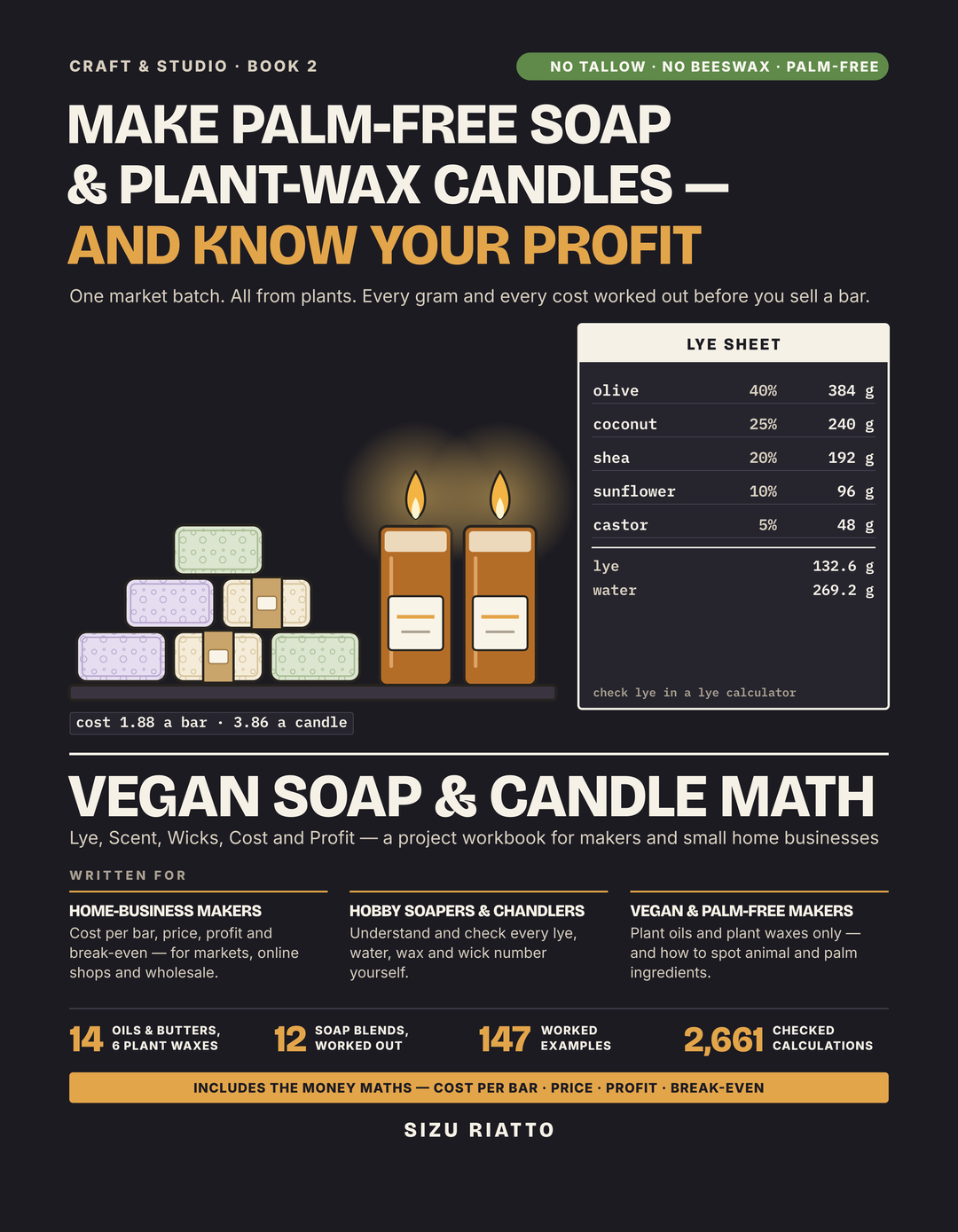
What you build: the Market Batch. 12 melt-and-pour guest soaps to start; one palm-free cold-process loaf of 960 g of oils, 132.6 g of lye at a 5 % superfat, cut into 10 bars labeled 120 g (4.2 oz); and 12 soy candles in 70 mm jars, 245.8 g each, burning about 30 hours. Then the money: 1.88 a bar and 3.86 a candle in materials, and break-even at 4 batches a year at the book's example prices.
Who it is for: home-business makers who want cost per bar, price, profit and break-even for markets, online shops and wholesale; hobby soapers and chandlers who want to understand and check every lye, water, wax and wick number themselves; and vegan and palm-free makers, with plant oils and plant waxes only and how to spot animal and palm ingredients. Who it is not for: liquid-soap formulators, cosmetic chemists, and anyone looking for a safety assessment: the book does the arithmetic and points to the rules. Metric first, imperial beside it; every price illustrative and dated.
The book was written in collaboration with AI tools and reviewed by the author. Its numbers are checked by a verification program, and its figures are drawn by the same program, but mistakes may remain: see corrections & errata. Whatever this book or this site says, check every lye number in a lye calculator before you weigh.
Base to melt from the cavities' water fill, with a spill allowance, the scent in grams and ounces, and the blocks to buy.
A mold's inside size to oils by the 0.70 rule, and a recipe in percents to grams, rounded to your scale.
NaOH oil by oil from the SAP values you type, your superfat and your lye's purity, and the true superfat.
Water from a concentration, a ratio or a % of oils, the other two beside it, and the heat the lye gives off.
Hardness, cleansing, conditioning, iodine, INS and linoleic + linolenic, each against its range, oil by oil.
Scent in grams, as % of oils and of the batch, the certificate's cap, and the allergens over 0.01 %.
Slice and fresh bar weight, your weigh-ins drawn as a cure curve, and a label rounded down twice.
A jar to its fill line, the hot-wax weight, the top-up, both 0.86 rules, and the wax for a run.
Wax and fragrance from a load or a content, °C and °F, and the CLP sensitizer check.
A starting wick row, the test-burn log, the burn rate, the wax left at 13 mm and the label's hours.
Pack prices to price per gram, then a bar or a candle with its pieces and your time, as a cost stack.
Markup and margin both ways, contribution, and the break-even count in units, batches and money, charted.
The four fill-in sheets from the back of the book. Print a clean one for each batch and keep the book away from the lye.
What one batch needs, the pack to buy, its price and how many batches it covers.
The test burn, two make days, the six-week cure log and the market day.
Recipe, lye, water, scent, cut and cure, and the candle run with its wick and burn time.
Cost per unit, price, markup and margin, fixed costs and the break-even count.