 Sizu
Rates and the Bill
Two meter reads to kWh a day; UK gas m³ to kWh, US therms and CCF; the bill rebuilt line by line.
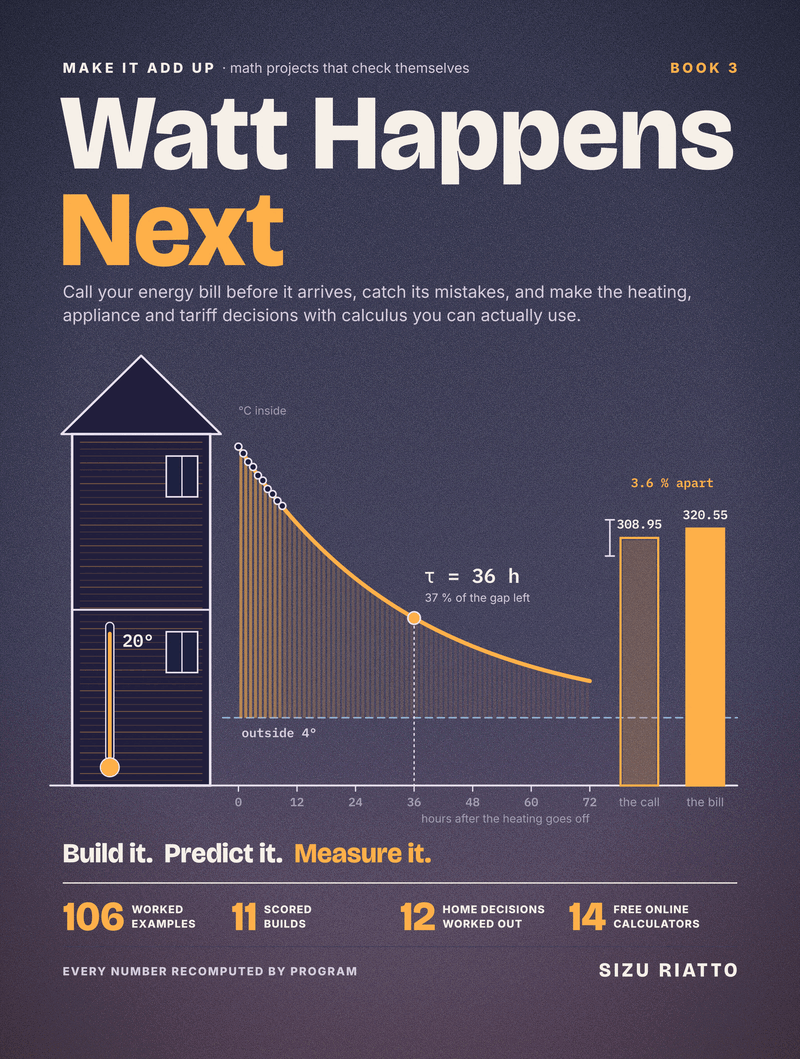
Call your energy bill before it arrives, catch its mistakes, and make the heating, appliance and tariff decisions with calculus you can actually use. Read your own meters, log one cold night, and build a model of your house that predicts the next bill with an honest band: rates, slopes, areas under curves, exponential cooling, the best thickness of insulation and a house stepped forward hour by hour.
Hardcover and paperback, 8.25 × 11 in, one book page for both.
Home › Books › Watt Happens Next
One house, its two meters and one month of bills, worked into a model that calls the next bill before it arrives. Every chapter hands it one number.
These are worked examples at an illustrative tariff from November 2026, with a column for your own numbers, not promises.
Not for: exam-syllabus coverage or proofs, or anyone who wants the answers without the arithmetic. It is never a substitute for a gas engineer, an electrician, an installer or the regulator where the book says so.
Call It: every chapter ends with a number to write down before you measure it, then Check It: the gap scores 3, 2, 1 or 0 points. Spot the Slip: every chapter hides one planted mistake of the kind real bills and real people make (an estimated read taken as actual, kW written for kWh) for you to find. The Bill Score: when the bill arrives, your call within 5% of it is Gold, within 10% Silver, within 20% with the audit sheet complete Bronze; reproducing every line earns the Audit level. A Quest Map tracks the eleven stations, and a Trophy page holds the season scoreboard.
No saving is promised: your house, your habits, your tariff and the weather decide it, and published savings figures are quoted as their sources', with their conditions. The book's house, its meters and its bill were worked out on paper from published figures, not measured by us: read your own meters and log your own night. Tariffs are illustrative and change. It is not professional advice: never open a meter, a consumer unit (US: panel) or a gas appliance; cold has costs, so never set back the heating where pipes can freeze, where there is damp or mold, or where someone vulnerable lives; use a plug meter rated above the appliance; heat pumps, solar, batteries and EV chargers are licensed or certified installers' work. For a bill dispute, follow the regulator's route and keep paying the part that is not in dispute.
The book was written in collaboration with AI tools and reviewed by the author. Its numbers are checked by a verification program, and its figures are drawn by the same program, but mistakes may remain: see corrections & errata.
Each calculator opens on the book's house and shows its formula, so you can check it by hand.
Two meter reads to kWh a day; UK gas m³ to kWh, US therms and CCF; the bill rebuilt line by line.
A month of gas against outdoor temperature: the best-fit line, your heat loss in W per °C, tomorrow's gas.
Count the meter's light for watts now; add up a plug-meter audit; find the base load and the mystery load.
Forward and central differences from any table; the cooling rate against the gap to outside.
kWh from half-hourly or spot power readings by rectangles and trapezoids; degree-hours of a night.
Degree-days from daily temperatures, and next month's gas from your heating line.
An overnight log to the time constant τ two ways, the half-life and the house's heat store.
Degree-hours saved by letting the house coast overnight, in kWh of gas a night and a month.
The insulation thickness with the lowest total cost, and a top-up's heat saved and payback.
A day of house temperature stepped with Euler's method; reheat time; heat pump against gas.
Your next bill from your own model and the month's normal weather, with an honest band.
Rebuild every line, flag an estimated read, and work out the bill on your own reads.
Your call against the bill: Gold, Silver or Bronze, the Audit level, and the season scoreboard.
Any energy decision in your own numbers: cost, kWh saved, price, money a year and payback.
The Quest Map, the meter reading log, the plug-meter audit, the overnight cooling log, the bill audit sheet, the decision ledger, the Call It log and the Trophy page with the season scoreboard, on one page.