 Sizu
Home › Grow by Numbers › Printables
- The Quest Map
- Template A — The Sowing Calendar (the first 30 days)
- Template B — The Harvest Log
- Template C — The Call It Log
- Template D — The Label Sheet
- Template E — The Cost and Price Sheet
- The Trophy Page
The Quest Map
Grow by Numbers · sizuriatto.com/go/greens-printables
Eleven stations, one for each chapter from 1 to 10 and one for the Build. Each station hands one number to the shelf. When you have done a chapter's Build Step and written its number in your column, tick its box. When all eleven are ticked, the shelf is running, the first eight trays are weighed, and the Trophy page at the back is waiting for your score.
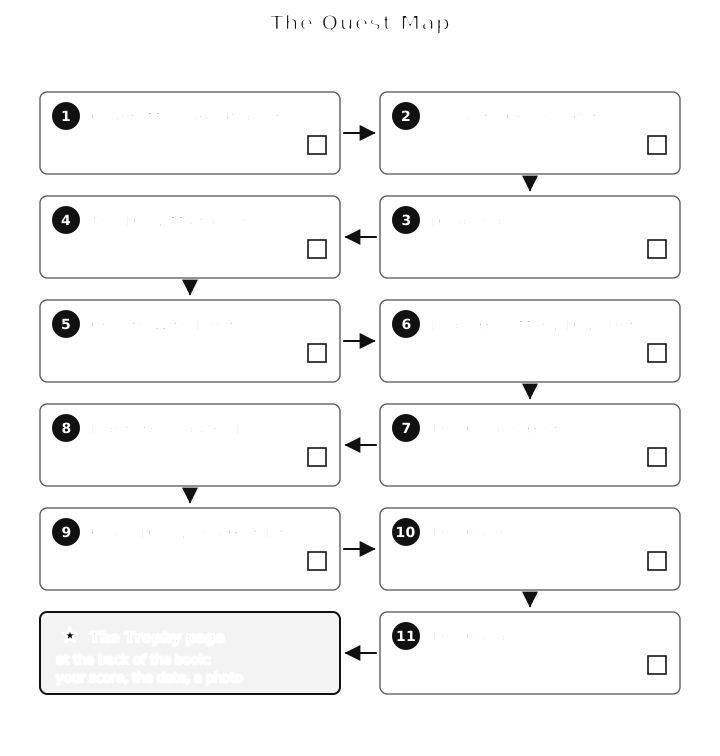
You do not have to take the stations strictly in order, but the numbers do build on each other: the calendar (station 1) decides how much seed you need (station 2), the seed and the harvest give the daily multiplier (station 4), and the multiplier and the ceiling give the S-curve that tells you when to cut (station 5). Chapter 11 uses all ten numbers again, once each, in order, as Steps 1 to 10, and it reprints this map as its checklist.
Template A — The Sowing Calendar (the first 30 days)
Grow by Numbers · sizuriatto.com/go/greens-printables
Two trays every three days, the crops in turn: radish, broccoli, sunflower, pea. The book's plan is printed in the Sow and Cut columns; write your dates in the second column and tick each job as it is done. Sunflower and pea are soaked the evening before they are sown. A tray cut in the morning frees its place for that day's sowing, so the shelf never holds more than eight. "Standing" is the trays on the shelf once the day's cutting and sowing are done.
Day 0 is: Crops in turn:
| Day | Date | Soak tonight | Sow (pair) | Cut (pair) | Standing | Done; notes |
|---|---|---|---|---|---|---|
| 0 | 1: radish | 2 | ||||
| 1 | 2 | |||||
| 2 | 2 | |||||
| 3 | 2: broccoli | 4 | ||||
| 4 | 4 | |||||
| 5 | sunflower | 4 | ||||
| 6 | 3: sunflower | 6 | ||||
| 7 | 6 | |||||
| 8 | pea | 6 | ||||
| 9 | 4: pea | 1: radish | 6 | |||
| 10 | 6 | |||||
| 11 | 6 | |||||
| 12 | 5: radish | 8 | ||||
| 13 | 8 | |||||
| 14 | 8 |
| Day | Date | Soak tonight | Sow (pair) | Cut (pair) | Standing | Done; notes |
|---|---|---|---|---|---|---|
| 15 | 6: broccoli | 2: broccoli | 8 | |||
| 16 | 3: sunflower | 6 | ||||
| 17 | sunflower | 6 | ||||
| 18 | 7: sunflower | 8 | ||||
| 19 | 8 | |||||
| 20 | pea | 4: pea | 6 | |||
| 21 | 8: pea | 5: radish | 6 | |||
| 22 | 6 | |||||
| 23 | 6 | |||||
| 24 | 9: radish | 8 | ||||
| 25 | 8 | |||||
| 26 | 8 | |||||
| 27 | 10: broccoli | 6: broccoli | 8 | |||
| 28 | 7: sunflower | 6 | ||||
| 29 | 6 |
The month in numbers. The book's plan: 10 sowings, 20 trays sown, 7 harvests (14 trays) in the first 30 days, about 4,370 g cut. Pairs 8, 9 and 10 are cut on days 32, 33 and 39. Yours: sowings trays cut grams cut
Template B — The Harvest Log
Grow by Numbers · sizuriatto.com/go/greens-printables
One line a tray. Before you cut, write your called day and your called grams, in pen. Then cut, weigh the greens alone (tare the bowl first) and fill in the rest. Gap = (weighed − called) ÷ weighed, ignoring the sign. Points the Call It way: within 5 % scores 3, within 10 % scores 2, within 20 % scores 1, beyond that 0. The book's planning figures, if you want a starting point for your call: radish day 9, 280 g; broccoli day 12, 300 g; sunflower day 10, 400 g; pea day 11, 225 g.
The first eight trays: the Harvest Score
| Tray | Crop | Sow day | Called day | Cut day | Called g | Weighed g | Gap | Points |
|---|---|---|---|---|---|---|---|---|
| 1 | radish | 0 | ||||||
| 2 | radish | 0 | ||||||
| 3 | broccoli | 3 | ||||||
| 4 | broccoli | 3 | ||||||
| 5 | sunflower | 6 | ||||||
| 6 | sunflower | 6 | ||||||
| 7 | pea | 9 | ||||||
| 8 | pea | 9 | ||||||
| Total |
| Your Harvest Score | Yours | The level |
|---|---|---|
| Total gap: (total weighed − total called) ÷ total weighed | Gold within 10 %; Silver 20 % | |
| The widest miss on a cut day, in days | Gold 1 day; Silver 2 days | |
| Eight trays cut, weighed and logged? | Bronze | |
| Your level |
Trays 9 to 20: the rest of the first 30 days
| Tray | Crop | Sow day | Called day | Cut day | Called g | Weighed g | Gap | Points |
|---|---|---|---|---|---|---|---|---|
| 9 | radish | 12 | ||||||
| 10 | radish | 12 | ||||||
| 11 | broccoli | 15 | ||||||
| 12 | broccoli | 15 | ||||||
| 13 | sunflower | 18 | ||||||
| 14 | sunflower | 18 | ||||||
| 15 | pea | 21 | ||||||
| 16 | pea | 21 | ||||||
| 17 | radish | 24 | ||||||
| 18 | radish | 24 | ||||||
| 19 | broccoli | 27 | ||||||
| 20 | broccoli | 27 |
Your calls should close in as the weeks go by: call the second round from the first round's weights, not from the book's.
Template C — The Call It Log
Grow by Numbers · sizuriatto.com/go/greens-printables
One line a chapter. Write the call before you measure, in pen. Gap = (measured − call) ÷ measured, ignoring the sign. Within 5 % scores 3 points, within 10 % scores 2, within 20 % scores 1; beyond that 0, and find out why, because that is the chapter. Some numbers can only be measured on the running shelf: those lines are checked in Chapter 11.
| Ch. | What you call | Your call | Measured | Gap | Points |
|---|---|---|---|---|---|
| 1 | Your tray's inner floor area, from its label; then measure | ||||
| 2 | Radish seeds in 1 g; then count a weighed gram | ||||
| 3 | The weight of 150 g of pea seed after its 10-hour soak | ||||
| 4 | The radish tray's growth factor between two weighings (checked in Chapter 11) | ||||
| 5 | The first radish tray's harvest grams (checked in Chapter 11) | ||||
| 6 | Your tap water's pH (a test strip or meter) | ||||
| 7 | The spiral counts on a pinecone, pineapple or sunflower head | ||||
| 8 | A phone light meter's reading at 50 cm, from its reading at 25 cm | ||||
| 9 | Your fridge's real temperature | ||||
| 10 | Your break-even tray count (checked in Chapter 11) | ||||
| Your points, out of 30 |
Each chapter's own Call It box says exactly what to call and how to check it; where it and this line differ, follow the chapter.
The miss that taught you the most. Chapter: What you had assumed:
What you found out:
Template D — The Label Sheet
Grow by Numbers · sizuriatto.com/go/greens-printables
Chapter 7's golden label: 50 mm wide and 50 × 1.618 ≈ 80.9 mm tall, so it prints at 50 × 81 mm. The line across it cuts off a 50 mm square and leaves a smaller golden rectangle below, the same shape turned on its side. The proportion is an aesthetic choice, not a rule. Cut along the dashed lines, or copy the layout onto label stock.
microgreens
Use by:
Keep at 5 °C (41 °F) or colder
Allergens: none on the US or UK lists
Name, address:
microgreens
Use by:
Keep at 5 °C (41 °F) or colder
Allergens: none on the US or UK lists
Name, address:
microgreens
Use by:
Keep at 5 °C (41 °F) or colder
Contains sunflower (named as good practice)
Name, address:
microgreens
Use by:
Keep at 5 °C (41 °F) or colder
Contains pea (named as good practice)
Name, address:
microgreens
Use by:
Keep at 5 °C (41 °F) or colder
Allergen: MUSTARD
Name, address:
microgreens
Use by:
Keep at 5 °C (41 °F) or colder
Allergens:
Name, address:
Net wt 2 oz (56 g). The book's pack holds 2 oz of greens, which is 56.7 g; the grams are rounded down, so the label never promises more than the pack holds. Fill each pack a little over and weigh it.
Use by. The date you packed it plus the days your own greens keep in your own fridge. The book plans 7 days at 5 °C (41 °F); Chapter 9 shows why a warmer fridge shortens that fast, and how to test your own.
Allergens. Mustard, including its leaves and sprouted seed, is a legal allergen in the UK and must be named. Sunflower, pea and buckwheat are not on the US or UK lists; naming them is good practice. Wheatgrass is grown from wheat: ask your regulator before you sell it.
What else a label must carry depends on where you sell. A UK label for food you pack yourself, a US state's labeling rule, a mixed pack that counts as processed food: check with your council or state food office before the first sale (Chapter 10, and its Stop Line). Never add a health claim.
Template E — The Cost and Price Sheet
Grow by Numbers · sizuriatto.com/go/greens-printables
Every price here is illustrative: US prices seen in October 2026, without a currency sign. The book's four crops are worked; the last column is for yours, at your prices.
What a tray costs, and what it brings back
| For one tray | Radish | Broccoli | Sunflower | Pea | Your crop |
|---|---|---|---|---|---|
| Seed a tray, g | 28 | 13 | 85 | 150 | |
| Seed price a kg | 23.50 | 30.54 | 11.05 | 8.64 | |
| Seed cost = g ÷ 1,000 × price a kg | 0.66 | 0.40 | 0.94 | 1.30 | |
| Mix, 3 L at about 0.70 a L | 2.11 | 2.11 | 2.11 | 2.11 | |
| Days on the shelf | 9 | 12 | 10 | 11 | |
| Light = 0.32 kWh × days × 0.18 | 0.52 | 0.69 | 0.58 | 0.63 | |
| Cost to grow a tray | 3.29 | 3.20 | 3.63 | 4.04 | |
| Harvest, g (weigh yours) | 280 | 300 | 400 | 225 | |
| 2 oz packs = g ÷ 56.7 | 4.94 | 5.29 | 7.05 | 3.97 | |
| Sold at 5 a pack | 24.69 | 26.46 | 35.27 | 19.84 | |
| Packing at 0.33 a pack | 1.63 | 1.75 | 2.33 | 1.31 | |
| Contribution a tray | 19.77 | 21.51 | 29.32 | 14.49 | |
| Contribution a shelf-day = ÷ days | 2.20 | 1.79 | 2.93 | 1.32 |
The packs are counted as fractions so the four crops compare fairly; you sell whole packs.
The kit and the break-even
| Fixed costs | The book's | Yours |
|---|---|---|
| Shelf; four lights; 16 trays | 85; 80; 96 | |
| Timer; GFCI or RCD adapter; scale; sprayer | 10; 32; 16; 5 | |
| The kit | 324 | |
| Average contribution a tray sold | about 21.27 | |
| Break-even = kit ÷ contribution, rounded up | 16 trays | |
| With a year of insurance (299): 623 ÷ 21.27, rounded up | 30 trays |
A week of surplus
| The week | The book's | Yours |
|---|---|---|
| Grams a week, less the household's | 1,405.8 − 700 = 705.8 g | |
| 2 oz packs, rounded down | 12 | |
| Cost of a pack: greens + clamshell + label | about 1.00 | |
| Price of a pack | 5 | |
| Contribution a pack | about 4.00 | |
| Sales a week; contribution a week | 60; about 48.05 | |
| Weeks to pay back the kit | 7 |
Before the first sale: register where you must, carry insurance, label honestly, no health claims (Chapter 10's Stop Line). Paying yourself: at Missouri's 15 minutes a tray and a wage of 20 an hour, add 5.00 a tray; every crop above still contributes something, and the chapter shows which earns most for your time.
The Trophy Page
Grow by Numbers · sizuriatto.com/go/greens-printables
You called it, you grew it, you weighed it. This page is for the result: the shelf's score, the business level if you chose to sell, and a photo of the thing itself. Fill it in when the first eight trays are cut and logged (Template B), and keep it.
The Harvest Score
| Your call | The scale says | Gap | |
|---|---|---|---|
| The first eight trays, total grams | |||
| The widest miss on a harvest day, in days |
Ring your level:
| Gold | Silver | Bronze |
|---|---|---|
| total within 10 %, every tray cut within 1 day of its call | total within 20 %, every tray within 2 days | eight trays cut, weighed and logged |
The Business level (optional)
| Your call (Chapter 10) | It really took | Gap | |
|---|---|---|---|
| Trays sold to pay back the kit |
The game
Your Call It points, Chapters 1 to 10, from Template C (out of 30):
The chapter whose miss taught you the most:
The record
Date the first tray was sown: Date the eighth tray was cut:
Crops grown:
The best tray, its crop and its weight:
What you would change on the next shelf:
Signed:
Free to print and copy for your own shelf. Print at 100% on US Letter or A4; the labels print at 50 × 81 mm. The worked figures are the book's Microgreen Shelf, worked out on paper from published figures, not grown by us; prices are illustrative US prices from October 2026, without a currency sign.