 Sizu
You build a raised bed, then stand in the garden centre looking at a wall of soil bags with no idea how many to take. Guess low and you make a second trip. Guess high and you carry home soil you do not need. The answer is three multiplications and one division.
The example: a bed 8 ft long, 4 ft wide, to be filled 10 inches deep.
Step 1: get everything into feet
Soil volume is length × width × depth, so all three must be in the same unit. The depth is in inches, so divide by 12:
10 in ÷ 12 = 0.83 ft (rounded; the exact value is 0.8333…)
Step 2: multiply
8 × 4 × 0.8333 = 26.7 cubic feet
Using the exact fraction avoids rounding creep: 8 × 4 × 10 ÷ 12 = 320 ÷ 12 = 26.67. If you used the rounded 0.83 you would get 26.56, a small difference, but better to keep the exact number until the end.
Step 3: turn volume into bags
Bagged soil is usually labelled in cubic feet. Read your label, because sizes vary. Assume 2 cubic feet per bag:
26.67 ÷ 2 = 13.33 bags, so buy 14 bags. Always round up for bags: 13 bags leaves the bed a little short, and the last third of a bag cannot be bought.
Step 4: compare with bulk soil
Bulk soil is sold by the cubic yard. A cubic yard is 3 ft × 3 ft × 3 ft = 27 cubic feet.
26.67 ÷ 27 = 0.99, so 1 cubic yard only just covers the bed, with no room for settling. Add a 5 to 10% settling allowance and you need 28.0 to 29.3 cubic feet, which is more than a yard, so one yard leaves the bed slightly short once the soil settles: plan on a bag or two to top it off.
Now the money. These prices are examples only; use your local ones.
- Bags: 14 × $7 = $98
- Bulk: $40 for the yard + $50 delivery = $90
Bulk wins by $8 here, but notice what moved the answer: the delivery fee. If the yard were $40 and delivery $80, bulk would be $120 and the bags would win. The difference between the two is mostly a fixed delivery cost against a per-bag cost, so the bigger your project, the better bulk looks.
A full yard is 27 cubic feet, which is 13.5 bags, or $94.50 of bags at $7. So with these prices the $40 yard plus $50 delivery ($90) beats the bags once you need about 13 bags or more, and the gap widens for a second or third bed delivered in the same load.
Things that change the number
- Settling. Fresh soil sinks as it is watered. Many gardeners add 5 to 10 percent. For 26.67 cubic feet, 10 percent more is 2.7 extra, so 29.3 cubic feet, which is 15 bags (14.7 rounded up).
- A filler layer. Some people put logs or coarse material at the bottom of a deep bed. If the bottom 4 inches is something else, only 6 inches needs soil: 8 × 4 × 6/12 = 16 cubic feet, so 8 bags.
- Different bed shapes. A round bed is π × radius² × depth. L-shaped beds are two rectangles added.
- Weight. Wet soil is heavy. Moving 14 bags is real work; a wheelbarrow helps.
A quick check before you leave the shop
Do a sanity check with whole numbers. A 4 × 8 ft bed is 32 square feet. One cubic foot of soil spread over one square foot is 12 inches deep, so a bed 10 inches deep is a bit less than 32 cubic feet: 26.7 is about right. If your sum had come out at 2.7 or 267, you would know a decimal point had slipped.
It also helps to know that each 2 cubic foot bag covers 24 square feet at 1 inch deep, or 2.4 square feet at 10 inches. Dividing 32 square feet by 2.4 gives 13.3 bags, the same answer from a different direction.
Try it with your own numbers
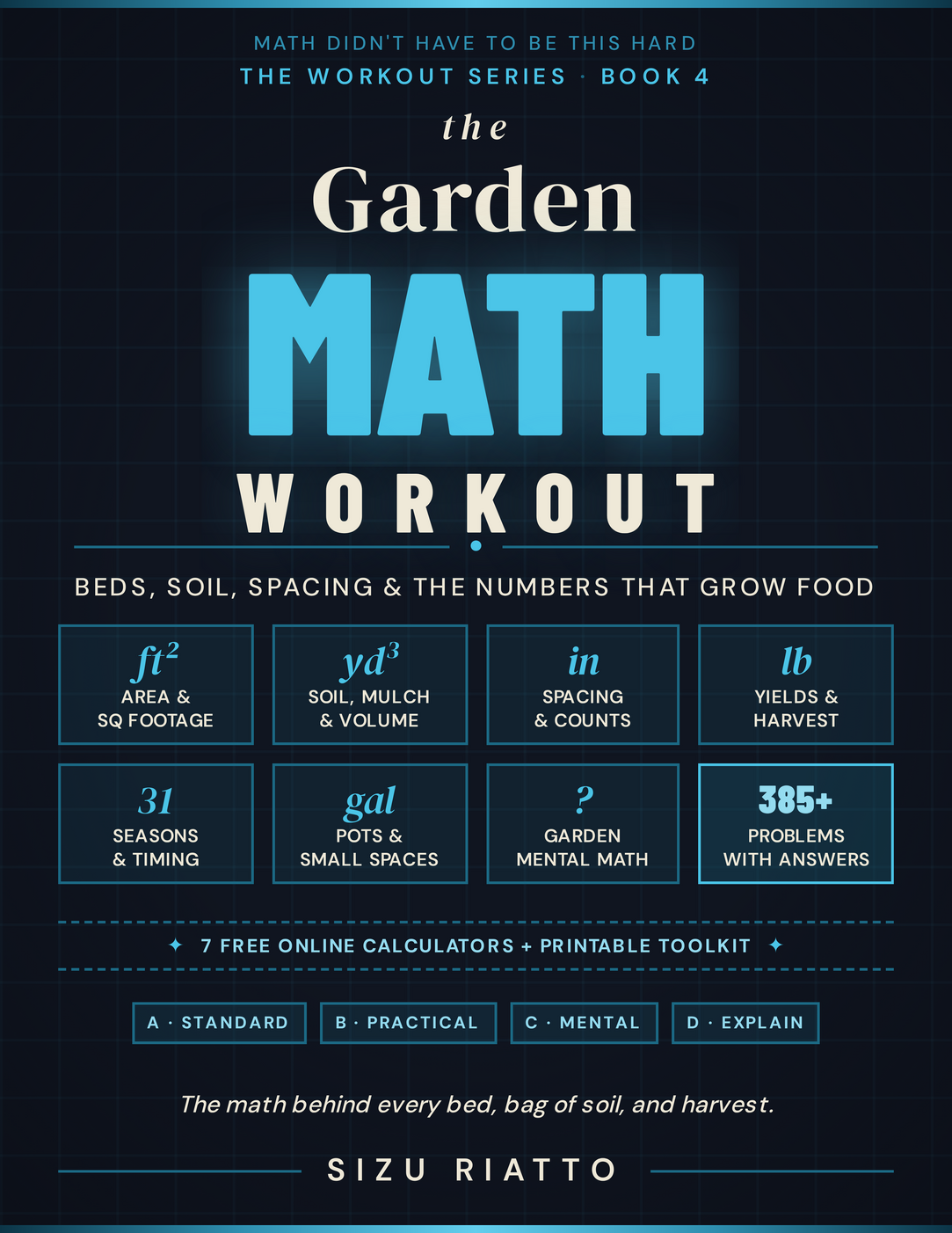
The free Soil & Mulch Volume calculator gives cubic feet, cubic yards and bag counts, then prices bags against a bulk delivery. It comes from The Garden Math Workout, whose chapters cover area, soil and mulch volume, spacing and plant counts.
Rule of thumb: length × width × depth (all in feet) gives cubic feet. Divide by the bag size and round up, or divide by 27 for cubic yards. Add the delivery fee before you compare prices.
This is arithmetic for planning a project, not horticultural or structural advice.