 Sizu
A tub of oyster mushrooms gives a big first flush, a smaller second and a smaller third, and then it fades. Many growers keep waiting for a fourth that never really arrives. But the fall-off follows a pattern, and the pattern lets you call each harvest before it comes and know when the tub is finished.
Three flushes
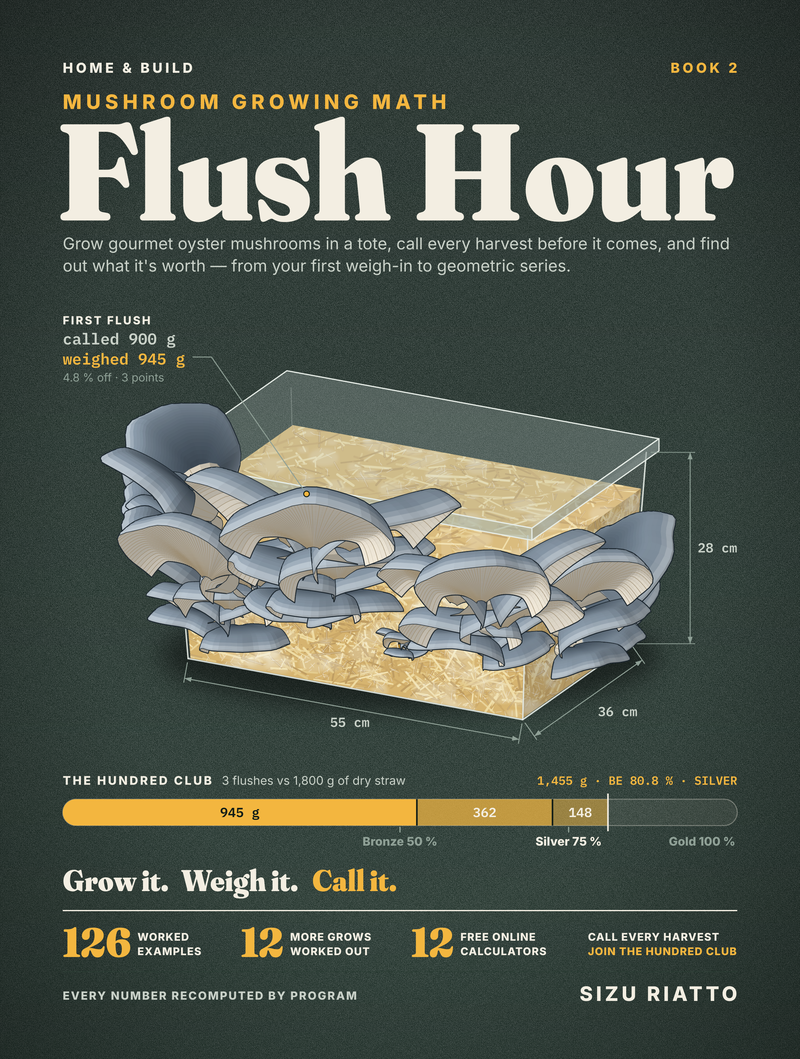
The book’s tub is spawned on 1,800 g of dry straw. It gave three flushes, weighed in grams:
- Flush 1: 945 g
- Flush 2: 362 g
- Flush 3: 148 g
In all that is 945 + 362 + 148 = 1,455 g. Biological efficiency (BE), the fresh mushrooms divided by the dry straw, is 1,455 ÷ 1,800 × 100 = 80.83%.
The ratio
Divide each flush by the one before it:
- 362 ÷ 945 = 0.383
- 148 ÷ 362 = 0.409
They are close. A single typical ratio is the geometric mean, which is (last ÷ first) raised to 1 ÷ (n − 1): (148 ÷ 945)^½ = 0.3957, about 0.4.
Calling the next flush
A sequence that multiplies by the same ratio each step is geometric: flush n = a × r^(n − 1), where a is the first flush. With r = 0.4 and a = 945:
- Flush 2: 945 × 0.4 = 378 g (weighed 362)
- Flush 3: 945 × 0.4² = 151.2 g (weighed 148)
Three flushes by the model total 945 + 378 + 151.2 = 1,474.2 g. The honest use is to write your call down before you cut, then weigh it and see how close you were.
How much can the tub ever give?
The sum of a geometric series with a ratio under 1 has a limit:
a ÷ (1 − r) = 945 ÷ 0.6 = 1,575 g
That is a BE ceiling of 1,575 ÷ 1,800 = 87.5%. It is an upper bound, never a promise: the tub will not reach it.
When to stop
Two tests, and when both say stop, start a new tub. First, the pace: a fourth flush would be about 148 × 0.4 = 59.2 g and come 14 days later, which is 59.2 ÷ 14 = 4.23 g a day. Compare that with the tub’s average so far, 1,455 g over 53 days = 27.45 g a day. Second, a floor: the smallest flush worth the wait, say 100 g. A 59.2 g flush is under it and slower than the average, so both tests say the same thing.
Honest limits
The ratio 0.4 is one study’s average. Tubs, strains and the rest between flushes move it, so fit it from your own flushes. The model describes flushes you have already weighed; it is not a forecast to bank, and the sum to infinity is a ceiling. The book’s tub, its straw and its harvests were worked out on paper from published figures, not grown by us, so weigh your own. No yield or profit is promised. The book sets out the safety rules for growing at home alongside every number.
Try it with your own flushes
The free Flush After Flush calculator takes your flushes in grams, fits the ratio, gives the next flush, the sum so far, the ceiling and the stop test. It comes from Flush Hour: Mushroom Growing Math, which shows how to grow gourmet oyster mushrooms in a tote, call every harvest before it comes and find out what it is worth, from your first weigh-in to geometric series. It is available as a hardcover.
Worked example from the book. Weigh your own tub; results vary.