 Sizu
Some things grow by adding the same amount every step, and some grow by multiplying by the same factor. A tray of microgreens is the second kind: each day’s growth is a share of what is already there. The multiplier hidden inside “from here to there in so many days” is the number that lets you plan a harvest, compare crops and check a rate someone quotes you. It takes one root on a calculator.
The question
A radish tray starts as 28 g of seed and, nine days later, is 280 g of harvest. What is the steady daily growth rate?
The tempting answer is to take the gain, 280 − 28 = 252 g, and divide by nine: 28 g a day. But the tray does not add 28 g a day. It gains little at first, when there is little plant, and a lot later.
The method
If the same multiplier applies every day, then after nine days the start has been multiplied by it nine times:
start × multiplier⁹ = end
So multiplier⁹ = end ÷ start = 280 ÷ 28 = 10, and the multiplier is the ninth root of 10, written 10^(1/9).
On a calculator, 10^(1/9) = 1.2915. That is a growth of about 29% a day.
The check
Multiply the start by 1.2915 nine times and you should land on 280. Here is the ladder.
Day 1 is 28 × 1.2915 = 36.2 g; day 4 is 77.9 g; day 8 is 216.8 g; day 9 is 280.0 g. Look at the shape: the last day adds 63.2 g, more than the whole tray weighed on day 3. That is what multiplying does.
Other crops have other multipliers. The book gives broccoli about 1.3, sunflower 1.17 and pea shoots 1.04. A pea shoot at 1.04 is not a bad crop. It brings most of its weight in with the seed, so there is less left to multiply.
The same root for loans and savings
The same idea explains why rates quoted per month and per year do not convert by multiplying or dividing by twelve.
- A loan at 1.5% a month is (1.015)¹² − 1 = 19.56% a year, not 12 × 1.5 = 18%. Each month’s interest is charged on a bigger balance.
- Savings at 3% a year is 1.03^(1/12) − 1 = 0.2466% a month, not 3 ÷ 12 = 0.25%.
The gap looks small on one month. Over years it adds up, which is why a lender that quotes the monthly rate and a bank that quotes the yearly one are not comparing like with like.
What the model leaves out
One multiplier for every day is a model. A real tray grows slowly at first, fast in the middle and slowly at the end, along an S-curve. The Microgreen Shelf in the book was worked out on paper from published figures, not grown by us, so weigh and measure your own trays before you rely on the numbers.
Rule of thumb
Divide the end by the start, take the root for the number of steps, and that is the multiplier. Take 1 away and multiply by 100 for the percent per step. To convert between months and years, use powers and roots, never ×12 or ÷12.
Try it with your own numbers
The free Daily Multiplier calculator takes a start, an end and a number of steps and gives the multiplier and the percent per step. It also converts a monthly rate to a yearly one and back. It opens on the radish example. It comes from Grow by Numbers, which builds a four-tier microgreen shelf and teaches ratios, sequences, exponentials and logarithms on the way. It is available as a hardcover.
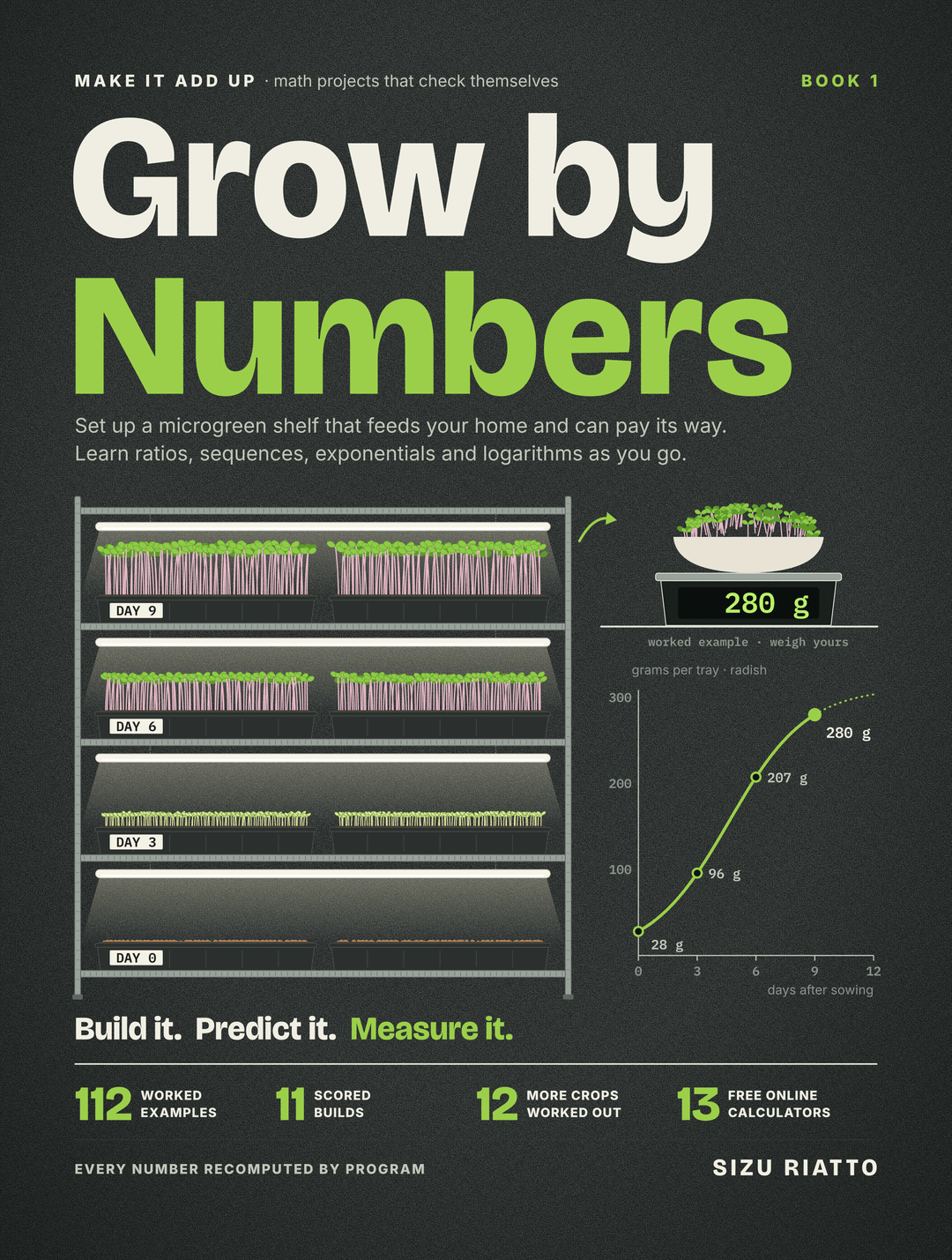
Weights and multipliers above are worked from the book’s example, not measured by us.