 Sizu
A bill gives you one total, and it is easy to accept it. But every line on it is a count multiplied by a rate, and you can rebuild each one from your own meter in a few minutes. Do it once and you can tell an honest bill from an estimated one, and see which part of the total you can actually change.
Electricity: from two reads to power
Over 28 days the electricity meter went from 41,236.4 to 41,505.2 kWh.
- Used: 41,505.2 − 41,236.4 = 268.8 kWh
- Per day: 268.8 ÷ 28 = 9.6 kWh
- Average power: 9.6 ÷ 24 = 0.4 kW, a steady 400 W
Watts are a rate, like the speedometer. Kilowatt-hours are an amount, like the odometer. A 3 kW kettle running for 3.5 minutes uses 3 × (3.5 ÷ 60) = 0.175 kWh.
Gas: from cubic meters to kWh
A UK gas meter counts cubic meters, but the bill charges kWh. The conversion is
kWh = m³ × 1.02264 (volume correction) × calorific value (MJ per m³) ÷ 3.6
The meter moved 232.8 m³, and the bill gives a calorific value of 39.5:
232.8 × 1.02264 × 39.5 ÷ 3.6 = 2,612 kWh, or 93.3 kWh a day. (In the US, the bill gives therms: 1 therm is about 29.3 kWh.)
The bill, line by line
With the unit rates and standing charges printed on the bill, each line is a multiplication:
- Electricity units: 268.8 × 0.26 = 69.89
- Electricity standing charge: 28 days × 0.55 = 15.40
- Gas units: 2,612 × 0.08 = 208.96
- Gas standing charge: 28 days × 0.30 = 8.40
Total: 69.89 + 15.40 + 208.96 + 8.40 = 302.65.
The gas units are 208.96 ÷ 302.65 = 69% of the bill. A standing charge is paid whether or not you use anything, so only the unit lines move when you turn the heating down.
Honest limits
Rates differ by supplier and by tariff, and the figures here are the book’s worked example, not a quote. If the bill says “estimated”, your read is a guess and the next bill will correct it, so send your own reading. Your calorific value and volume correction are printed on your bill; use those, not these.
Try it with your own meter
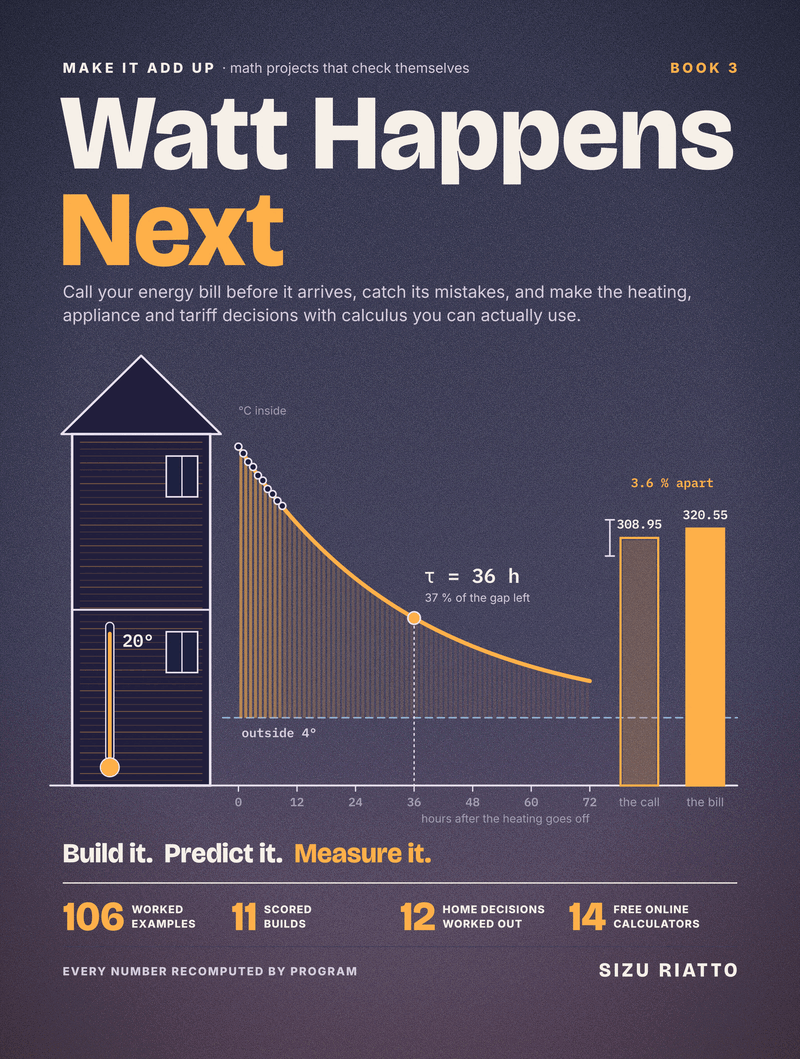
The free Rates and the Bill calculator takes two electricity reads and two gas reads and rebuilds the bill, in UK or US units. It comes from Watt Happens Next, which uses rates, slopes, areas and exponential cooling to call your next energy bill before it arrives and to check whether a heating or appliance decision pays back. It is available as a hardcover.
Worked example from the book. Prices are illustrative; check your own bill.