 Sizu
Home › Books › Event Planning Numbers Didn’t Have to Be This Hard
What you’ll get from it
- Know how many will come: turn a guest list into a likely headcount with a low and a high, chase the replies, and know what the number you give the caterer will cost.
- Know how much to buy: pounds of food, gallons of drinks, bags of ice, servings in a cake and packs at the store, rounded the right way, so you don’t run out in the first hour or throw half of it away.
- Know where everyone sits: square feet per guest, how many tables of which size, a seating plan that keeps families together, and a floor plan drawn to scale before the tables arrive.
- Know what it will really cost: a budget with a spare line, a quote read down to the service charge and the tax, a ticket price that can’t lose money, and spending tracked against the plan.
- Know who pays what: costs split fairly by household, to the cent, and settled up in as few payments as possible; plus a countdown from the day and a day-of schedule with a buffer.
What this book is
Event books are about style; the numbers are left out. This one is the arithmetic of hosting, explained slowly from the first idea: every event, from a dinner for twelve to a wedding for a hundred and fifty, runs on six numbers (people, food and drink, space, money, time and helpers), and every chapter is the arithmetic of one decision a host makes, with the slip it prevents. Planners’ rules of thumb are given with their ranges and labeled as starting points, never as rules, and the book shows you how to replace them with your own numbers.
It builds in order. Part One is who’s coming: the guest list, replies and the final count, and the per-guest number that scales everything. Part Two is food and drink: portions, drinks and ice, cake servings, shopping by the pack and the potluck. Part Three is space: floor space, tables, seating plans, a floor plan to scale, linens and lights. Part Four is money: the budget, quotes, ticket break-even, tracking and fair splits. Part Five is time and helpers: counting back from the day, the day-of schedule, volunteer shifts and running a fair. Part Six puts it together. Every sum, unit conversion, date counted back and clock time added up in the book’s working boxes was checked by computer.
Who it’s for
Anyone hosting something bigger than they’ve planned before: a big birthday, an anniversary, a reunion or a graduation party; couples planning a wedding on a real budget, and the family members helping; club, team and church volunteers running a dinner, a potluck or a fundraiser; PTA and school volunteers running a fair or a bake sale; and the person at work who always ends up collecting the money. No math beyond arithmetic is needed. It isn’t a style guide, and it isn’t legal, tax, food-safety or allergy advice: the food in its examples is plant-based, the drinks are non-alcoholic, and a venue’s posted occupancy limit always comes first. Every person, hall and price in it is invented.
Every chapter, its worked examples, and its free tool
The calculators are free, need no sign-up, and keep what you type in your own browser. Each opens on its chapter’s first worked example and shows the working step by step, so you can check the book and then put in your own guests, prices and dates. The book is complete without them. All of them are on one page.
Part One · Who's Coming
Every event comes down to six numbers (people, food and drink, space, money, time and helpers); most grow from the headcount, so think per guest, know which costs are fixed, round whole things up, count dates back from the day, and plan with a range instead of one guess.
Tool: Event Numbers SheetWorked examples 1–6
- Planning a family birthday lunch on the back of an envelope: people, food, space, money, time and helpers
- What changes when six more guests say yes, and what doesn't
- What a room costs each guest when more or fewer people come
- Why a fraction of a table means one more table
- Setting an RSVP date by counting back from the party
- Planning food for the likely headcount and chairs for the high one
Count people, not invitations; sort them into groups that behave alike, multiply each group by an honest planning rate and add to get the expected headcount, cross-check it against the one-in-five rule of thumb, and work the rates low and high to get a range.
Tool: Guest Count EstimatorWorked examples 7–12
- Turning a stack of wedding invitations into a count of people
- Estimating wedding attendance group by group: family, friends, out of town, work
- Checking your own estimate against the planners' one-in-five rule
- A low, likely and high headcount from the same guest list
- Estimating a family party's headcount from locals and travelers
- Counting children and the grown-ups who stay at a class birthday party
Keep yes, no and no-reply counts that always add up to the list, chase every unanswered invitation before the caterer's deadline, give the number who said yes as the guaranteed count you'll pay for, and allow for no-shows only where people haven't committed by name, as at free events.
Tool: RSVP TrackerWorked examples 13–18
- Reading the RSVP list on the reply date: yes, no and no reply
- Turning the last unanswered invitations into a final count
- What a caterer's guaranteed count means when guests don't come
- Weighing six extra dinners against six missing ones
- Planning supplies for a free sign-up event with no-shows
- Using last year's show-up rate to plan this year's club dinner
Split every cost into fixed costs and per-guest costs; the total is fixed + per-guest × guests, the cost per guest is the per-guest amount plus a shrinking share of the fixed costs, step costs jump a whole unit at a time, and guests at different prices need a weighted average.
Tool: Per-Guest Cost CalculatorWorked examples 19–24
- Working out a club dinner's cost per head from fixed and per-guest costs
- How the cost per guest falls as turnout rises
- Tables and centerpieces that jump with the guest count
- Checking a caterer's main-dish quantity from a per-guest portion
- Turning a party's grocery receipts into a cost per guest for next time
- The average cost per guest with adult and children's prices
Part Two · Food and Drink
Pick one per-guest portion for each dish from the rule-of-thumb range (about a pound of food per adult, 4 to 8 ounces of main, half a cup per side, two rolls), multiply by everyone who eats, convert to the units you buy, count small children as half, and put one margin where running out would hurt most.
Tool: Food Quantity CalculatorWorked examples 25–30
- How many pounds of the main dish a wedding buffet needs
- Side dishes for a crowd in cups, quarts and baking pans
- Bread rolls for a buffet, by the dozen
- Adding a buffet margin to the main dish, and where to stop
- Appetizer trays for an office party with and without a meal to follow
- Food for a family picnic counting small children as half portions
Count drinks from people and hours first (a common starting point is about 2 drinks a guest in the first hour and 1 an hour after), then convert servings into gallons, bags of ice, pounds of coffee and boxes of tea, rounding up only at the end; check any "cup" on a label in fluid ounces before you divide.
Tool: Drinks and Ice CalculatorWorked examples 31–36
- A five-hour block party for 110: drinks to plan from the 2-then-1 rule
- Turning a block party's drinks into gallons of water, lemonade and iced tea, their cost and the tea bags
- Why 5 gallons of lemonade ran out 90 minutes into last year's party
- Bags of ice for 110 guests, checked against last year's leftover bags
- The club dinner's coffee: why a "100-cup" urn fills only 50 mugs
- Cups for a 34-guest birthday lunch at 2.5 cups a guest
A cake's servings are the area of its top divided by the area of one serving (about 2 square inches for a wedding slice, 3 for a party slice, from a tier about 4 inches tall), rounded down; a round's area is 3.1416 × radius × radius, so wider tiers serve far more, and a real cutting pattern gives a little less than the area promises.
Tool: Cake Servings by AreaWorked examples 37–42
- Wedding servings from a 10-inch round tier
- A three-tier wedding cake against a guest list of 128
- A 9-by-13 kitchen sheet cake to fill a 50-serving gap
- Party servings for a birthday cake, by area and by a real cutting grid
- Cutting a round cake in rings: why the outer ring holds most of it
- Cupcakes by the dozen for a class party of 28
Shop for a crowd in three steps: multiply the recipe by guests ÷ servings, round each amount up to whole packs and pots (and look at the leftover it creates), and compare pack sizes by unit price but buy by the total bill, since the mix with the least waste can beat the pack with the best unit price.
Tool: Pack and Shopping PlannerWorked examples 43–48
- Scaling a family chili recipe from 8 servings to 34
- Plates and napkins in whole packs, and when to round down
- Rice by unit price: when the cheaper bag per pound costs more today
- Party plates: the big pack that costs more per plate
- 220 plates for a block party: the cheapest mix of two pack sizes
- Chili for 34 in an 8-quart pot: how many batches
Plan a potluck by dividing the portions needed by the servings in a dish, splitting the dishes into mains, sides, salads and desserts, and then checking that every kind of dish covers every guest (shares alone can leave one kind short); count your list by last-name letters before you choose the sign-up split.
Tool: Potluck PlannerWorked examples 49–54
- How many potluck dishes 110 people need
- Splitting 42 potluck dishes into mains, sides, salads and desserts
- Checking every kind of potluck dish covers every guest
- A potluck sign-up by last-name letters that matches the mix
- A school bake sale: pieces per visitor and the ask per family
- Plates, cups, napkins and cutlery for a 110-guest potluck, per household
Part Three · Space, Tables and Seats
A room's floor is a budget of square feet: subtract the stage, buffet and dance floor first, plan guests at a comfortable number of square feet each (about 10 to 12 for a seated dinner is a common starting point), size the dance floor for the share dancing at once, and treat the venue's posted occupancy sign as a ceiling you never cross.
Tool: Room Space PlannerWorked examples 55–60
- A hall's floor area in square feet
- Floor space for a seated dinner of 128
- Sizing a dance floor for 128 wedding guests in 3-foot panels
- Stage, buffet and dance floor first: the floor left for tables
- The code factors against a hall's posted occupancy sign
- Space for a 34-guest lunch in a small room
Tables needed are guests divided by the comfortable seat count, always rounded up; a table's comfortable count comes from its edge (about 24 inches a guest), so check the length of a long table and count chairs for every part of the day that overlaps.
Tool: Table CalculatorWorked examples 61–66
- Seating a wedding of 128 at 60-inch rounds and a head table
- Why a 60-inch round seats 8 comfortably and 10 tightly
- Mixing 72-inch and 60-inch rounds, and the empty seats it leaves
- Sizing a head table with everyone on one side
- One long family table that's longer than the room
- Chairs for a ceremony and a reception set at the same time
Seat groups, not guests: place the biggest groups first, split a group evenly across neighboring tables when you must, keep a little slack in the fill rate, and add up every table before you print the chart.
Tool: Seating Plan HelperWorked examples 67–72
- Packing family groups into tables of 8, biggest first
- Fill rate: fifteen tables or sixteen for 120 guests
- Splitting a family of 11 across two neighboring tables
- Working out a kids' table both ways
- Adding up the seating chart to find a missing guest
- Two long rows and the best seat for the guest of honor
Draw the room to scale, give each table its real footprint with guests seated, place the fixed things and a 36-inch route first, then count how many tables actually fit.
Tool: Floor Plan PlannerWorked examples 73–78
- Choosing a scale to draw a hall on one sheet of paper
- A round table's footprint with guests seated
- Spacing tables center to center
- Fitting fifteen tables, a dance floor and a buffet into a hall
- Checking a 36-inch route for a guest in a wheelchair
- Fitting two rows of tables and a buffet line into a small room
A cloth is the table plus twice the drop in each direction; a runner or a string of lights is the length plus its ends; anything sold in packs rounds up, with a spare on purpose for anything that can break.
Tool: Linen and Decor CalculatorWorked examples 79–84
- Sizing floor-length cloths for round tables
- Sizing lap-length cloths for a club dinner
- Working backward from a cloth to its drop
- A table runner for tables end to end
- Napkin packs and centerpiece stems, rounded up
- String lights around a hall's walls, with the drape
Part Four · Money
Take the spare off the top, split the rest into lines by shares that add to 100%, check the amounts add back to the total, and when a line runs over, decide on purpose which line pays.
Tool: Budget SplitterWorked examples 85–90
- Taking a 10% spare off a wedding budget first
- Splitting a budget into eight lines by shares
- A wedding budget per guest
- Deciding where a photographer's higher quote comes from
- A club dinner budget built up from its costs
- Why one food line has two different percentages at once
A quote is a chain of multiplications: a subtotal, a service charge, tax and a deposit, each a percentage of some earlier line. Ask of every percentage "a percentage of what?", turn the quote into one all-in total and one true price per guest, and work the balance as total minus deposit.
Tool: Quote CheckerWorked examples 91–96
- A wedding catering quote, line by line, to one all-in total
- The same bill with tax on the food only
- A 30% deposit and a balance that add back to the cent
- Two caterers compared per guest, all in
- A hall booking deposit, a damage deposit and the balance's due date
- A tip you choose, and why its base matters
Each ticket pays for one guest's own cost and leaves a margin toward the fixed costs, so the tickets needed to break even are the fixed costs divided by the margin, rounded up. Choose a price with a margin of safety, so a few people can stay home without the event losing money.
Tool: Ticket Break-Even CalculatorWorked examples 97–102
- Why last year's club dinner lost money
- The break-even ticket price for the expected turnout
- The price for each turnout
- Choosing a ticket price with a margin of safety
- Members' and guests' prices and the average ticket
- A pasta-night fundraiser's break-even and profit
Track every budget line's actual against its estimate: the variance in dollars shows where the money went, the percent shows which estimates to trust. Let the contingency absorb the overs, list deposits and balances by month, and count money as spent the day you sign for it.
Tool: Budget TrackerWorked examples 103–108
- Estimate against actual for every wedding budget line
- Dollars over against percent over
- How much of the spare the overruns used
- A month-by-month calendar of deposits and balances
- Money signed for against money already paid
- The club dinner's final ledger and surplus
Agree on the rule first (equal, by a count, or a mix where fixed costs are split equally and per-person costs by people), then split to the cent: round every share down and give the leftover cents to the shares that lost most. Settle up from net balances, paid minus share; at most one payment fewer than the number of people is ever needed.
Tool: Fair Cost SplitterWorked examples 109–114
- Four equal shares of a bill, to the cent
- Shares in proportion to each household's people
- The room split equally, the food by people
- Settling up from net balances in three payments
- A block party's costs per household, rounded for cash
- Eighteen coworkers share a farewell gift
Part Five · Time and Helpers
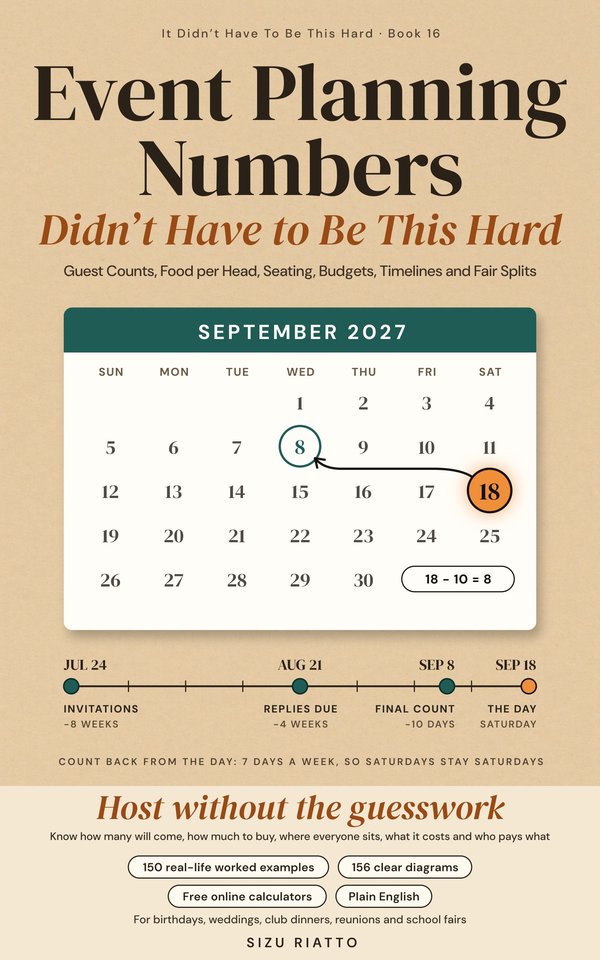
Write the event date first, give every task a lead time, and subtract to find its deadline; weeks keep the weekday, months don't. Work back through chains of steps, sort the deadlines into a countdown, and leave a gap wherever one date depends on another.
Tool: Countdown PlannerWorked examples 115–120
- Counting back 8 weeks to the mailing date
- The gap between the reply date and the final count
- Seven months back against thirty weeks back
- Working back through design, printing and addressing
- A family lunch's four dates, and a clash between two
- A wedding countdown sorted by deadline
Work backward from the time that can't move: add the jobs on each chain, take the longest chain (the critical path), put a buffer just before the fixed time, and count teardown in person-minutes against the people who will really stay.
Tool: Run-of-Show PlannerWorked examples 121–126
- The latest start for a birthday lunch setup
- Adding a buffer before the doors open
- Two helpers working two chains at once
- The critical path of a wedding hall setup
- A wedding reception timeline and its buffet line
- Teardown in person-minutes before midnight
Measure help in person-hours (people × hours), cut it into shift slots people can say yes to, compare with what volunteers offer, match people to how busy each job really is, add floaters, and remember that jobs come in whole pieces and a bottleneck (one oven, one ladder) doesn't speed up with more hands.
Tool: Volunteer Shift PlannerWorked examples 127–132
- Person-hours of booth help at a school fair
- Shift slots against volunteers
- Sharing out the fair's setup
- Rebalancing booths and filling a shift schedule
- Servers for a buffet and a plated dinner
- The oven bottleneck in a cupcake bake
Turn tickets back into dollars at the rate the money came in (bundles make a ticket worth less than its face price), judge each booth by its net after costs, add the costs to a net goal to get the takings target before dividing by visitors, take the float out before you count, and at halftime compare the rate still needed with the rate so far.
Tool: Fair and Fundraiser PlannerWorked examples 133–139
- What a bundled fair ticket is worth
- Finding where a fair's money went, year against year
- Each fair booth's net after costs
- Turning a net goal into a takings target per visitor
- A cash box float, in and out
- Pricing a bake sale for its target
- The takings thermometer and the rate still needed
Part Six · Putting It All Together
After every event, write down what you planned and what happened (people, food, drinks, money, time) and turn the difference into your own rates per guest, per hour or per yes; combine several years by adding before dividing, and don't over-learn from one odd day.
Tool: Event ReviewWorked examples 140–145
- A wedding's attendance rate
- Main dish eaten per person
- A block party's own drinks rate
- Final cost per guest
- Where a reception ran late
- Three years of a club dinner's show-up rates
Every event is six numbers (people, food and drink, space, money, time, helpers): start with the headcount and the date, multiply per-guest numbers, round up what comes whole, count back from the day, share costs and work fairly, and write down what happened.
Tool: All the Event ToolsWorked examples 146–150
- A dinner for 12 at home, start to finish
- A child's birthday party, start to finish
- A club picnic on a hot afternoon
- An office collection and farewell
- A class reunion that pays for itself