 Sizu
Home › Books › Garden Numbers Didn’t Have to Be This Hard
What you’ll get from it
- Buy the right amount of soil once: bed volumes in cubic feet and yards, bags or a delivered load (and where one beats the other), soil mixes by parts, pots and planters by what they really hold, mulch and compost by the 324 rule.
- Sow what will come up: plants in a row, on a grid or in offset rows (and why offset rows can lose in a narrow bed), seeds to sow from a germination rate, two seeds a cell, and a seed test on a paper towel.
- Plant on the right dates: what an average frost date really means, counting back to seed starting, days to maturity to a harvest date, the last fall sowing, steady harvests by succession, and degree days.
- Water what your plants need: an inch of water turned into gallons and minutes, the bucket test for a hose, drip lines in gallons an hour, a season of rain read from a gauge, and what a roof pours into rain barrels.
- Plan a harvest you can count on: yields as honest ranges, a harvest log with its peak and halfway week, drying and sharing by weight, what the garden costs and saves, and a rotation for the years ahead.
What this book is
Most garden disappointments are a number nobody worked out: a bed half-filled, seeds that came up too thick or too thin, a week without water, a crop that met the frost. This book turns a garden into five numbers you can work out: space, soil, plants, water and time, with money in each. Each chapter is the arithmetic of one gardening decision, with the mistake it prevents, worked through slowly from the first idea. Nothing beyond arithmetic is needed; the one time a calculator’s tan button appears, it is explained from zero.
It builds in order. Part One measures the ground: paces and tapes, bed shapes, drawing to scale, sun and shadows. Part Two is soil: raised beds, mixes, containers, mulch, compost and the three numbers on a bag. Part Three is seeds, spacing and dates. Part Four is water, from an inch of rain to rain barrels and the water bill. Part Five is the harvest: estimating it, logging it, drying and sharing it. Part Six is money and next year. Every sum in the book’s working boxes was checked by computer.
Who it’s for
First-time gardeners about to build raised beds; community-garden plot holders; balcony and windowsill growers with pots; gardeners of some years who have always guessed at soil, seeds and water; and parents or grandparents gardening with a child. It is a reading book, not a workbook, and a companion to the hands-on Garden Math Workout. It gives no pest-control or chemical advice, no fertilizer rates of its own and no canning instructions: your seed packet, the label on the bag and your local cooperative extension service always come first. Every example is plant-based, and every person, garden and price in it is invented.
Every chapter, its worked examples, and its free tool
The calculators are free, need no sign-up, and keep what you type in your own browser. Each opens on its chapter’s first worked example and shows the working step by step, so you can check the book and then put in your own measurements and prices. The book is complete without them. All of them are on one page.
Part One · Measure the Ground
A garden runs on five numbers in order, space, soil, plants, water and time, with money following each; space comes first because the others are all multiplied by it.
Tool: Garden Numbers PlannerWorked examples 1–6
- Two raised beds as an area and as a share of the yard
- Soil for two beds: area times depth, then whole bags
- How plant spacing changes the count fourfold
- An inch of water a week on two beds, in gallons and cans
- Counting 70 days forward to a first-harvest date
- Pricing bed soil in bags and as delivered bulk
Calibrate your pace once against a tape and use paces to plan; use a tape for anything you'll build or buy; square corners with 3-4-5 (bigger triangles are more accurate), check them with equal diagonals, and draw circles with a stake and a string.
Tool: Pace, Tape and Square Corner HelperWorked examples 7–12
- Calibrating your own pace over a measured 100 feet
- Pacing a yard and checking the estimate against a tape
- Squaring a bed corner with the 3-4-5 check and why bigger triangles help
- Checking a bed for square with equal diagonals
- Marking a round bed with a stake and string, and its edge
- Measuring a gentle slope with a string and line level
Split any bed into rectangles, triangles and circles, or take a simple shape and subtract a piece; never count a corner twice; measure wavy edges in strips; and keep perimeter, the edge, separate from area.
Tool: Garden Bed Area CalculatorWorked examples 13–18
- How much of a community-garden plot grows food
- Area and edging of an L-shaped corner bed
- A round bed's area and its share of the square around it
- A corner triangle bed as half a square
- A keyhole bed: a circle minus its path
- A wavy border measured in strips every 5 feet
A plan is a drawing where every length is at one scale; pick the scale from the page, draw the fixed things first, then measure anything on paper and divide by the scale to know it in the yard.
Tool: Garden Plan Scale ConverterWorked examples 19–24
- Choosing a scale so the yard fits the page
- Reading real sizes back off a scale plan
- A plan's scale written as a ratio
- Checking a path on the plan against a garden cart
- How many beds and paths fit across a yard
- Finding an area by counting grid squares
Count hours of direct sun before you plant; a shadow on level ground is the height divided by the tangent of the sun's angle, and the noon angle is ninety degrees minus your latitude, plus about twenty-three in late June and minus it in late December.
Tool: Shadow Length and Sun Hours CalculatorWorked examples 25–30
- Logging the hours of direct sun on a balcony
- A fence's noon shadow at the spring equinox
- The same fence's noon shadow in late June
- The midwinter noon shadow and how far the beds stay clear
- Whether a tree's long evening shadow can reach a bed
- Why tall crops go on the north side of a bed
Part Two · Soil
Soil fills a volume: turn every length into feet, multiply length × width × depth, divide by 27 for cubic yards or by the bag size for bags, round up, and price bags against bulk with the delivery included.
Tool: Raised Bed Soil CalculatorWorked examples 31–36
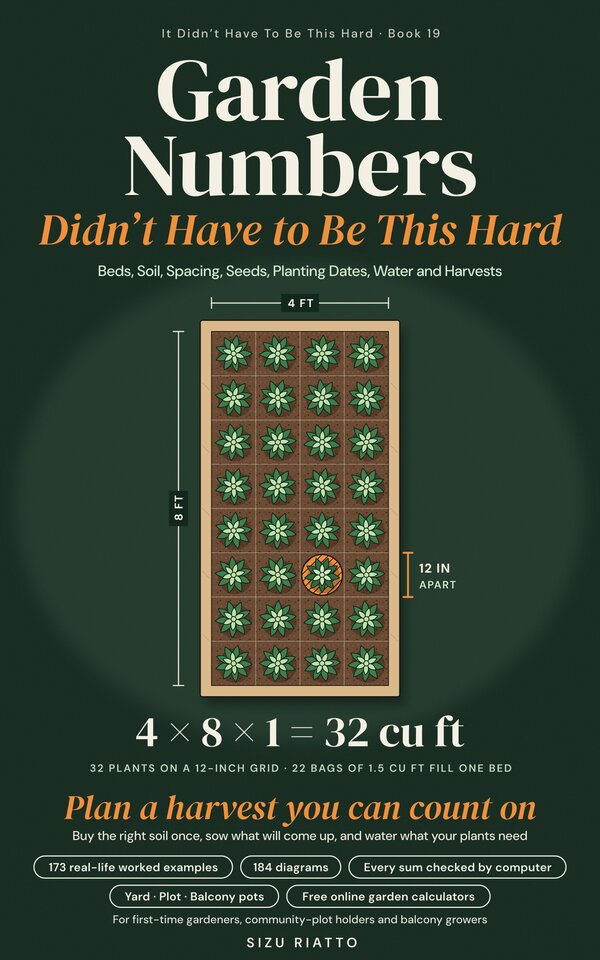
- Volume of one 4 × 8 ft raised bed, a foot deep
- Filling two raised beds with bagged mix
- Bulk soil by the cubic yard, in half-yard steps
- Break-even between bagged and delivered soil
- Topping up beds that sank, from your own measurement
- Dry quarts on small bags, and the real price per cubic foot
A recipe in parts fixes the shares, not the size: add the parts, find one part as the total divided by the number of parts, multiply, turn each amount into its own bags, and fix a mix by holding the ingredient you're not adding steady.
Tool: Soil Mix by Parts CalculatorWorked examples 37–43
- A recipe in parts as percentages
- Scaling a 3 : 2 soil recipe to 10 cubic feet
- Turning a recipe into bags of different sizes
- Checking the ratio of a batch already mixed
- Adding compost to bring a mix up to 40%
- Mixing 20 cubic feet by half-full wheelbarrow loads
- A three-ingredient recipe sized to whole bags
Measure containers inside, use length × width × depth for boxes, π × radius² × height for straight pots and the middle width (or the tapered rule) for tapered ones, divide by 1,728 for cubic feet or 231 for gallons, fill an inch below the rim, and treat every size on a pot as a name until you've measured it.
Tool: Container Soil CalculatorWorked examples 44–50
- Volume of a railing planter in cubic feet and gallons
- Volume of a tapered pot, and the rim slip
- What a "5-gallon" grow bag and a nursery "gallon" hold
- Potting mix for a whole balcony of containers
- What filling an inch below the rim saves
- Potting mix for a microgreen tray in dry quarts
- Potting mix around a nursery root ball
Mulch is area × depth with the depth in feet; a cubic yard covers 324 divided by the depth in inches square feet; a ring is the big circle minus the small one; and small jobs usually belong in bags once the delivery is counted.
Tool: Mulch and Top-Dressing CalculatorWorked examples 51–57
- Wood chips for 300 feet of garden paths
- How far a cubic yard or a bag of mulch spreads
- Mulching a small border: bags against a delivered yard
- Mulch for a ring around a round bed
- An inch of compost top-dressing on two beds
- Straw mulch by the bale against bagged chips
- The cost of ordering four yards for a one-yard job
Build a compost pile from about two or three parts browns to one part greens by volume (the chemists' 25 to 30 parts carbon to 1 of nitrogen is by weight), make it at least a 3-foot cube (27 cubic feet) to heat up, and plan on getting back about half of what you put in.
Tool: Compost Mix CalculatorWorked examples 58–63
- Browns and greens by volume in a 27 cubic foot bin
- Carbon-to-nitrogen as a ratio of totals, and why ratios don't average
- Leaves to add to a pile of greens
- Compost bin size: 27 cubic feet, not 3
- Weeks to fill a compost bin from kitchen scraps
- Finished compost from a full bin, and what it covers
The three numbers on a fertilizer bag are percentages by weight (bag weight × number = pounds), the second and third are phosphate and potash rather than the plain elements, bags are compared by the price of the nutrient you need, a label's rate is scaled to your bed, and every whole pH step is ten times.
Tool: Fertilizer Label and Soil pH CalculatorWorked examples 64–70
- Pounds of nitrogen, phosphate and potash in a bag
- Comparing fertilizers by the price of nitrogen
- Scaling a label rate to one 32 square foot bed
- How many seasons one bag of fertilizer lasts
- Turning a soil test's nitrogen into pounds of two fertilizers
- Phosphate and potash against phosphorus and potassium
- Reading a soil test's pH as powers of ten
Part Three · Seeds, Spacing and Dates
Divide a row's length by the spacing for plants in a row, square 12 inches divided by the spacing for plants per square foot in a bed, and count staggered rows before trusting them: they gain about 15% only in large plantings and can lose plants in a 4 ft bed.
Tool: Plant Spacing CalculatorWorked examples 71–76
- Radishes in a 20 ft row, and what a whole packet does
- Rows across a patch against a grid bed
- Plants per square foot at four spacings
- Staggered rows in a large planting: the real gain
- Staggered rows in a 4 × 8 ft bed: fewer plants
- A mixed bed planned by the square foot, with packets
A germination rate is a chance per seed: divide the plants you want by it and round up for the average, then sow two seeds a spot wherever a gap would hurt, because a spot is empty only if every seed in it fails.
Tool: Seed Sowing CalculatorWorked examples 77–83
- Seeds to sow for four tomato plants
- Two seeds a cell: the chance of an empty cell
- Why four seeds seldom give four plants
- A paper-towel germination test on old pepper seed
- Seeds against transplants: cost per plant
- A bed's seed list redone with germination rates
- Seed per tray of microgreens and a year's cost
The average last frost date is a coin flip, so count seed-start windows back from it in whole weeks, plan tender plants by a safer date, add days to maturity from the right start, and count fall crops back from the first frost with two weeks to spare.
Tool: Planting Calendar from Frost DatesWorked examples 84–90
- The frost-free season in days
- Counting back from the frost date to sow tomatoes
- The average frost date against a safer date
- Harvest dates from days to maturity
- The last sowing date for a fall crop
- One crop in a shorter season: the shrinking margin
- A whole season's dates on one strip
Size each sowing to one interval of eating (weekly use × weeks between sowings ÷ the share that make it), sow on a rhythm as long as the crop's harvest window, count the sowings like fence posts between the first date and the cutoff, and check the last one against the fall deadline.
Tool: Succession Sowing PlannerWorked examples 91–97
- A lettuce glut from one sowing
- Sizing a sowing from weekly use
- Five lettuce sowings two weeks apart
- A ten-day radish rhythm
- Three bean sowings with picking windows end to end
- Two varieties sown on one day for two harvests
- The gap left by one missed sowing
Plants grow on warmth, so for each day average the high and the low, subtract the base (50°F for many summer crops), count a negative as zero (or use the 86/50 caps), add the days up from the day after planting, and trust the running total over the calendar.
Tool: Growing Degree Day CalculatorWorked examples 98–105
- Degree days for one May day
- A cold day by the plain and the 86/50 methods
- The 86 cap on a hot day
- A month of degree days, and the cost of sowing early
- Predicting first beans from a degree-day total
- Comparing a month's degree days with a typical month
- What sowing two weeks early really buys
- The same crop in a year four degrees cooler
Part Four · Water
An inch of water is a depth: multiply the area you grow on by the inches and by 0.623 to get gallons, subtract the week's rain, and give the difference in one or two deep waterings.
Tool: Garden Water Need CalculatorWorked examples 106–111
- Why an inch of water on a square foot is 0.623 gallon
- Gallons for an inch on one 4 × 8 ft raised bed
- Adding bed areas before working out the water
- Checking a nightly watering-can habit against an inch
- Watering only the week's shortfall after rain
- Watering the growing area, not the whole plot
Time a bucket of known size two or three times to learn your hose's gallons a minute (or add up your drip emitters' gallons an hour), then divide the gallons your beds need by that flow to get the minutes.
Tool: Watering Time CalculatorWorked examples 112–118
- Measuring a hose's gallons a minute with a bucket
- What a few minutes of hose really gives a plot
- Hose minutes for a full inch, split in two waterings
- Drip emitters, gallons an hour and run time
- Setting a hose timer from the minutes needed
- Soaker hose run time from the label's gallons an hour
- Measuring how much water balcony containers drink
Read a gauge at the same time each day, add the week, and count each week's rain only up to the inch you plan on: the difference over the season is exactly what the tap has to supply, and the median week tells you more than the average about a usual week.
Tool: Rain Log and Water BudgetWorked examples 119–124
- Adding a week of rain gauge readings, overflow included
- A season's rain total and its mean week
- The median week of rain, and why it differs from the mean
- Counting the weeks rain fell short of an inch
- Gallons to make up over a four-week dry spell
- How much of a season's water came from rain
A roof catches its footprint times the rain times 0.623, less about a fifth for splash and spill, so barrels fill in less than an inch of rain; size them with a week-by-week ledger of rain in and garden water out, not with the season's total.
Tool: Rain Barrel and Roof Catchment CalculatorWorked examples 125–131
- Measuring a roof by the ground it covers
- Gallons an inch of rain sends down one downspout
- How much rain fills two 55-gallon barrels
- Rain caught and overflowed in a wet week
- How many dry weeks two full barrels can water
- A week-by-week rain barrel ledger for a season
- Gallons a quarter of a house roof sends to one downspout
Turn your bill's unit into gallons (a CCF is 748), find where your household's own use sits on the tiers, and price the garden's water at the tier it lands on; for a small garden watered by the shortfall it's usually a few dollars a season, so water well and divide before buying anything to save water money.
Tool: Garden Water Cost CalculatorWorked examples 132–138
- Turning a CCF on a water bill into gallons
- A household's water bill before the garden
- Pricing a garden's water on a tiered bill
- Garden water when the household is already over a tier
- A season's garden water cost month by month
- Payback of rain barrels in water saved
- Gallons and cents of water behind a pound of tomatoes
Part Five · The Harvest
A harvest is a range, so multiply your plants by a low, a middle and a high yield; divide a target by those yields to get plants needed, and plan anything you can't undo on the low number.
Tool: Harvest EstimatorWorked examples 139–144
- A tomato harvest planned as a low, middle and high range
- How many tomato plants for 3 pounds a week
- Comparing crops by store value per square foot
- Pounds from a 10-foot pantry row of bush beans
- A balcony's cherry tomatoes counted in pint boxes
- Whether a harvest plan survives a poor year
Weigh or count every pick and write it down; add for the total, divide by plants and weeks for fair comparisons, find the peak and the week half the harvest was in, and check the season against your planned range.
Tool: Harvest Log CalculatorWorked examples 145–150
- Adding up a season's harvest log
- Harvest per plant and per week
- Finding the peak week and its share of the season
- A running total and the week half the harvest was in
- Checking a season against the planned range
- Comparing two growers per plant and per square foot
Most of a vegetable is water, so drying leaves the dry matter plus a little water: dry matter = fresh × (1 − water share), dried = dry matter ÷ (1 − water left); freeze by the bag, rounding up; share whole things by dealing them out and in proportion by an agreed rule, checking that the shares add back.
Tool: Harvest Sharing and Drying CalculatorWorked examples 151–156
- What 10 pounds of tomatoes weigh once dried
- Fresh tomatoes needed to fill one jar of dried
- Sharing 16 zucchini among 9 households
- Sharing a herb bed's basil by hours worked
- Freezer bags for 6 pounds of beans
- The share of a community garden's harvest given to a pantry
Part Six · Money and Next Year
Keep start-up costs (paid once) and yearly costs (every season) apart; price the harvest at what you'd really have paid; the harvest's value minus the yearly costs is each season's gain, and the start-up divided by that gain is the seasons to pay back.
Tool: Garden Cost and Savings CalculatorWorked examples 157–162
- A raised-bed garden's start-up costs with tax
- A garden's yearly costs, water included
- Pricing a season's harvest at store prices
- Yearly garden costs per pound and per dollar of produce
- Seasons for a garden to pay back its start-up
- A community plot's cost per pound
Group crops by plant family, divide the garden into as many sections as groups, and move each group one section along every year; a family returns after as many years as you have sections; scale next year's sowings by what you wanted over what you grew.
Tool: Crop Rotation PlannerWorked examples 163–168
- Sorting a plot's crops into plant families
- A four-section crop rotation table
- How many years until a plant family returns
- Rotating with only two beds, and adding a third
- Counting the days garlic holds its bed
- Scaling next year's sowings from this year's log
Any garden, from a balcony box to six school beds, is the same five numbers in the same order (space, soil, plants, water, time), with money following each; keep them in one notebook and next year starts from this year's numbers.
Tool: All the Garden ToolsWorked examples 169–173
- A keyhole bed from area to soil, plants and water
- A beginner's 4 × 4 ft bed, start to finish
- A balcony salad garden in three railing boxes
- A six-bed school garden: bulk soil, water and rotation
- A fall garlic bed: cloves, heads and compost