 Sizu
Home › Books › Kitchen Numbers Didn’t Have to Be This Hard
What this book is
The arithmetic of the kitchen, explained slowly and in plain English, from the very first step. Every recipe is a handful of numbers, and a handful of moves handles them all: multiply everything by one factor, climb up or down the ladder from teaspoons to cups, compare like with like, and count back from the time you want to eat. It isn’t a cookbook: it explains the numbers inside any recipe, so the recipes you already love work for your kitchen, your guests and your budget. Every example is plant-based.
It builds in order. Part One is the numbers on a recipe: the units ladder, cups and grams, the two kinds of ounce and oven temperatures in °F, °C and gas marks. Part Two is scaling: the scale factor, awkward amounts, baker’s percentages, pan sizes and what doesn’t scale. Part Three is ratios and swaps: cooking by ratio, kitchen percentages, substitutions, dried to cooked and mixing strengths. Part Four is money and big batches: cost per serving, unit prices, cooking for a crowd and batch cooking. Part Five is time: getting a meal on the table at once, temperatures beyond the oven, and one whole dinner planned from start to finish. Every calculated figure was computed by program and checked a second way, and every line in the book’s sum boxes, unit conversions included, was read back off the finished pages and checked.
Who it’s for
Home cooks who cook for one or two from recipes written for six, or now and then for a crowd; anyone who collects recipes from other countries in grams, metric cups and Celsius; plant-based cooks converting old favorites; batch cooks who want to know what each portion costs; and new cooks, or cooks with a child beside them, who want to understand the numbers rather than follow them blindly. No math assumed beyond whole-number arithmetic. Not a cookbook, and no nutrition, diet or health advice; the few food-safety numbers are quoted from USDA. Every story is invented to show an idea.
Every chapter, its worked examples, and its free calculator
The calculators are free, need no sign-up, and keep what you type in your own browser. Each opens with its chapter’s worked example loaded. The book is complete without them.
Part One · The Numbers on a Recipe
Every number on a recipe is an amount, a count, a time or a temperature, and together they're a set of ratios; read them all, including the times hidden in the method, before you start, and plan backward from when you want to eat.
Calculator: Recipe Time and ServingsWorked examples 1–7
- Adding up every time on a recipe, the soak and the rest included
- How many dinners a six-serving lasagna makes for two, and how big each piece is
- Sharing a batch of 24 cookies between eight friends, then five
- Adding 3/4 cup and 2/3 cup of flour by dropping to teaspoons
- Measuring 2 cups of oats with a 1/3-cup scoop
- Matching a 28-ounce can with two smaller cans
- Counting back from a 7:00 dinner to the time to start, and the soak
US measures form a ladder (3 tsp to a tablespoon, 16 tbsp to a cup, 2 cups to a pint, 2 pints to a quart, 4 quarts to a gallon, with 2 tbsp to a fluid ounce); multiply going down, divide going up, and drop to teaspoons, 48 to the cup, whenever an amount is awkward.
Calculator: Teaspoons, Tablespoons and CupsWorked examples 8–14
- Three ways to measure 3/4 cup when the 3/4 cup is missing
- An eighth of a cup of lemon juice as tablespoons and fluid ounces
- Five tablespoons of curry paste as a quarter cup plus one
- A third of a cup of spice rub in teaspoons and tablespoons
- Three quarts of lentil soup into 2-cup lunch containers
- Whether a gallon of iced tea is enough for twelve guests
- What a pinch of salt is, and why it isn't scaled like a cup
A cup measures space and a gram measures weight, so converting needs each ingredient's own grams per cup (this book's working numbers: flour 120 g spooned, sugar 200 g, water 236 g, oil 218 g, maple syrup 312 g); flour varies with how you fill the cup, and a scale with a tare button removes the question.
Calculator: Cups to Grams, by IngredientWorked examples 15–21
- Turning 250 g of flour into cups and spoons
- How much more flour a dipped cup holds than a spooned one
- Weighing water for a British loaf: milliliters as grams
- Why a half cup of oil weighs less than a half cup of water
- Weighing 3/4 cup of maple syrup instead of scraping a cup
- Weighing flour in a heavy bowl, with and without tare
- An Australian tablespoon and a metric cup in US spoons
An ounce is a weight (28.35 g, sixteen to the pound) and a fluid ounce is a volume (two tablespoons, eight to the cup); they agree only roughly and only for water, so liquids in ounces are usually fluid ounces and anything dry in ounces goes on a scale.
Calculator: Ounces, Pounds and GramsWorked examples 22–28
- Cutting 8 ounces from a 14-ounce block of tofu
- Eight fluid ounces of oat milk against eight ounces of flour
- Pounds and ounces into ounces and grams, and back
- Dami's one-kilogram bag of lentils in pounds and ounces
- Testing "a pint's a pound" with US and British pints of water
- A pasta recipe in grams on a scale that shows ounces
- How much of a 15-ounce can of chickpeas is chickpeas
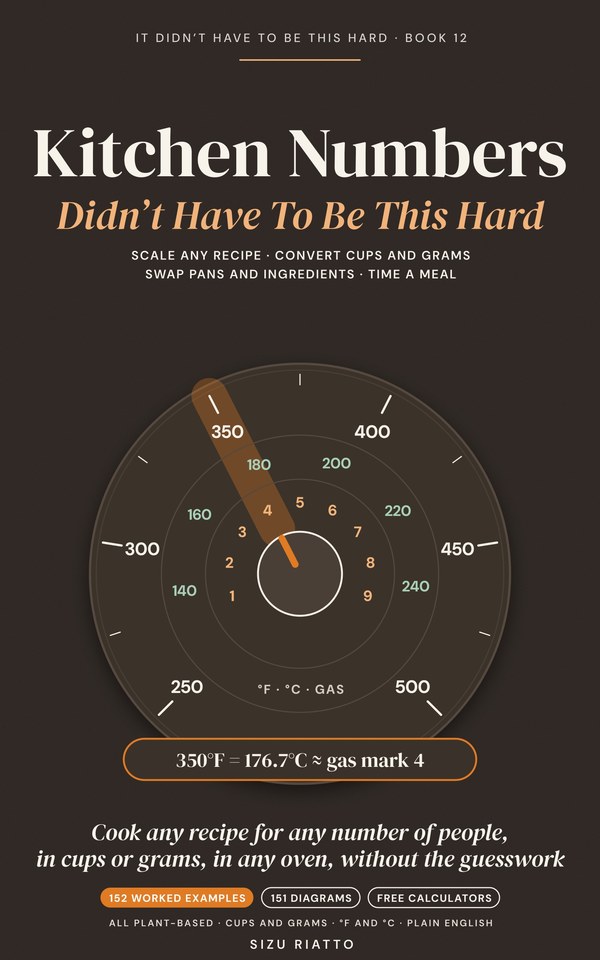
°F = °C × 9/5 + 32 and °C = (°F − 32) × 5/9 (the 32 lines up the starting points, the 9/5 stretches one scale to the other); gas mark = (°F − 250) ÷ 25; then lower for convection as your manual suggests and correct for your own oven's offset (subtract if it runs hot, add if it runs cool), measured with an oven thermometer.
Calculator: Oven Temperature ConverterWorked examples 29–35
- Setting a Fahrenheit oven for a 180°C recipe
- Converting 425°F to Celsius for a friend abroad
- Testing the "double it and add 30" shortcut at oven heat and on a spring day
- Gas marks to °F and °C
- Lowering a recipe's temperature for a convection or fan oven
- Correcting for an oven that runs 15 degrees hot
- Why pasta takes longer at 5,000 feet
Part Two · Scaling a Recipe
To scale a recipe, find one number, the scale factor (what you want ÷ what the recipe makes), and multiply every amount by it; keep the factor as a fraction when it comes from small whole numbers, turn the answers into cups and spoons, and check a line by dividing back.
Calculator: Recipe Scaler That Speaks Cups and SpoonsWorked examples 36–42
- Scaling a chili from six servings to fifteen with one factor
- Halving a cookie recipe and turning 3/8 cup into tablespoons
- Scaling a stew down by two-thirds, and why the fraction beats the decimal
- A curry card scaled from four servings to six in a second column
- Letting a 20-ounce pack of tofu set the scale factor
- Checking a scaled line by dividing back, and through one serving
- Scaling a granola to the oats left in the canister
Any scaled amount can be measured by going down the units ladder to teaspoons and building it back up from the cups and spoons you own; round generously only on large, forgiving ingredients, measure salt and leaveners carefully, and weigh any cup-sized ingredient that would take a pile of spoonfuls.
Calculator: Turn Any Amount into Cups and SpoonsWorked examples 43–49
- Two-thirds of three-quarters of a cup is half a cup
- A third of a quarter cup, down the ladder to teaspoons
- Building 1 7/8 teaspoons from one ring of spoons
- Measuring two-thirds of a can of coconut milk
- One and a half flax eggs
- Rounding salt and flour: the same habit, very different errors
- Weighing an awkward amount of brown sugar instead of spooning it
In a baker's formula the flour is 100% and every other ingredient is a percentage of the flour's weight, so the total is always over 100%; choose the dough weight you want, divide by the total percentage to get the flour, and multiply the flour by each percentage.
Calculator: Baker's Percentage Dough CalculatorWorked examples 50–56
- Turning a baker's formula into grams for 500 g of flour
- Hydration: water as a percentage of the flour
- Working back from four rolls to the flour
- Sixty supper rolls from one division
- A pizza dough in cups turned into percentages, spooned against scooped
- Replacing a tenth of the flour with whole wheat
- A plant-based sandwich-bun formula with five ingredients on the flour
A pan holds batter in proportion to the area of its floor (length × width, or 3.1416 × radius × radius for a round pan), so the scale factor for a pan swap is the ratio of the areas; the depth sets the baking time, and a 9-inch round is almost exactly an 8-inch square.
Calculator: Pan Size SwapWorked examples 57–63
- Moving brownies from an 8 × 8 pan into a 9 × 13
- An 8-inch round against a 9-inch round
- The 9-inch round and the 8-inch square that match
- Two 9-inch layers baked as one 9 × 13 sheet
- How deep 6 cups of batter sits in two different pans
- What a loaf pan holds, and why the box sum is an upper limit
- Muffins from a cake recipe, counted by volume
Amounts follow the scale factor but temperatures don't; heating a pot takes roughly as much longer as there is more food, heat takes about four times as long to travel twice as far, crowded trays steam, and a microwave's time can be roughly scaled by the ratio of wattages, then checked.
Calculator: Microwave Time by WattageWorked examples 64–70
- A doubled soup takes about twice as long to boil
- Roasted chickpeas and the crowded tray
- Potato chunks twice as thick take about four times as long to heat through
- A package time for 1,100 watts in an 800-watt microwave
- Doubling a snack cake: two pans or one, same oven setting
- Counting back from dinner to switch the oven on
- Cooling a gallon of chili in a pot or in shallow containers
Part Three · Ratios and Swaps
A ratio gives a recipe's shape without its size: add up the parts, divide the total you want by them to get one part, and hand out the parts, or let whichever ingredient you're short of set the size of a part.
Calculator: Cook-by-Ratio CalculatorWorked examples 71–77
- Turning a 3 : 1 vinaigrette into cups for exactly one cup
- Reading a rice package's ratio and measuring the water
- Overnight oats for a week from a 1 : 1 : 1/2 ratio
- Filling a 3-cup container with trail mix at 2 : 2 : 1
- A 3-2-1 pie dough weighed out for one tart
- Matching the oil to the last of the vinegar
- Comparing two iced-tea concentrate ratios
A kitchen percentage is a fraction of a named base (the water, the flour, the vegetable as bought), so find the base first, divide by a yield when you shop, and turn stacked changes into multipliers that multiply.
Calculator: Kitchen Percent CalculatorWorked examples 78–84
- Salt for a 2% pickle brine on two different bases
- Salting bread dough at 2% of the flour
- How much squash to buy from its yield percent
- Why the same water is two different percents of one dough
- How much mushrooms shrink, and how many to buy
- Cutting a cookie recipe's sugar by 20%
- Less sugar and a bigger batch: why percents multiply
A swap is an exchange rate, so multiply by the published rate (one-for-one only where it says so), convert through the thing that does the work (grams of salt, packets of yeast, eggs' worth of binder), and change one ingredient at a time.
Calculator: Ingredient Swap CalculatorWorked examples 85–91
- Replacing two eggs with flax eggs
- How many eggs' worth of aquafaba is in one can
- Measuring butter amounts off plant-based sticks
- Swapping instant yeast for active dry, packets to teaspoons
- Replacing a cake of fresh yeast with dry yeast
- Swapping table salt for kosher salt by weight
- Why baking soda can't replace baking powder spoon for spoon
Dried foods grow when they cook, so multiply by the yield multiplier to plan the pot and divide by it to get back to dried, using the volume rule for cups and the weight rule for grams.
Calculator: Dried to Cooked ConverterWorked examples 92–98
- How many cans a pound of dried chickpeas is worth
- Cooking two cans' worth of chickpeas from dried
- How much dry rice for four plates
- How much a box of pasta weighs once cooked
- How much of a soup's water the lentils absorb
- When a can drains to more than the 1 1/2-cup rule
- Freezing cooked chickpeas in can-sized bags
Strength is the strong ingredient over the total, so follow the strong ingredient: diluting grows the total, reducing shrinks it, mixing gives a weighted average, and "1 to 3" means four parts while "1 in 3" means three.
Calculator: Concentrate and Dilution CalculatorWorked examples 99–105
- Mixing an 8-cup jug of cold brew at 1 to 3
- Why "1 to 3" and "1 in 3" are different strengths
- Stock paste for a pot of soup and a café's lunch
- How much stronger a sauce gets when it reduces
- Watering a 3% brine down to 2%
- Simple syrup strength by weight and by volume
- How much stock rescues a soup that's too salty
Part Four · Money, Shopping and Big Batches
Each ingredient costs its share of the package: the amount used over the amount in the package, in the same unit, times the price. Add the shares for the cost of the pot, divide by the servings for the cost of one, and remember that anything thrown away is paid for by what you ate.
Calculator: Recipe Cost per ServingWorked examples 106–112
- Costing 1 1/2 cups of lentils from a 1 lb bag
- The price of one tablespoon of olive oil from a 500 mL bottle
- The price of a teaspoon of a spice sold by weight
- Costing a whole pot of chili, line by line, and one lunch from it
- How a box of spinach that partly wilts raises the price of what you eat
- Why cooking for two costs more per serving when opened cans go to waste
- Why a per-serving cost times the servings can miss the total by a cent or two
A unit price is price divided by amount; two packages compare only in the same unit, so convert one first. When part of a package won't be used (liquid, trimmings, spoilage), divide by the amount you'll actually use, and redo the sum after any coupon.
Calculator: Unit Price Compare, Any UnitsWorked examples 113–119
- Comparing a 1 lb box of pasta with a 500 g box, per 100 grams
- Big and small canisters of oats, per ounce
- Canned against dried chickpeas, per cooked cup
- Shelf tags in different units: oat milk per quart and per fluid ounce
- A bag of onions against loose ones when part of the bag spoils, and the break-even
- How a coupon on the small jar of peanut butter changes the cheaper buy
- The price of a tablespoon of maple syrup and of a pour over pancakes
Scale by one exact factor (guests over servings), fit the result into your pots at a fill line and your pans by pieces, round up only when you meet whole packages or equipment, add shared ingredients across recipes before rounding, and rework the list with a buffer to see what really changes.
Calculator: Crowd Cooking PlannerWorked examples 120–126
- Scaling a stew from 8 servings to 60
- How many stockpots a crowd-sized stew needs, at a safe fill line
- Rounding a crowd recipe up to whole bags and cans
- Counting pans of cornbread by pieces for a supper
- Prep time for a crowd, alone and with helpers
- Planning for 10% more guests, and what it actually changes
- Consolidating two recipes into one shopping list, rounding once
Divide the batch into equal portions, then multiply each portion's container and freezer space by the count and divide the cost and time by it. Leave headroom in containers, start the two-hour clock when the heat goes off, and run a week-by-week ledger to see the freezer's peak before it happens.
Calculator: Batch Cooking PlannerWorked examples 127–133
- Portioning one pot into twelve equal lunches
- Choosing containers for a batch, with room to freeze
- The average cost of a lunch over three batch-cooked recipes
- The cooking time a batch saves, per portion
- How much of a freezer drawer twelve lunches fill
- Getting a batch portioned and refrigerated within two hours
- A week-by-week freezer ledger for three batches
Part Five · Time and the Whole Meal
Fix the serving time and count each dish back from it, preheating, cooking and resting included; the longest dish starts first, one oven goes from cooler jobs to hotter ones, two hands-on jobs never share a minute, dishes that hold give you a window, and a buffer goes at the start.
Calculator: Meal Countdown PlannerWorked examples 134–140
- Counting a roasting dish back from serving time, preheat included
- Three dishes started longest first so all finish together
- Sharing one oven between a cake and roasted vegetables: cooler job first
- Finding and fixing a hands-on clash between gravy and greens
- A dish that holds turns a start time into a start window
- A 10% buffer added at the start of a meal plan
- Counting a focaccia back through mixing, rising, baking and cooling
Check a thermometer in ice water (32°F) and correct in the right direction; convert a temperature with the full formula but a difference by 5/9 or 9/5 alone; know USDA's numbers (Danger Zone 40–140°F, 2 hours out or 1 above 90°F, fridge 40°F or below, freezer 0°F, reheat to 165°F) in both scales; shift candy stages by how far below 212°F your water boils.
Calculator: Kitchen Temperatures, °F and °CWorked examples 141–147
- Checking a thermometer in ice water and correcting its readings
- USDA's Danger Zone in Celsius, and converting a temperature difference
- USDA's 2-hour limit for food left out, and the 1-hour limit above 90°F
- The soft-ball sugar stage in Celsius, shifted for altitude
- Checking a fridge against USDA's 40°F line, in both scales
- A freezer at 0°F in Celsius, and where the two scales cross
- Reheating leftovers to USDA's 165°F, with a thermometer's correction
A whole dinner is the book's moves in order: scale every recipe, convert into the units your own tools read, fit the pans by area, cost what each dish uses (and shop in whole packages), then count back from the moment you serve.
Calculator: Whole-Dinner PlannerWorked examples 148–152
- Scaling three recipes from three countries to ten guests
- Converting metric cups, Australian tablespoons, grams and oven temperatures
- Scaling a cake by pan area and spreading cornbread in a bigger pan
- Cost per person, and the shopping list
- Counting a one-oven evening back from serving time, with a buffer